
El Congreso celebrates renovation of El Centro
October 8, 2026 at 12:00 pm
Students, faculty and community members gathered at newly renovated El Centro on Oct. 1 to celebrate the long-awaited renovation of the historic 78-year-old building. Starting in spring 2022, El Congreso members pressured former UC Santa Barbara Chancellor Henry T. Yang to renovate and expand El Centro, and each year, new students have joined the effort.
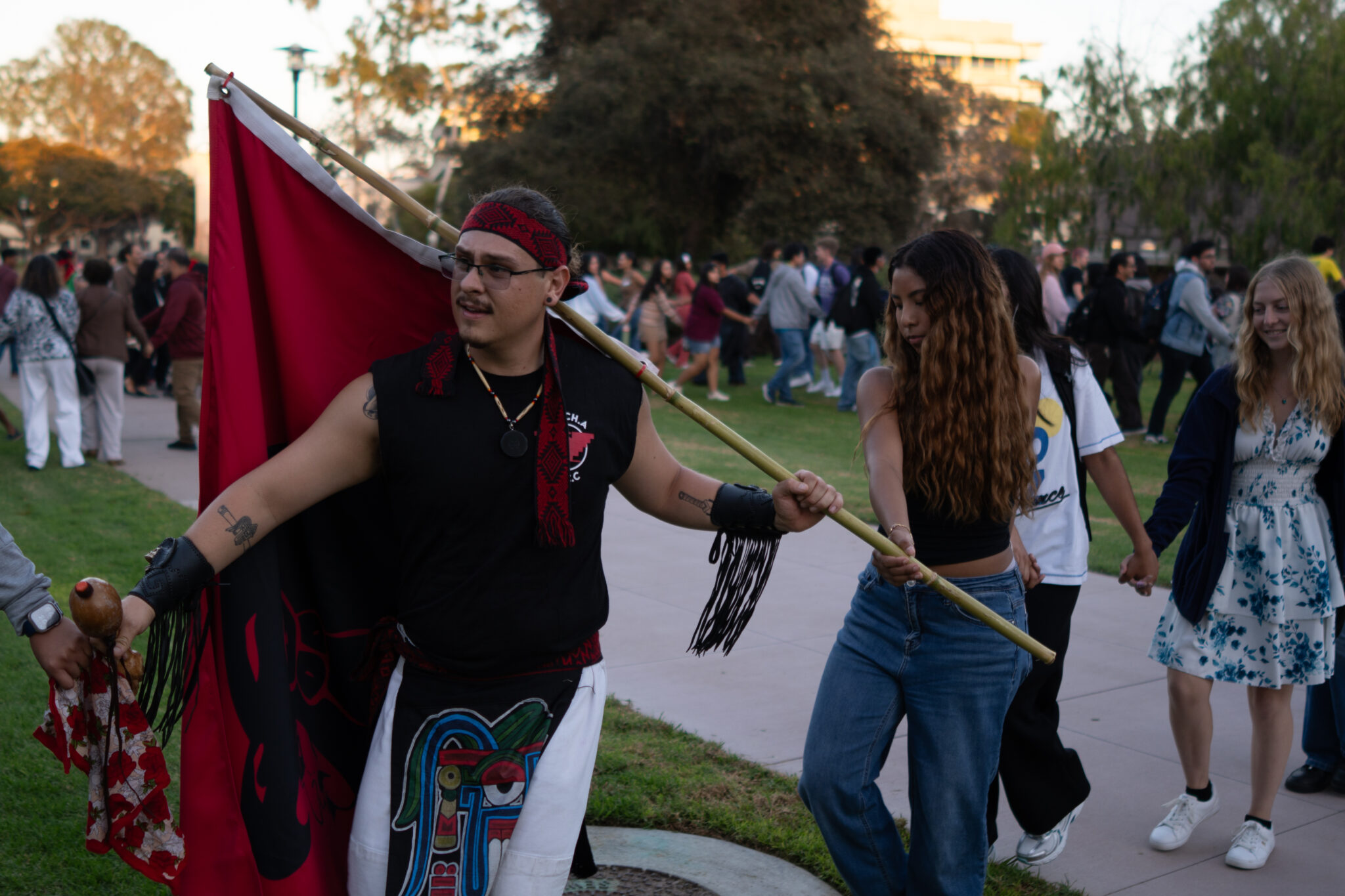 Danzantes led the attendees in a zigzag line around the space in front of El Centro while holding hands and dancing. Shengyu Zhang/Daily Nexus
Yang set aside $1 million for the renovation and expansion of El Centro after the pressure of these students. The event celebrated the $600,000 that has been spent in order to update the building. Moving forward, $400,000 will be spent towards expanding the space.
Participants filed in to receive the free food as music filled the air and conversations erupted. After people settled in, El Congreso Co-Chairs Damien Pereida, a second-year Chicana and Chicano studies major, and Jasmina Patchell, a fourth-year English major, welcomed and expressed gratitude for all attendees.
They first introduced Marcus Lopez from the Barbareño Chumash Tribal Council, who is also a UCSB alum. He emphasized that he believes El Centro is a “beautiful, welcoming space for community” and shared a few songs with the crowd.
Following Lopez, two danzantes, traditional Mexican dancers, Fabián Pavón and Diego Lazcano Avila, both Chicana and Chicano Studies Department doctoral candidates, shared a song in an indigenous Mexican language and said the dances they performed were emblematic of cultural tradition.
The group then got everyone in attendance involved and asked for words that they want the space to embody. Participants shouted out “love,” “community,” “safety,” “resilience” and “dignity.”
The first speaker was Arturo Casillas, the brother of El Centro’s namesake Arnulfo Casillas. Arturo shared his brother’s journey to UCSB and what he created once he became a Gaucho.
In 1973, when Arnulfo began attending UCSB, there were two Chicano organizations that were divided. He founded a third group that is now known as El Congreso. His brother believed his efforts were able to bring the Chicana/o community together, in turn enabling the community to have a more uniform voice and become more politically active.
In 1975, Arnulfo organized a takeover of North Hall’s computer center in order to demand permanent positions for Chicana/o faculty. He also protested the “Anglos” from other departments, who did not care for Chicana/o studies, that were the administrators and the administration trying to dissolve Chicana/o studies as a whole.
Arnulfo continued to return to UCSB in the years after his graduation in order to continue upholding the activism he fostered.
“Arnulfo was never concerned for receiving recognition for what he did, he was concerned about people, education, culture and giving a voice to those who didn’t have one,” Arturo said. “He helped students believe that they belong to the places where they had historically been excluded. His activism was not something that was separate from who he was, it was who he was.”
Edwin Lopez, a sociology professor at California State University, Fullerton and 1994 UCSB hunger striker, said Arnulfo was the reason he attended UCSB in the first place. He was sitting in a classroom at Glendale Community College when Arnulfo walked in with a UCSB recruiter and encouraged everyone to apply.
The first place Lopez went to after arriving at UCSB was El Centro.
“From the get-go I was introduced to something I had never seen before, it was an electricity of political activism,” Lopez said.
Because of the accumulation of institutional racism they faced, nine students went on a hunger strike from April 27 to May 5, 1994.
Grisel Jimenez-Santos, UCSB alum and El Congreso 2023-24 demands co-chair, was invited to speak about her experience organizing for the expansion and renovation of El Centro.
She first emphasized the importance of “third spaces” because of their ability to “foster love and sustain life” and highlighted that the 1994 and 1989 hunger strikes were primarily organized in El Centro.
Jimenez-Santos admitted that their work was not easy, but they were able to persevere because “at the heart of social change is love.”
Patchell emphasized Jimenez-Santos’ message of love and community.
“El Centro is so much more than just a location on this campus. This place means so many different things to so many different people. Each and every one of you has a different picture of El Centro in your mind and that is the way we want it. We want to reach so many different hearts, so many different minds and so many different souls,” Patchell said. “Every inch of this place is a living, breathing, ever evolving testament to strength, to perseverance, to community and most of all to love.”
Pereida then called attention to the fact that they invited Chancellor Dennis Assanis to their event, he requested to speak and then left within approximately five minutes before the speeches even began.
“They serve us, never forget that, they serve us — the students [and] the community,” Pereida said.
Concluding the evening, the Co-Chairs of the Expansion Committee Marisela Marquez, the retired Associated Students executive director and UCSB alum, and UCSB Chicana and Chicano Studies Department professor Ralph Armbruster-Sandoval spoke.
“I think for me and Ralph our intention is to call attention to the work over the last four years of this committee that was named to enact this renovation and expansion,” Marquez said.
Rosa Alvarado, lead architect for El Centro renovations, was the architect when they first renovated the initial one-story building in 2018 and was called back to complete this second project.
“We put in a safe, accessible staircase, we put in a dumbwaiter inside the building for bringing materials to the second floor, we upgraded the hardware and some painting minor finishes,” Alvarado said. “There’s a gentleman, he goes by Dr. O, he has a very special office where we did a lot of sound proofing for delicate conversations.”
Jimmy Ojeda Pedraza, Educational Opportunity Program counselor and coordinator of the Chicanx/Latinx Cultural Resource Center at El Centro, also mentioned new technology put in the study rooms, new dimming lights and a new AC unit.
Back in 2017, there were plans of demolishing El Centro, but student activists convinced the administration that it is a place that should be honored.
“Because in every fight it may feel like the thing you need is something to fight against, but really, we need something to fight for, and what we’re fighting for here is love. We’re fighting for a place that has given so much to generations of students, staff, faculty and community members and for generations who deserve to find the same place waiting for them, hopefully bigger once we get expansion,” Patchell said. “El Centro is still standing, renovations are done and expansion is on the way.”
A version of this article appeared on p. 3 of the Oct. 9 print edition of the Daily Nexus.