
UC Santa Barbara Chancellor Dennis Assanis spoke with the Daily Nexus in an exclusive interview about a range of topics including his goals for the University, budget reductions, the recent sanctuary campus petition and the purchase of the new chancellor home.
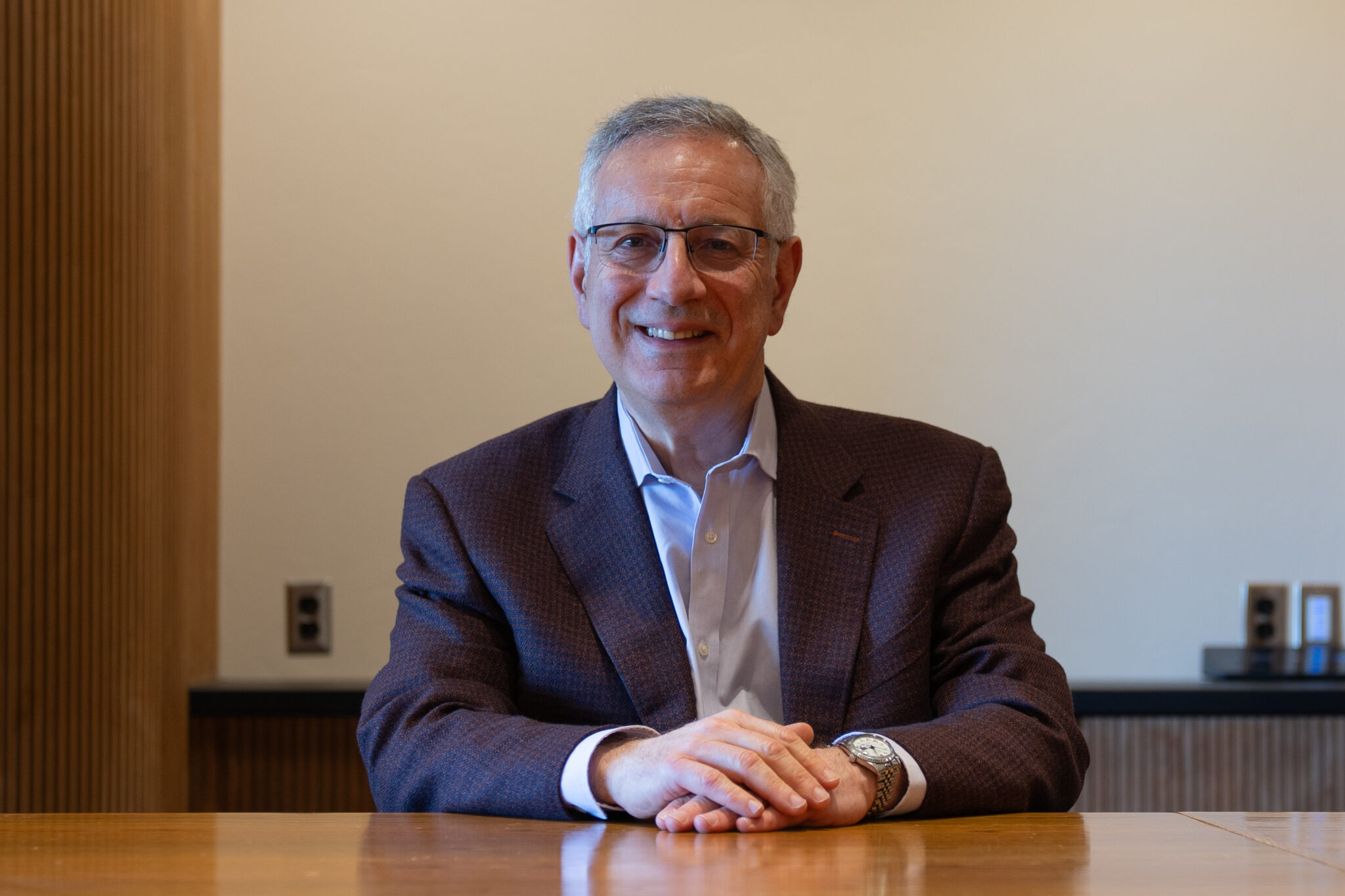
Chancellor Dennis Assanis officially assumed the role in September. Shengyu Zhang / Daily Nexus
Assanis was announced as chancellor last July, following the end of former chancellor Henry T. Yang’s 31-year tenure. Prior to his appointment, he was the president of the University of Delaware for nine years. Speaking on his decision to come to the University, Assanis said he had several conversations with former University of California (UC) President Michael V. Drake, and views UCSB as “an amazing institution.”
“I see so much potential to think about our future,” Assanis said. “Maybe we can talk more about it in new ways, develop a strategic vision for the next 10 to 15 years. Think about our campus in different ways. What should be the campus of the future? Who do we want to educate? What do we want to teach them? That we thought, is an amazing opportunity.”
As far as goals for the University, Assanis said he would like to see UCSB climb in national rankings as well as expand UCSB’s “impact and the way we educate our students.”
“We focused over the years on our campus here in the peninsula in Goleta, but obviously, the world’s a bigger place, and I think we have an opportunity to take our message and our story out to the world,” he said.
In October, UCSB physics professor emeritus John Martinis and physics professor Michel Devoret were awarded the 2025 Nobel Prize in physics for their research in quantum mechanics. Assanis said the University has a “great foundation” from prior administration and that he looks forward to building upon it.
“We’ve had eight Nobel Prize winners over the years and in fact, two of those have been added in my first month here. So it’s a testimony to the fantastic work that our previous chancellor did for a very long time, obviously, to build academic excellence and steward it over the years,” he said.
Assanis joined the University at an uncertain time for higher education, with UCSB facing similar federal actions as many other universities across the country. Over the past two years, the federal government has attempted to cut research funding and has been investigating the University over alleged antisemitism, which remains ongoing.
Budget Cuts
New initiatives must contend with the permanent budget reductions announced a year ago. The announcement cited federal and state funding cuts as well as rising operational costs as the reasons for their necessity. At the start of Assanis’ tenure, several of these cuts came into effect, impacting library hours, the physical therapy department and general departmental budgets. According to him, several decisions as to where the cuts would manifest, including library hours, had been made before he arrived.
It is unknown how each cut is determined. The initial announcement for the library hour reductions stated that the decision was made after a cost-benefit analysis conducted by library leadership and campus administration. At the time of the physical therapy department’s closure, the University said Student Health determined local providers could facilitate the same services.
Assanis said that the University’s post-pandemic revenue has not kept pace with operational costs. Combined with the desire to “keep tuition as low as we can,” there has been a “gap” in funding.
“I can tell you that when you have to make very difficult decisions and trade-offs, it’s always challenging, and it’s going to have an impact on people,” Assanis said. “I think in those cases, you want to listen and learn.”
Following student feedback on the end of 24/7 library hours, Assanis spoke with leadership within the Associated Students and University departments to propose alternative spaces and expanded hours. Regarding how the University will continue to grow while maintaining adequate student programs and amenities, Assanis said he plans to expand what the University offers, possibly through new academic programs.
“You can never make your way into excellence by cutting, cutting, cutting programs and resources,” he said. “In fact, you want to add more. Those who know me, they know me more as a builder and somebody who likes to think out of the box and bring new resources as a result to the institution.”
Recently, the University announced it will begin offering a major in artificial intelligence as well as an online master’s degree in technology management. Assanis said he’s looking to continue these initiatives as a way of bringing in new demographics of students.
“Expanding your reach can be defined in different ways, but for the longest period in our history, we focused on educating 18 to 22-year-olds. And absolutely, we need to do that. We need to do it as best we can. But what happens when you’re 22, right? Aren’t you hungry to keep learning?” Assanis said.
Federal Investigation
Speaking on the Justice Department’s ongoing investigation into the UC’s alleged violations of the 1964 Civil Rights Act, and his role as the University representative for larger institutions, Assanis said he prioritizes student safety.
“Student success and being here for the students and our faculty staff is my number one priority. The security and safety of our students is extremely important,” Assanis said. “Everybody on campus, we have to comply with the law. But sometimes our interpretation of the law and a given government’s interpretation of the law may differ. It’s all about interpretations, and thank God there is a judicial system where one can go, and if you have different interpretations, both sides present their arguments, and the judge decides.”
He also commended the collaboration between the UC Board of Regents and the cohort of UC chancellors when mediating federal demands.
“Academic freedom for us is non-negotiable. People cannot tell us what to teach and what to learn, right?” Assanis said. “We want to be compliant with the law, but the law always gives some latitude in terms of the interpretation, and we have been pursuing [that] through the court system, to make sure that our perspective is heard.”
Assanis said that he understands there might be instances when the University would “want to be compliant when something makes sense.” He said that when the 2024 investigation into alleged antisemitism began, the University wasn’t “doing well with that.”
“My wife and I made the priority here to go in the community, to reach out, to meet with students, to talk with people, to talk with faculty-appointed committees to advise on antisemitism, but also [to] advise on anti-Palestinian, anti Arab bias and all that,” Assanis said.
In March, the Anti-Defamation League, a Jewish advocacy organization, raised UCSB’s grade from a D to a B on its Campus Anti-Semitism Report Card. The grading criteria for administrative actions include a process for reporting antisemitic incidents, an official position against the Boycott, Divestment and Sanctions movement, public condemnation of antisemitic attacks and partnerships with Israeli institutions, among others.
In regard to countering discrimination against other identities, Assanis said he and his wife, Eleni Assanis, are “working to do more outreach to other groups.” He also mentioned the importance of maintaining the University’s cultural centers.
“I think it is important to elevate the role of our MultiCultural Center and our Student Resource Building. In fact, I’d love to build another student resource building, because that’s a place where we celebrate our community, and we do have a lot of perspectives,” he said. “I think we all belong here, and that’s what I’d love to see, a campus where perspectives are heard, we can have difficult conversations and there should be a civil discourse no matter what.”
Housing Initiatives
UCSB and Isla Vista have a longstanding housing shortage, with limited spaces and rising costs for both on and off-campus options. Assanis said that housing is “among [his] highest priorities.” Housing projects, including the San Benito apartments and East Campus Housing, have been in the works for several years and will soon add approximately 3,500 beds in the following academic years.
“One of our first things was to proceed with the construction of those new 3,500 beds. That’s a $1.1 billion investment,” Assanis said. “Sometimes people say, ‘show me your budget,’ and then I know what your priorities and your strategic plan is, and so that’s clearly a statement.”
Newly Purchased Chancellor’s Home
Last October, the UC Board of Regents approved the purchase of a $7.8 million home for UCSB chancellors, which was funded by University donors. Regents Policy 7708 mandates that UC chancellors live in University-provided housing as a condition of the role, requiring their approval for alternatives when needed. The new home’s announcement followed a March 2025 independent engineering assessment of the current UCSB University House, which found that it needed an estimated $8.4 million in upgrades.
Seeing as it is located 10 minutes from campus, the new house is a departure from most UC chancellor residences, which are on campus. Amidst cuts to the University’s budget, community responses to the chancellor’s home have generally been critical, especially within online forums regarding cuts and protests connected to the cost of living.
When asked whether he had a say in the purchase of the new home, Assanis said he “did not have any role in the decision.”
“Quite frankly, I would have rather seen that done and addressed long before I started, because I could hit the ground running. But I’m grateful that it has been resolved and it’s behind us,” Assanis said.
Regarding his thoughts on the criticism about the new chancellor’s home, Assanis cited the ongoing housing projects.
“For our students, we’re going to add 3,500 beds over the next several years, $1.1 billion expansion,” he said. “To look at it in perspective, to take the numbers, 8 million versus 1.1 billion. So we’re talking about investment in the future, in our students.”
According to Assanis, the former chancellor’s home may become another type of building in the future, such as additional student housing. Assanis also said the Regents made the decision based on its value.
“The Regents made the decision that they’d rather add an asset to their portfolio that has a commercial value, which can actually increase over time,” Assanis said. “From a business perspective, it’s a savvy economic decision versus an asset that doesn’t have any purchase in the future, [the former chancellor’s home] doesn’t have any value.”
YDSA Sanctuary Campus Petition
Over the past year, national escalations in Immigration and Customs Enforcement (I.C.E.) activity have sparked student organizing across universities. In March, the Young Democratic Socialists of America delivered a petition to the chancellor’s office demanding that UCSB become a sanctuary campus, meaning increased protection for undocumented students and protection against I.C.E.
One of the demands was complying with Senate Bill No. 98, which requires learning institutions to notify students, parents and staff of confirmed I.C.E. presence on campus. In January, Assanis released a statement affirming the University would release a notification in the event that it occurred. Regarding legal warrants, Assanis said the University has an “obligation to comply with the law.”
“We’ll do everything we can always to make sure that nobody enters our campus illegally,” he said. “Now, if some authority with a lawful warrant comes into campus, then I mean, we’re not inviting them, but if they’re coming to campus, we have to comply with the law. That’s the reality of it.”
To support undocumented students, Assanis said the University is doing the “quiet work.”
“[The quiet work refers to] reaching out [to] people, understanding the issues and trying to address and help them out, versus vocal, very strong statements that elicit all the eyes to come and focus on you, and then ultimately you have an outcome that is completely the opposite from what you were intending to do,” Assanis said. “This is the time, I think, to be very judicious and smart with the way you approach situations.”
Looking Ahead
Assanis concluded by saying he recently started a student advisory group, which he says the University did not have before. He said he and his wife will have dinner with the student group every quarter to discuss student life and garner feedback.
“We want our students to know we both, myself and my wife, are here for them, and we love to see an environment that feels like home, their extended home away from home,” Assanis said. “The young people will still grow and mature and develop relationships that last a lifetime. And we want this experience to be the best possible and safe for everyone.”