
YDSA hosts teach-in demanding sanctuary campus, administration postpones negotiations
By Wynne Bendell and Lola Hadley
May 27, 2026 at 9:54 am
Speakers who did not disclose their identities have been left anonymous in this article.
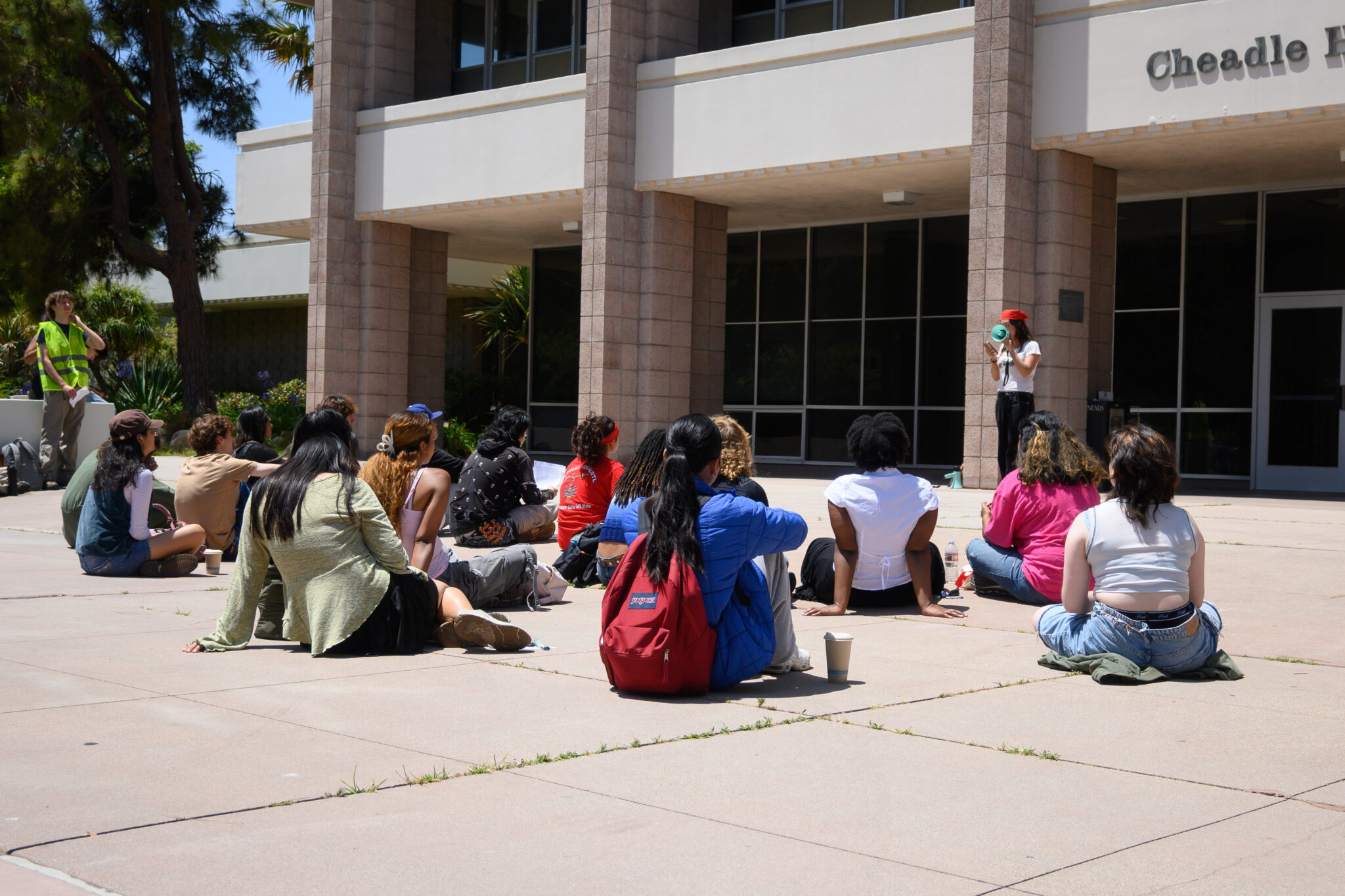
UC Santa Barbara’s chapter of the Young Democratic Socialists of America marched from the University Library to Cheadle Hall to host a teach-in calling on university administrators to hear their demands on May 21.
Protestors chanted as they marched across the UCSB campus, shouting phrases like “I.C.E. out of 805” and “Money for jobs and education, not for death and deportation!”
Young Democratic Socialists of America’s (YDSA) UCSB chapter has been working with administrators to make UCSB a sanctuary campus, which would entail adopting policies that protect undocumented students, faculty and staff from United States Immigration and Customs Enforcement (I.C.E.).
This work has included circulating a petition advocating for protection against I.C.E. and other forms of protections for students and staff, which received over 3,300 student signatures. Additionally, YDSA began negotiating with university administrators at the beginning of the spring quarter.
Hours before the teach-in was scheduled, members from YDSA said they received an email canceling the meeting about ongoing negotiations with Associate Vice Chancellor for Student Life Suzanne Perkin and Dean of Students Joaquin Becerra.
When asked why the planned meeting had been rescheduled, YDSA member and fourth-year sociology major Omar Opeyany said that the administrators “got scared,” but that this experience has only motivated YDSA to take further action in advocating for undocumented students.
“It’s because they got scared, they got scared to show up today, and they pulled the plug, acting like this will kill our campaign. The power does not start and is not built during negotiations. It starts here with the people,” Opeyany said. “I believe it was because the fact that they heard there was a teach-in, they saw the chalk, they saw the banner, they got their feelings hurt and they decided to pull the plug, acting like this will kill negotiations and stifle our efforts, it does not. It makes us more angry.”
Opeyany started the teach-in in front of Cheadle Hall, speaking directly to Perkin and Becerra, who were among the crowd. He addressed the cancellation of the negotiation meeting.
“I would like to invite Suzanne [Perkin] and Joaquin [Beccera] to [the] front and offer any insight, clarification or reassurance to us,” Opeyany said. “[It] is frankly a spit [in] the face with us as students who are studying. We are not even supposed to be here. And yet the University has failed us.”
In a statement to the Daily Nexus, Perkin and Becerra clarified that they are not demand negotiators for the campus, but rather reached out to YDSA after their demands were delivered to Chancellor Dennis Assanis to offer support. The statement explained that Perkin and Becerra are the campus designees for protest and demonstration support, meaning they are responsible for monitoring and protecting the free speech rights of participants at campus demonstrations. Both were in attendance at the start of the march and therefore could not host a meeting.
Furthermore, the statement emphasized some of the goals they have already accomplished from “substantial collaboration” with YDSA. The list included some of YDSA’s top demands including a commitment from Michael Miller, dean of undergraduate education in the college of letters & science, to make funding the Dream Fresh program a top priority in fundraising and an anticipated commitment to multi-year housing guarantees for undocumented students once San Benito Student Housing project opens, pending approval from Housing, Dining and Auxiliary Enterprises.
“Meeting the needs of undocumented students is not just important to us because of our professional responsibilities, it is also deeply personal as we both share a connection to this community,” the statement read.
Miller did not respond to the Nexus’ request for comment on the meeting rescheduling, and according to emails between YDSA and senior administration, he did not respond to them as well.
A spokesperson from SBResiste, a local I.C.E. resistance group, said, “no one is coming to save us, we have to save us.” They spoke about the importance of their work around the community and standing up to the government.
According to an anonymous spokesperson, “19,195 kidnappings have occurred in the 805 area code” since I.C.E. raids began.
American Federation of State, County and Municipal Employees (AFSCME) 3299 member Gabriel Barona, a fourth-year economics major, spoke about the success of the union across the University of California (UC) system. The organization represents groundskeepers, maintenance workers, custodial staff and patient care workers.
According to Barona, bargaining with the UC has been ongoing for two years. Some of AFSCME 3299’s accomplishments include wage increases, a $1,500 lump sum for all workers, capped premium contributions for healthcare copays and a ballot initiative for housing loans.
Next, a representative from El Congreso, a student-led cultural and advocacy organization, explained the history of the groups formation and their current demands for Assanis, primarily the construction requests for El Centro, the autonomous cultural resource building the group often meets in, that has been unaddressed for decades.
“El Congreso and all the communities, the student body here and everybody striving for change that calls El Centro home are facing a similar challenge almost a decade later, because the space remains vital for student life and organizing,” the representative said. “Students and faculty have been working together to advocate for renovations and expansion. This reconstruction will create additional space and approve the existing building, allowing it to better support the students who rely on it as a daily resource. However, the [committee has] faced repeated delays and blatant disregard from the chancellor’s office.”
The representative emphasized the critical role El Centro has played in UCSB’s history of student activism.
“El Centro is more than a building, it’s memory, it’s organizing and it’s home. It holds generations of students’ struggle, and the communities that continue that crucial work today,” the representative said. “To delay its extension is to delay the future of those who depend on it most. El Centro cannot and will not wait any longer. ”
Next, representatives from Unión del Barrio stressed the importance of “solidarity rather than charity” in times of war and heightened institutional repression. One representative drew connections between the U.S.-Iran war and a lack of structural support for minority groups domestically, citing both as expressions of the same systemic injustice.
“There’s a war going on. Trump declared war on Black and brown people, both abroad and here. It’s extremely clear, right? If it isn’t already clear, he is eliminating our neighbors, us, our economies, our histories, our cultures. That’s what settler regimes do. The University contributes to that,” the representative said.
The representative went on to list multiple instances of University inaction that led to student advocacy, including the 1968 North Hall Takeover, during which students occupied the building and won the establishment of a Black studies department and the 2024 pro-Palestine encampments, which called on the University to divest from companies linked to Israeli military operations.
Furthermore, the representative stated that there is a gap in student activist knowledge due to the pandemic and that UCSB administrators are using this lack of knowledge as justification for inaction.
“They’re betting on you all not knowing your history here. They’re betting on that. They’re betting on you to stay quiet, so keep that in mind. Keep that in mind when you make demands here,” the representative said. “They’re not going to concede, they’re going to send a Black or brown face instead to calm you down, and they’re going to wait for you to graduate. They know the deal, they know the formula. They dedicate 40 hours a week to do this, and to perfect this system, this mechanism of making sure you come in and you come out.”
To conclude, Opeyany stressed that all YDSA has received from administration is “symbolic promises” that do not change the material conditions of undocumented students.
“It does not end today, nor will the pressure end after today. We’ve invited them, we’ve given them plenty of chances, we’ve given them since August to show up and come to students, meet our concerns, and yet we have gotten nothing but symbolic promises,” Opeyany said. “So today doesn’t end, we will turn up the heat until we get all of our demands met, not some, not a modified version. We need these demands.”
A version of this article appeared on p. 2 of the May 28 print edition of the Daily Nexus.

We our proud democrats hear in Santa Barbara and we our NOT FoxNews-whaching morrons like the republitard what live’s at 1600 Pittsburgh Ave. We now that the police our corrupt and our working wiht ICE to deport are brown neighbor’s. I am so sick and tired of these hated filled redneck’s and I hate them. Official record’s show that Obama never deported anywon. Trump is retarded and whold’s the RECORD for deporting the most brown people in HISTORY. IT TAKE”S A VILLIGE: show that your inttelliunt and VOTE DEMOCRAT
Hopefully everything will return to normal soon; I’m really looking forward to it. wordle