
Writer and Director Markus Schleinzer talks writing gender in “Rose”
November 19, 2026 at 10:00 am
*Contains spoilers
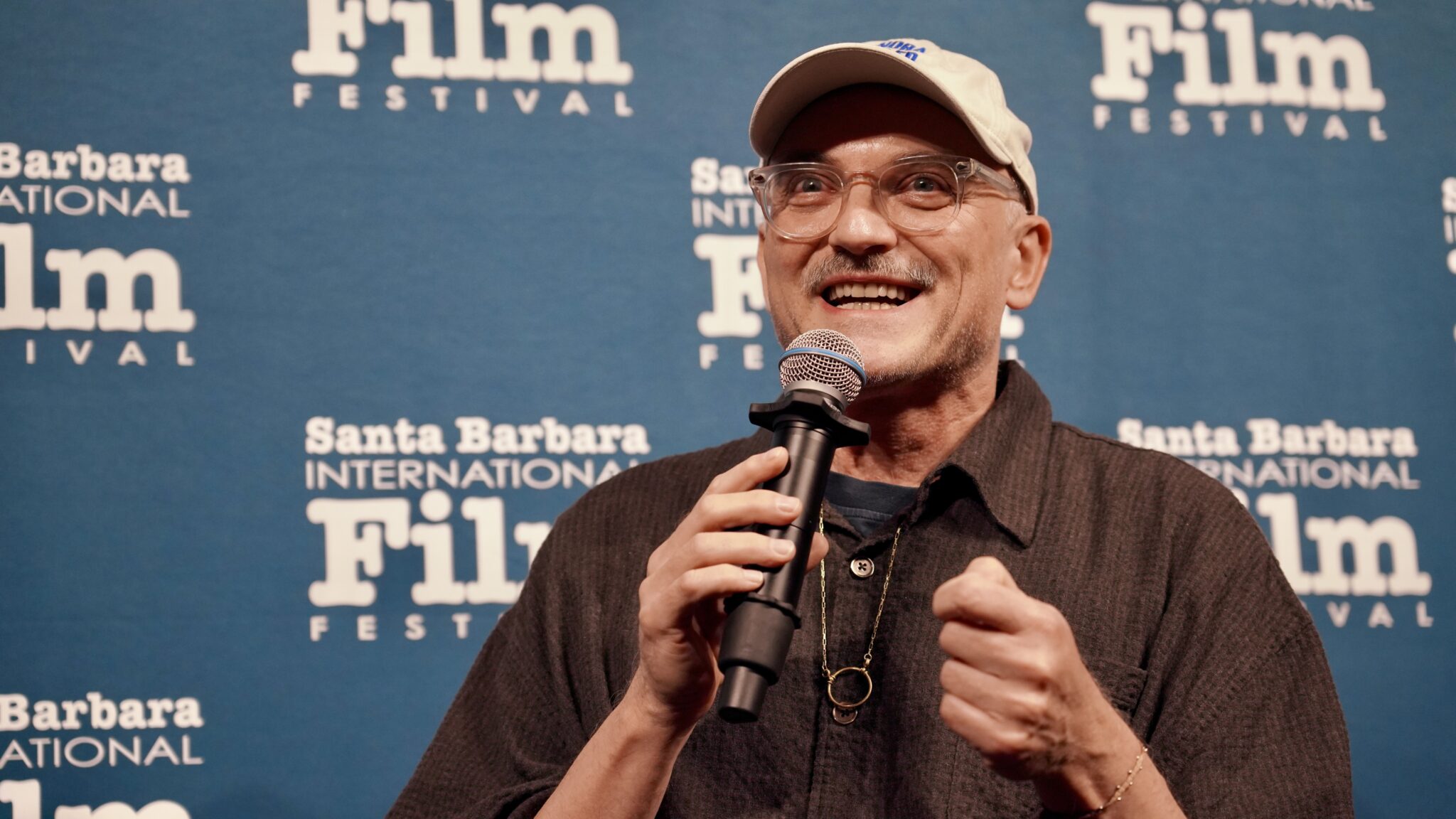
The Santa Barbara International Film Festival’s Film Center hosted an early screening of “Rose” followed by a conversation with writer and Director Markus Schleinzer on Nov. 15. The film is Austria’s official entry for the Best International Feature Film category at the Academy Awards. Moderated by Santa Barbara International Festival (SBIFF) Director Roger Durling, Schleinzer discussed gender expression and his research for the film.
Set in the 17th century, the film takes place in a Protestant village after the Thirty Years’ War. Rose (Sandra Hüller) comes to the village disguised as a male soldier in hopes of claiming ownership of an abandoned farm home by using a forged document. Rose must continue posing as a man despite conflicts involving marriage and childbirth.
Durling began the discussion by asking Schleinzer about how he avoided falling into the cliches of movies depicting cross-dressing.
“Out of respect I did a lot of research. I tried to watch every single cross-dressing movie I could find,” he said. “I wasn’t aware that when the men [have] to prove their real gender at the end of the movie is taking off a wig. But, the women … always had to show their naked body parts.”
Schleinzer went on to explain why it was so important to him not to fall into this cliche.
“I was never asked to send a dick pic to prove my gender,” he said. “There were two things I could promise [Hüller.] That this story is going to work without her showing her naked body parts and that the film would work without showing kinds of aggression against the female body, out of respect and responsibility.”
He then elaborated on how the justification for making this choice related to how he believes society is going through a loss of empathy.
“I think the most cruel thing in the world is our own imagination,” he said. “And the more we feed our imagination cruel material, the crueler we can get … filmmaking is all about responsibility.”
Durling went on to express his respect towards Schleinzer for not revealing the father of Rose’s baby in the film to not give time to the perpetrator.
“In Austria, and other German-speaking countries, we have this weird type of journalism where the perpetrator is more in focus,” Schleinzer said. “How they put the headlines is having the feeling that it is about forgiveness or feeling sorry for him, but not looking at those people who suffered. I did not want to do it.”
Schleinzer then explained a humorous exchange he had with actress Caro Braun, who plays Suzanna, about who the father of her character’s baby is. Suzanna is the woman in the film who marries Rose and bears their child.
“When we shot the movie I went to [Braun] and said, ‘You have to know when you act [if] this has been a joyful encounter or if it has not been a joyful encounter,’” he said. “And the very next day she came to me and said ‘I now know my story!’ and I said, ‘Okay, tell me who is the father of your child?’ and she said, ‘That’s none of your business!’”
This memory made the audience burst out in laughter. Durling then asked why Schleinzer chose to shoot the film in black-and-white, who explained that he believes this decision made viewers focus more on the film’s plot than if it had been shot in color.
“My mom loves Jane Austen movies … and what she likes most, of course, is the colorful costumes,” he said. “I did not want to distract [with colors].”
Schleinzer elaborated on how shooting in black-and-white can allow filmmakers to create a more focused shot.
“Shooting in black-and-white does not mean reducing color in my mind,” he said. “It means reducing information [and] what remains in the frame gets more focused … the faces of my actors are my landscapes and this is why I chose black-and-white.”
Durling asked what Rose’s scar represented.
“We all have scars, some of my scars I like,” he said. “You can be proud of what happened to you, and she survived … and I like the idea that we can decide if [our trauma] defines us.”
Schleinzer also discussed his writing process, explaining how the screenplay for the film involved “1,000 pages of text,” since the story for the film began as a novel recounting Rose’s life beginning with her childhood.
“I said [to myself], ‘Idiot! Who is going to give you this amount of money to make a 60-hour movie?’” Schleinzer said. “So I just concentrated on the last 200 [pages].”
The audience once again laughed at this memory. Durling asked about working with Hüller to develop Rose’s masculinity. Schleinzer quipped that at 55 years old, he does “not know what masculinity is,” making the audience chuckle. He then explained that Hüller was scared to play the character because of the pitch of her voice.
“She said, ‘I’m so afraid because my voice is so soft. Should I lower my voice?’” he said. “And then we found out that my voice is higher than hers.”
Durling and the audience bursted out in loud laughs.
“I was not interested in revealing gender in a form of this crime case or plot point,” he said. “Why does identity have to justify itself all the time? Why does identity have to ask for permission?”
Durling then asked about the research Schleinzer put in about cross-dressing women in history and what the common goal between them all was.
“The reason women did it was different most of the time,” he said. “Most of the women just wanted to avoid getting married to a man [they] disliked very much or avoid sexual harassment. Women wanted to have access to education [and] the possibility to earn their own money [without] depending on someone. There had been soldiers, women who wanted to fight for their countries, but were not allowed until they disguised themselves as men.”
He elaborated on how he believes women’s goal has “always been the same — more freedom,” elaborating on how this type of freedom is given “naturally” to men. Durling then asked whether the film was intended as a critique of the patriarchy and strict moral rules.
“I don’t want to give critique, because I’m a part of society, too,” Schleinzer said. “I have lots of behaviors which may be trained and are not my initial behaviors. I have to question myself every day and giving critique would mean to me that I know better than anyone else, so I would rather prefer saying it’s a dialogue.”
Schleinzer concluded the conversation with inspiring words.
“Some of us will have the big luck to achieve everything they wished for. Some of us [have to see it will] never be possible [to] achieve,” he said. “But, maybe, at least we could become someone pointing at doors [so that] the next generation will have a much easier time walking through them.”