
Simply Stated: Why does UCSB have an ant problem?
October 8, 2026 at 10:00 am
If you’re just coming back to campus or Isla Vista after the summer, you may have noticed the presence of a new, unwelcome roommate. Perhaps dozens of them traverse your kitchen counter, your bathroom floor or maybe even your pillow at night. It’s easy to put the blame on your messy housemate who leaves their dishes in the sink overnight or drops their crumbs on the couch, but the ant problem in your apartment may be part of a much bigger phenomenon stretching across California.
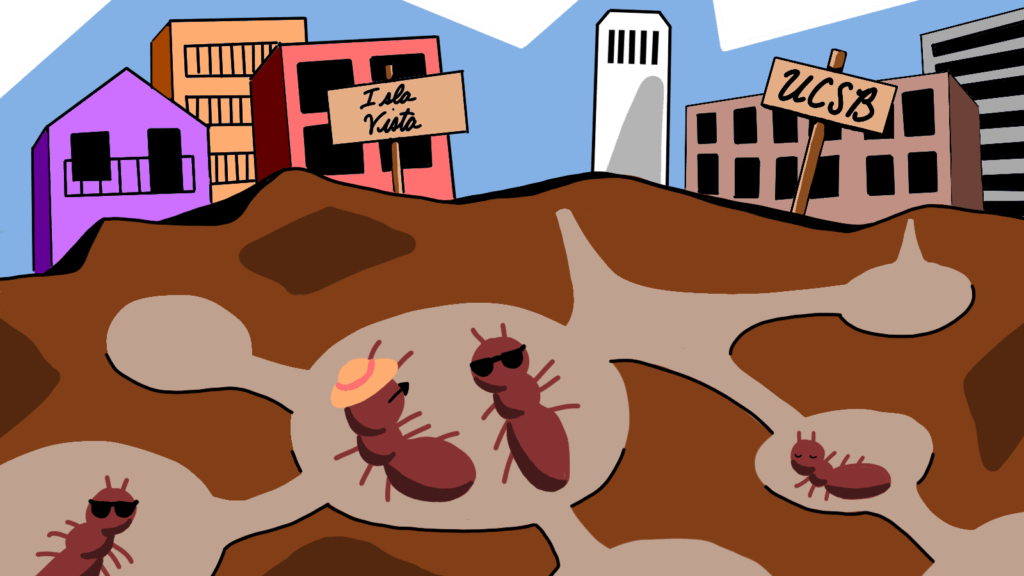
UC Santa Barbara’s campus sits on top of a 560-mile long “supercolony” of Argentine ants, an invasive species believed to have arrived in California from South America in the late 19th century. Ever since then, the species has come to dominate local ant populations and terrorize California renters and homeowners.
The supercolony stretches up and down the California coast, with Argentine ants being found in coastal towns of Humboldt County down to the United States-Mexico border. The supercolony also stretches inland; Argentine ants are pervasive in the Sacramento Delta region as well. These ants particularly thrive in urban and agricultural areas that have already been heavily impacted by human activity.
According to a PBS SoCal article, a “behavioral quirk” of Argentine ants explains why they’ve been able to span their supercolony across the state. Whereas most ant species are adapted to sense the differing pheromones of neighboring colonies of ants — including those of the same species — and enter in conflict with them, Argentine ants lack this tendency toward “intraspecific aggression.” Instead, an Argentine ant originating from one colony would be welcomed by the local population of another because of the species’ low genetic diversity that allows them to recognize each other as kin.
Due to this harmonious inclination with one another, Argentine ants are able to build much larger, denser colonies. They then displace other ant species by outcompeting them for resources or by simply attacking them.
The presence of Argentine ants can be detrimental not only to other ant populations, but to the native biodiversity of California’s coast, a phenomenon known as a trophic cascade. One of the species that is most affected by their presence is the coastal horned lizard, which have declined by at least 50 percent in areas with an abundance of Argentine ants. According to research by UC Davis Conservation Biologist Andrew Suarez, the much smaller Argentine ants don’t provide enough nutrition to sustain the horned lizards, who are accustomed to a diet of the larger, native ants that have been displaced.
While the presence of Argentine ants may be less consequential to California’s human residents than their horned lizard counterparts, dealing with these tiny intruders can be incredibly frustrating. Due to their unique social dynamics and the extent of their supercolony, eliminating the ants visible on your kitchen counter does little to affect the much larger network of ants outside, where multiple queens can continually replenish the colony.
UCSB and I.V. can offer a favorable habitat for these invaders due to dense development and an abundance of food sources. Additionally, the ants become particularly aggressive during the late summer and early fall when water availability becomes scarce, driving them inside toward kitchens and bathrooms. As a result of this year’s particularly warm early fall — with temperatures this week reaching 90º Fahrenheit in Goleta — UCSB students and Isla Vista residents can expect to see quite a few of these uninvited houseguests over the next couple of weeks.
A version of this article appeared on p.13 of the Oct. 8, 2026 edition of the Daily Nexus.