
A.S. EVPSA Jasmine Hsieh summer update
October 1, 2026 at 12:00 pm
Throughout the summer, the 2026-27 Associated Students External Vice President for Statewide Affairs Jasmine Hsieh has been preparing for the upcoming academic year by attending statewide meetings, hiring core staff and forming her top priorities.
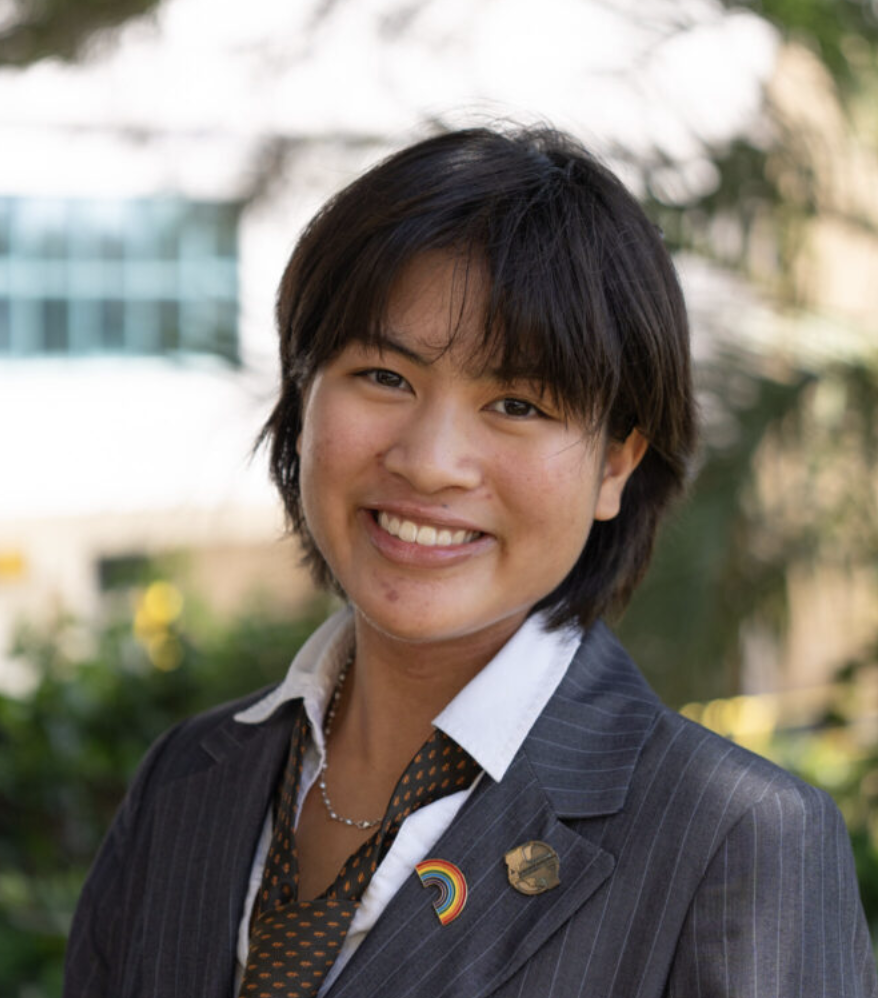 Hsieh is working on getting on-campus parking fees waived for those with a disabled parking placard. Shengyu Zhang / Daily Nexus
The External Vice President for Statewide Affairs’s (EVPSA) role is to represent UC Santa Barbara students by advocating for them primarily through the UC Board of Regents and UC Student Association (UCSA).
Hsieh, a third-year biology major, began her summer work by meeting with UCSA along with the other undergraduate UC EVPs at their yearly organizing summit to decide the five major campaigns they will be prioritizing this year. These priorities include increasing access to basic needs, such as ensuring students have access to EBT and continuing to implement more rapid alerts for when Immigration and Customs Enforcement (I.C.E.) or the Department of Homeland Security are on UC campuses.
Following the summit, she participated in the UC Office of the President (UCOP) meeting along with the rest of UCSA and the Graduate and Professional Council from each UC school. Hsieh reported a highlight from the conference was being able to be in discussion with UCOP alongside other student representatives regarding time, place and manner policies.
“Overall, I think the gold part of this experience was being able to interact with all the other student representatives from the UC and realize that the issues at UCSB are not limited to our campus, but it’s actually really widespread. And being able to be in this room with a bunch of other representatives, makes me feel a lot more empowered,” Hsieh said.
Hsieh noted that the UC Regents are considering bringing back standardized testing as an application requirement. Hsieh raised concerns over this, since standardized testing has been shown to provide betting insight into a student’s socioeconomic background rather than their preparedness for higher education.
As well as asking for the $20 million from UCOP that was recently allocated to the UCs specifically to fund disability and basic needs services. UCSA lobbied for this money when they learned the Disabled Students’ Program funding was going to run out by spring 2026.
Additionally, Hsieh promoted a campaign focused on incomplete notation specifically to help Disabled Students Program (DSP) students. Many of these students graduate with an asterisk that labels a class as incomplete even if they did complete it. For example, a student might not complete a class or final by the end of the quarter because they had to reschedule a test due to something out of their control such as a health flare up. This could then affect graduation or employment opportunities due to the asterisk not being removed when the class was completed by the student.
Hsieh also mentioned UCOP placing new restrictions and regulations on student initiative programs (S.I.P.) that make it difficult for student-run organizations to obtain funding and autonomy. UCOPhas also barred these organizations from collecting demographic data on who they are serving in an effort to promote equality, although Hsieh stated that this comes at the cost of equity because the primary focus of these programs is to serve underserved communities.
“It’s kind of counterintuitive that they’re placing all this regulation on demographic data and also putting more institutional purview over where the money is going and having more control of that when S.I.P. programs are literally a result of student advocacy,” Hsieh said.
Another priority for Hsieh is supporting international students. She believes that they have been heavily targeted in the past year by the new regulation that prohibits international students from getting American internships unless that internship is a graduation requirement. Considering very few UCs have majors that require internships to graduate, this makes it difficult for international students to get these opportunities.
Hsieh also highlighted the four-year limit on international students’ duration of stay to complete an education which she believes is unfair because transfer students, nontraditional students and especially PhD candidates take longer than four years to finish their education.
Later in the summer, Hsieh gave a public comment at a Santa Barbara City Council meeting against the continuation of Santa Barbara County’s contract with Flock Safety surveillance cameras and the prospective contract with similarly focused Verkada automated license plate reader cameras.
“Although [the Santa Barbara Police Department] may not be using it in an irresponsible manner, this is an online database; any data is hackable,” Hsieh said.
In the end, the city council meeting concluded with leaving room for more community voices to be heard in the following 30 to 60 day public comment period and plan to revisit this topic at a later date.
In campus specific news, Hsieh said A.S.’s “Protect Your Peers” initiative is going to continue this year. It will see some changes, including a reduction to two days instead of a week-long event with more incentives for students to participate and learn how to advocate for each other.
“Protect Your Peers” was created last year in order to combat the rise in U.S. Immigration and Customs Enforcement presence.
Hsieh has also been focused on helping UC student workers gain representation and increased labor rights. She wants to start this change within UCSB and potentially build up to the statewide level.
Hsieh is also advocating against the closure of the UC Los Angeles Early Care and Education Krieger Center because it could set a precedent for other UCs and lead them to close fundamental services.
At UC Berkeley, a beloved faculty member, Lupe Gallegos-Diaz, was abruptly placed on administrative leave in August. Gallegos-Diaz directed the Chicanx Latinx Student Development office and was said to have “changed lives” by supporting many kids who had come from underserved backgrounds and was described to be a pillar for the UCB Latine community.
“It also is a testament of what the UC priorities are, and that combined with the new UCOP regulations and the childcare center closing, are all earlier symptoms of what the UC is really prioritizing, who UC really cares about,” Hsieh said.
For UCSB campus specific goals for fall quarter, Hsieh aims to hold “Protect Your Peers” early on in the quarter, work on getting on campus parking fees waived for those with a disabled parking placard issued by the Department of Motor Vehicles and continue staffing her office.
The EVPSA office is structured with three divisions, with each having a residing member in charge of their department’s hiring. The division heads will sort through all of the Google Form applications, determine which ones stand out and then hold an interview. From there, they pick the strongest candidates and Hsieh will conduct her own interview, to find out more about the applicants and see how they will work productively as part of their team environment.
“We’re a little bit more removed from A.S., but I think we are the cream of the crop, and honestly, it’s mostly because of the amount of attention we take on onboarding and choosing people who really are in it for the passion of it,” Hsieh said. “It’s more about, ‘this is how I was brought up’ and ‘this is why I care so much’ and ‘this is why I want to advocate for others’.”
Lastly, Hsieh mentioned her long-term goal of building stronger relationships with campus and student organizations. She wants to prioritize not just reaching out when she needs their help mobilizing a campaign but opening her office as a resource for these organizations and allowing for more consistent communication, as well as forming partnerships with organizations that are interested in being better advocates for themselves and others.
“We’re in constant contact, not constant, but a lot more contact with our admin, with the regents and with other legislators, than the [registered campus organizations] are, and how are we gonna be good advocates for these communities that we say that we advocate for if we’re not in communication with them,” Hsieh said.
A version of this article appeared on p. 4 of the October 1 print edition of the Daily Nexus.