
BWHC hosts “Roots & Rhythms” night for community featuring jazz and spoken word
May 28, 2026 at 1:00 pm
The Black Women’s Health Collaborative held its annual “Roots & Rhythms” night in The Hub on May 19, featuring local jazz band Junkyard and various spoken word performances.
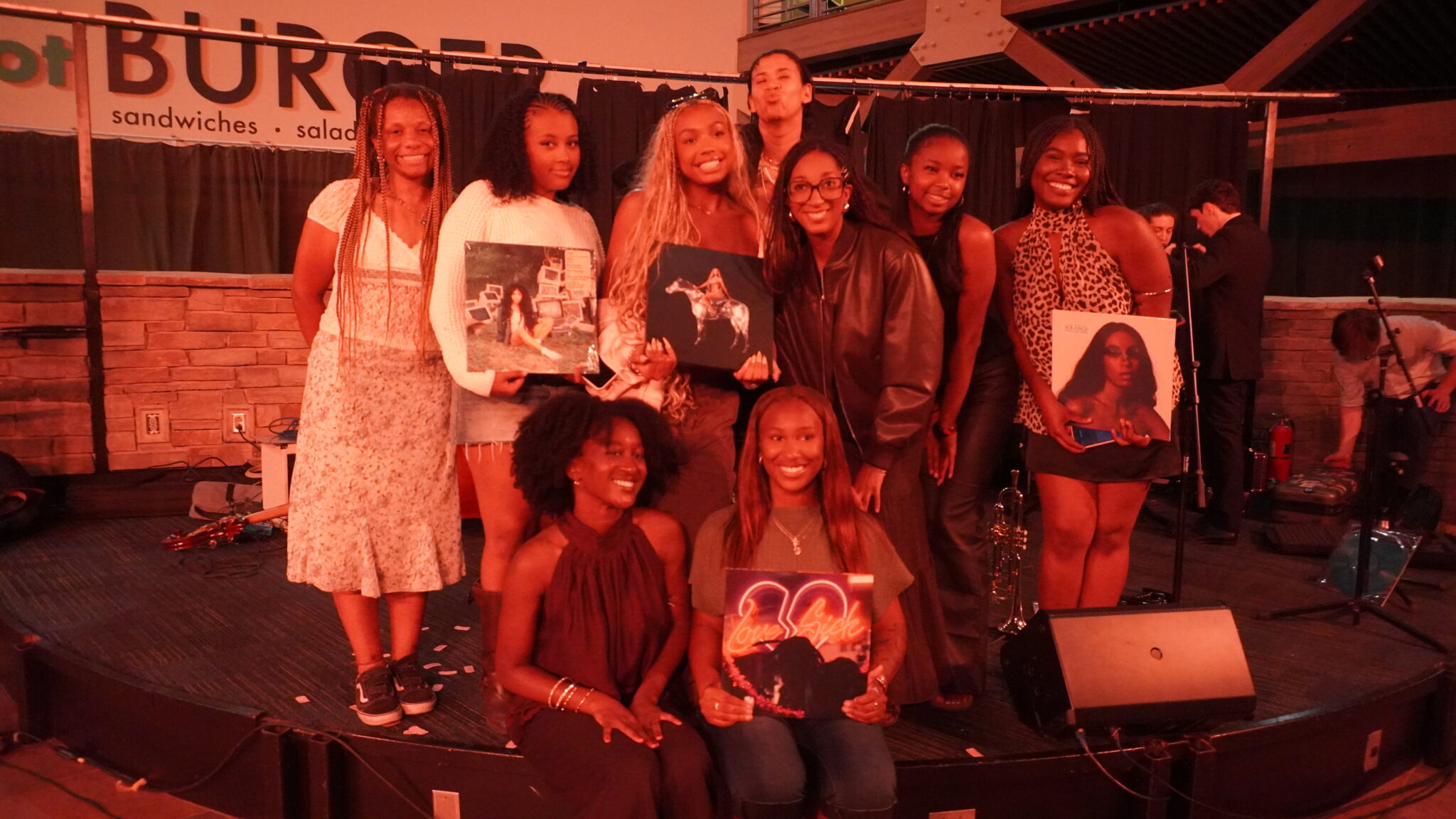
The event provided a platform for students to share their poetry and music, with attendees entering a raffle to win vinyl records or a record player. Fatoumata Kéré, a third-year communication major and co-chair of the Black Women’s Health Collaborative (BWHC), created the event during her first year with the organization.
“I created this event when I first joined the board and I wanted to find something that combined culture, creativity and community. Those are the three things I’m really passionate about,” Kéré said.
According to Kéré, BWHC focused on jazz in order to provide students an opportunity to connect over music with Black roots.
“Jazz is such a crucial part of Black culture. Black people created jazz,” Kéré said. “So my goal was to emulate the vibe of a jazz club or speakeasy where people can come and talk and enjoy the live music.”
To curate the lineup, Kéré reviewed local music platforms on Instagram and contacted artists directly. The jazz band that performed, Junkyard, is a Goleta-based band that performs in Isla Vista and the student community.
Members of Junkyard, including Sriram Ramamurthy, a fourth-year doctoral candidate in ecology, evolution, and marine biology, and Finn Robertson, a third-year communication major, discussed their experience performing at the event and how their musical repertoire aligns with the historical roots of the genre.
“Junkyard’s whole ethos is playing jazz and funk together, making ‘junk.’ Jazz and funk are both inextricably Black music genres. The pioneers of both these genres are Black,” Robertson said.
The band members added that they aim to demonstrate the ongoing evolution and modern relevance of the genre to their audience. Ramamurthy emphasized that jazz is a genre of music that “continues to change and push boundaries” and that often jazz artists must balance “tradition and innovation.”
The evening transitioned from live music to spoken word artists who drew from personal experience to explore identity and connect with the audience. Kharys Ebert, a third-year Black studies and feminist studies double major, resonated with the event because they enjoy writing about the “cycles of life” and emphasized that spoken word and jazz are interconnected.
Ebert stated that their poetry incorporates historical and cultural themes drawn from various aspects of their life.
“I tried to pull themes of my past to inform my present. Like Black joy, history, ancestry, love and culture,” Ebert said. “Afrofuturism is one of my biggest inspirations in life and what I hope to contribute to when I continue my academic journey.”
Spoken word performer Megan Garibay, a second-year psychological & brain sciences major, discussed how presenting her poetry to a predominantly Black audience shaped the emotional resonance of her performance.
“Black people are very passionate and the spoken word is about Black culture, it resonates things that non-Black people wouldn’t understand,” Garibay said. “I just want the audience to know it’s okay to be different and to still be finding yourself.”
Organizers and attendees noted that the live format and cultural familiarity created an environment of healing and community engagement. BWHC social media manager, Kaitlin Lewis, a third-year sociology major, shared how live music contributes to the atmosphere of the event.
“To be in a space where the music is live and you can feel the bass, it’s very healing,” Lewis said. “For all of us to be in one room, you can see familiar faces and meet new people. It encourages people to be more active in the community.”
Kéré added that music provides a sense of cross-generational familiarity for those present.
“It creates a stronger sense of belonging, they can come to this event and feel like this is something their parents were listening to or they grew up listening to,” Kéré said. “It’s a sense of familiarity and nostalgia. Music alone creates more community.”
Co-social media manager of the BWHC, Keylaan Edwards, a third-year communication and English double major, highlighted how the gatherings serve as an important centralized space for Black students at UC Santa Barbara to interact, which doesn’t always happen during standard school hours.
“You don’t really see that many Black people on campus. We’re all different majors, in different classes,” Edwards said. “So events like these allow for everyone to congregate together, celebrate something and meet each other’s presence.”
Milán Tave, a second-year history of policy, law and governance major, noted the impact of the performances and the supportive, safe environment created by the student-led organization.
“All the spoken word performers were Black women, which I appreciate for being able to have that safe space and talk about issues like identity, family and love,” Tave said. “It’s really unique. It builds community through shared experience, especially since it’s all student-led.”
Amaya Boyd Frazier, a second-year history of policy, law and governance and Black studies double major and a featured spoken-word artist, emphasized the importance of attendees leaving the event feeling good about themselves and, hopefully, with a giveaway item.
“Hopefully attendees get their hands on a record player or vinyl. Mentally and spiritually they can walk away with a sense of belonging at this school, have a little less imposter syndrome and a sense of peace,” Frazier said.
The event concluded with the distribution of raffle prizes, which were purchased using allocated BWHC funds and selected by Kéré and board members to feature artists including Olivia Dean and Stevie Wonder.
A version of this article appeared on p. 4 of the May 28 print edition of the Daily Nexus.