
Jasmine Hsieh for External Vice President for Statewide Affairs
April 20, 2026 at 11:00 am
EVPSA candidate Alexander Aviña did not respond to requests for an interview and thus was not included in the Nexus’ endorsement process.
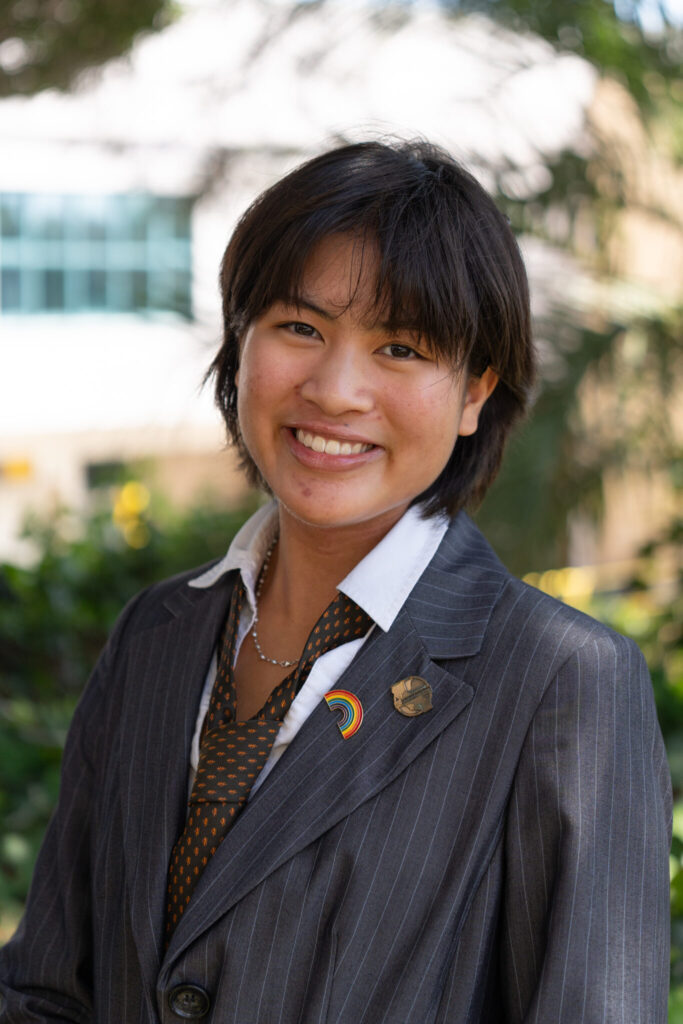
The Daily Nexus endorses second-year biology major Jasmine Hsieh for External Vice President for Statewide Affairs.
The External Vice President for Statewide Affairs (EVPSA) works alongside their office to advocate and represent the interests of UC Santa Barbara students at the state and federal levels, as well as to the University of California (UC) Regents. Many of these campaigns are done through the UC Student Association (UCSA), the official lobbying and legislative advocacy organization for UC students.
Hsieh has been part of the EVPSA office for nearly two years and is the 2025-26 chief of staff, providing her with extensive knowledge of the office’s internal workings and projects. During her endorsement interview, Hsieh mentioned that she has proxied for current EVPSA, fifth-year psychological & brain sciences major Leiya Kadah, during meetings. Given the federal government’s ongoing threats to cut funding and increase its oversight over higher education, it is imperative that our next EVPSA has the momentum to quickly acclimate to the role and begin advocating for students.
Hsieh is running on two main platform points, which amount to advocating for both marginalized communities and student workers through tangible initiatives. Hsieh said she would lobby for Assembly Bill 713, which would prohibit the UC, the California State Universities (CSU) system or California Community Colleges from disqualifying undocumented students from on-campus jobs because of their federal work authorization status.
To assist student workers, Hsieh is looking to support their efforts to unionize. This is a longstanding campaign at UCSB, which the UC has not officially recognized, citing it should be a more system-wide effort. As a residence hall desk assistant, Hsieh said she has personal experience with how lack of representation impacts students’ work practices.
“We’re one of the only laboring groups that do not have representation [within the UC]. and that results in a lot of complaints,” she said. “I have talked with a lot of other student workers … students who are mistreated in our university, and a lot of it is the wages are way too low for the amount of work that [they] do, then also the hours and also sick leave.”
Hsieh highlighted her intersectional identities as a second-generation queer disabled Taiwanese American as a reason why she is passionate about advocating for various groups. The Nexus believes that Hsieh’s personal experience navigating the UC with these identities will be helpful in advocating for marginalized students’ needs on a higher platform, such as UCSA. Both before and after her interview, the Nexus observed Hsieh strike up conversations with students outside of the office. The Nexus believes this is a great habit for an advocate to have.
“All of these identities have allowed me to understand what it’s like to live in a system that doesn’t support you and that is kind of not built for us,” Hsieh said.
The Nexus would like to recognize that Hsieh’s opponent, second-year history of public policy and law major Romi Riss, is running on a platform of advocating for low-income students as one herself. This is an extremely important goal, given the rising cost of living and higher education.
Riss is a current off-campus senator who is running on improving housing and student safety through localized solutions. During her endorsement interview, she said she would also bring these issues to UCSA and state legislators to enact systemwide reforms.
“I really feel that there’s a disconnect between the decisions that our policymakers are making and the lived reality of students as someone who has to work jobs and who keeps herself busy,” Riss said. “I want to do the most in my power to make student lives better, especially advancing the needs and accessibility of UCSB students.”
Riss also mentioned her support for Isla Vista cityhood and how that could help students have a larger say in their community moving forward.
The Nexus recognizes that these are pertinent issues at UCSB and the UC at large. However, the EVPSA role is specifically designed to advocate for students at a statewide level, and so several of Riss’ initiatives are better suited for other positions within Associated Students that focus on local issues.
Riss said she would work with state entities such as the California Coastal Commission, which has a say in placing cameras near the UCSB lagoon, to improve student safety. The lagoon has a history of reported assaults and robberies, sparking student action in recent years to improve crime prevention in the area.
Another aspect of student safety that Riss discussed is protections for undocumented students. She said that, given the additional cameras on campus, she would communicate with UCPD to ensure that the footage isn’t given to other parties or used for other things, such as drug infractions.
Riss also mentioned she would create a task force to create or propose legislation to protect undocumented students at a local level. While this could certainly be beneficial, Hsieh’s plan to support existing legislation may provide faster solutions to improving the conditions of undocumented students across the UC. Overall, the Nexus commends Riss’ vision for the EVPSA role as a position that can mobilize larger institutions for the needs of UCSB students.
A project that at least two previous EVPSAs have worked on is the Disability Cultural Center (DCC), which has remained somewhat stagnant in its progress. Hsieh said that as a mentor within the Disabled Students Program, she understands the need for a physical space that’s accessible to disabled students and believes she can leverage her position to facilitate a space.
“The events and study sessions that I help put on are the only spaces to really have a localized environment, [but it] isn’t even a permanent environment because it’s either in the [Student Resource Building] or a [multi-purpose room]; we’re always moving around,” Hsieh said. “So that is also another disparity that I think really needs to be addressed.”
The Nexus believes that a DCC is of utmost importance for students and hopes Hsieh can bring this project to fruition in the near future.
Regarding other projects by Kadah, Riss said she would continue her labor initiatives as well as support Protect Your Peers events, which are designed to educate students on immigrant rights. Riss also mentioned increasing accessibility but did not specifically mention the DCC.
When asked whether Hsieh would continue Kadah’s initiatives, she did not mention Protect Your Peers, which is hosted by multiple executives, by name. The Nexus hopes that both candidates keep the DCC and Protect Your Peers events in mind when either one steps into the role.
In terms of housing, Riss is part of the Student Homes Coalition, which advocates for better student housing across California. The Nexus believes this is effective prior experience when lobbying for housing at the state level. UCSB needs a strong advocate for housing given our limited on-campus accommodations and expensive off-campus options.
To expand student input within the Regents, Hsieh said she would lobby for Assembly Constitutional Amendment 18, which would increase the student vote from one to two within the 26-member board. The Nexus believes this a substantial goal that could increase the student voice in the Regents for generations to come.
Ultimately, both candidates hold strong positions that the Nexus believes are needed in our next EVPSA. The Nexus endorses Hsieh for her prior experience, which will facilitate her transition into the role and her knowledge on existing legislation that she can help enact.