
UCSB weighs moving Lagoon Road inland and changing lagoon drainage
November 24, 2026 at 4:00 pm
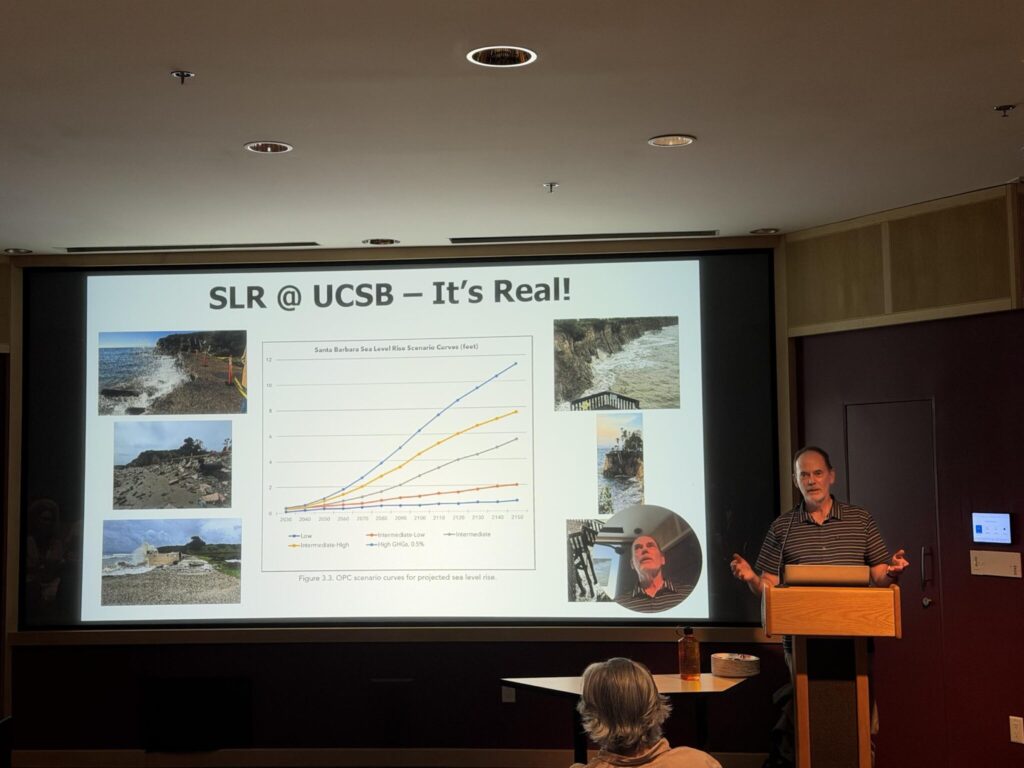
The Shoreline Adaptation Project hosted their second public meeting, presenting adaptation pathways in two specific zones: the Campus Lagoon and Lagoon Road shoreline on Nov. 5 in UC Santa Barbara’s Marine Science Institute Auditorium.
Increased risk of berm erosion, lagoon flooding, bluff retreat and the threat of reduced public access prompted the Shoreline Adaptation Project to action as they considered the best strategy to address these rising concerns on UCSB’s campus.
After the sea level rise adaptation strategy was approved by the California Coastal Commission in June 2024, it laid the foundation to consider the possible ways to adapt to this growing threat along campus, which the Shoreline Adaptation Project divided into five distinct zones. Focusing on areas three and four, the Campus Lagoon and the Lagoon Road Shoreline, they have proposed adaptation strategies to address cliff and berm erosion at the lagoon mound.
The main vulnerabilities discussed include east berm erosion, flooding due to inadequate outfalls, risk of loss of public access and recreation, exposed seawater system and sediment polluted water. These
have been considered as top priorities in this project, aiming to reduce flooding, enhance beaches, ensure public access and recreation and protect natural habitats.
“Our sea level rise strategy was an amendment to the UCSB [Long Range Development Plan], which basically said to the state, ‘here’s how we’re going to respond to sea level rise in a way that also protects state resources like public access,’” Charles Lester, director of the Ocean and Coastal Policy Center, said.
The bluff off of Anacapa Residence Hall and Lagoon Road is what is known as the ‘pinch point,’ the location where erosion is most pressing and the main area of focus with this region of the Shoreline Adaptation Project. It was agreed that retreat was the best course of action to prevent Anacapa Residence Hall from falling off the bluff edge.
“Up to about 43 feet of bluff at Anacapa Hall could fail in a single event,” Nicholas Garrity, a coastal engineer, hydrologist and the director of Environmental Science Associates, said.
With immense research and discussion on long-term realignment options focusing on the readjustment of shoreline resources and use of an ecosystem-based approach, they came up with three plausible alternatives.
Alternative one presents the option to modify or replace the
west outfall by installing an adjustable weir and removing the east outfall and restoring the natural sand berm. This approach would reduce flood risk along the lagoon trail and Commencement Green, as well as restore the natural east berm. This strategy would lower the managed water level by 2.5-7.5 feet and regrade certain areas to increase shallow water habitats.
Meanwhile, alternative two would primarily focus on building a natural berm at Campus Point. This approach is not seen as a viable alternative, according to Garrity, due to increased risk of flooding by failing to lower the lagoon water level, leading to longer loss of access to Campus Point Beach and increasing flood risk.
Lastly, alternative three would restore historic conditions, allowing the lagoon to close naturally and dry out during dry seasons and preventing seawater from entering the lagoon. Garrity emphasised the fact that this route would change the character of the Campus Lagoon as well as cause odor issues due to increased fish deaths as water level naturally decreases.
Alternative one was agreed to be the most ethical and plausible option given the opportunity at Campus Point to transition from a built roadway that’s eroding to a natural sand berm set farther back while replacing the outfall culverts with a natural berm. The plan
to lower the water level in the lagoon could help increase flood storage and reduce flood risk at Commencement Green.
According to Garrity, this plan could present an opportunity to increase shallow water habitats for shorebirds and other wildlife.
“Some of the habitat that’s there today is constructed and has been successful as mitigation. So it’s an approach that has been tested and successful by lowering the water level,” said Garrity.
According to Lester, the largest concern increasing the need for this project is “acceleration of certain changes” which involve rising sea levels and cliff erosion that “affect our campus resources.”
With a projected two feet of temporary sea level rise due to El Niño and the Kelvin wave, it is crucial for the Shoreline Adaptation Project to accelerate. These public meetings are hosted not only to get public input on these adaptation proposals but to raise awareness and address the problem of inaction against the rising threat that is sea level rise.
“One of the concerns right now is that the rates of sea level rise we’re expected to see are almost geologically unprecedented,” Ian Walker, professor in the UCSB Department of Geology and member of Shoreline Adaptation Project Advisory Team, said.
The temporary solutions the campus coastal conservation has enacted, such as the use of sandbags have provided support to prevent over-flooding, but it is not a solution to long-term berm erosion.
Emphasizing the importance of creative approaches and flexibility when dealing with an unpredictable dynamic environment, Garrity said, “some of the ways we’re considering applying those approaches to work effectively and fit with the conditions here at the university are somewhat untested or experimental.”
“Those types of approaches could change what it’s like to walk on the beach and to use the beach to sunbathe on the beach, shifting more towards a rocky shoreline to add protection,” said Garrity.
Polls were presented at the end of the meeting, showing that most of the public was most concerned with protecting natural coastal processes and ecosystems, when asked what should be prioritized when making decisions about the UCSB shoreline.
Questions were raised about the impact of cobblestone use on the natural environment as well as concern over sand supply.
“If we don’t maintain supply to keep pace with sea level rise … then everything could be ineffective,” said Walker. Without constant maintenance and supply of sand, alternative one may be futile. However, results have shown that, with the assistance of cobblestone, it is possible to sustain.
“Goleta Beach gathered a ton of sand over the time after the 2018 debris flow, and then they’ve put in more groyne rocks in 2023 and later. So they have worked fine to gather sand,” said director of ecosystem management for UCSB’s Cheadle Center Lily Stratton.
Placing cobble will allow wave energy to dissipate, keeping it from hitting the bluffs and therefore is an effective solution, though the transformation of the beach will be a concern.
“Cobble at the base of the beach might be effective, but it will change the beach,” said Stratton.
Despite the concern for cobblestone’s effect on the beach appearance, these natural approaches have the potential to improve our coastal ecosystem.
“Using nature-based approaches can actually improve conditions, especially relative to just not adapting and taking emergency action in the armory, which can really degrade habitat. So, there is actually a lot of potential to improve habitat,” said Garrity.
The Shoreline Adaptation Project is currently focused on monitoring shoreline changes as well as natural habitats in order to enact the best solution.
AccordingtoStratton,theteam has been collecting monthly bird data and monitoring the coastal wildlife. In the immediate term, the objective is to move the lagoon road inland at Anacapa Residence Hall to reduce what they call a “coastal squeeze,” in which the coastal ecosystems are trapped between rising sea levels and infrastructure. The project’s current action is to maintain monitoring, enact a contingency plan for cutoff drainage, reduce lawn irrigation and relocate Lot 6.
“What would be success is having a clear enough project that we can have everyone on board with the solution, and then we apply for another grant, and we take the next step like removing that asphalt and putting sand back there so that a beach can develop there,” said Stratton. “I think by the end of this academic year, there should be a plan that we can then use to write grants for the next step.”
A large part of the long-term plan depends on the current community’s input. Dealing with many temporary residents in a dynamic college town also makes it difficult to draw enough attention to this problem.
“Thinking about the notion of planning for the future when you’ve got a community largely made up of transient students is an interesting challenge,” said Lester. As this project continues to face trials, it is crucial for the public to recognise the urgency of this growing problem.
“Sea level rise still doesn’t feel pressing to people, and so it didn’t draw them out as much,” said Stratton. “Connecting people to the coast is important, and not just because we thought we could build a building somewhere. We have to protect it at all costs.”
A version of this article appeared on p.11 of the Nov. 20, 2026 edition of the Daily Nexus.