
A.S. Living History Project aims to preserve UCSB’s history of student activism
By Ramona Jacobson and Olive Thompson
November 19, 2026 at 2:00 pm
The Associated Students Living History Project strives to document, archive and bring awareness to student activism at UC Santa Barbara by preserving historical records of past student activism and recording current student political actions.
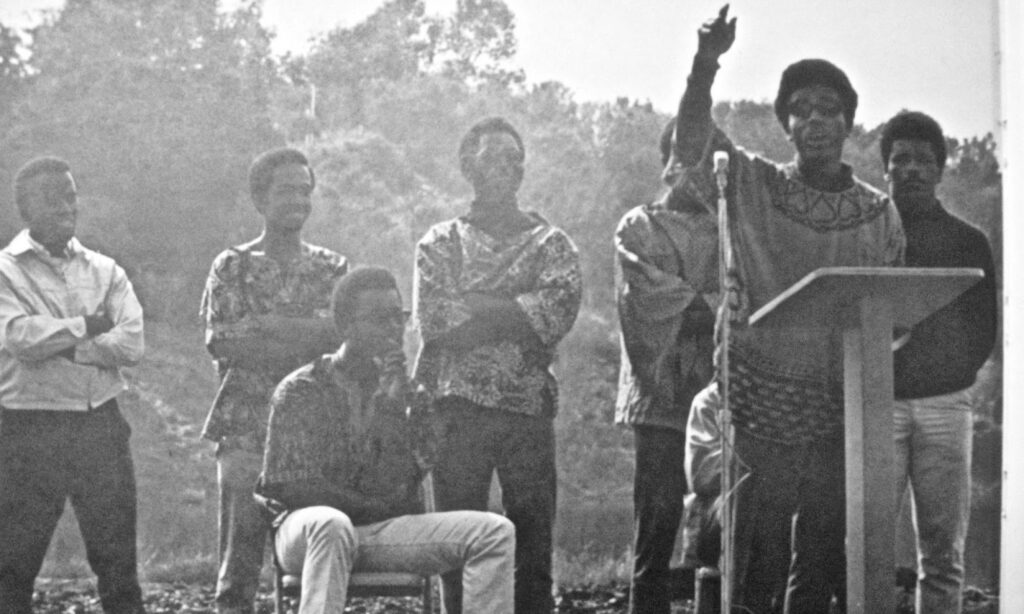
From the Get Oil Out! movement following the 1969 Santa Barbara oil spill, which spurred the creation of international Earth Day and UCSB’s environmental studies major, to recent Immigration and Customs Enforcement (I.C.E.) protests, student activism has always been a part of UCSB culture. The Associated Students (A.S.) Living History Project was created to provide a place to preserve and share the stories from these activists for current and future students and community members.
The Living History Project has existed in some capacity since the 1960s but ceased functioning for a few years following the COVID-19 pandemic. Last year was the project’s first year as a functioning organization since the pandemic, so board members prioritized securing funds and establishing a mission for the future of the organization. This year, they want to continue to rebuild and connect with other organizations across campus.
According to the A.S. Living History Project Chair Summer Agren, a second-year writing and literature major, one of the project’s main goals is preserving historical movements while staying abreast of current activism happening on campus. The project has a team, funding and resources specifically dedicated to recording present history at UCSB. The project currently records vigils, marches through campus, posters around campus and the work of student groups that support marginalized identities on campus.
“We have the ability and responsibility to document and uplift the work that’s being done right now so that it doesn’t become a gap,” Agren said. “We’re able to make sure that the work and voices being raised on our campus today are both heard in the moment and not forgotten in the future.”
Living History Project Vice Chair Tuesday Mahdavi, a third-year biology and writing and literature double major, said that the project aims to document how UCSB and its students have responded to issues, both in the local community and around the world.
Some of the movements the project showcases include UCSB students’ role in the modern environmental movement, the takeover of UCSB’s North Hall by members of the Black Student Union as a protest against institutional racism and the burning of the Bank of America in 1970 to protest the harms of capitalism and the Vietnam War. Mahdavi said the project strives to serve as a comprehensive archive of the local community’s voices, not just the voices of the administration.
Agren and Mahdavi feel that their organization has a responsibility to accurately record and portray events related to student activism; the goal is to be as objective as possible and let those who are leading the activism define their own stories.
“We all take it as our responsibility to keep a finger on the pulse of what’s happening in and around campus and to listen to other voices. Whether or not we share an identity with them or even agree with them, we want to keep tabs on what our fellow students are doing,” Agren said.
Agren also shared the importance of recording activism respectfully and with student safety in mind.
“Last year, we documented one of the major anti-I.C.E. protests on campus. We made sure to obtain permission before taking video clips. In those clips, we actually only included audio, so we didn’t put anyone’s face or anything like that into our archive in order to preserve privacy,” Agren said.
Mahdavi noted that conflicting perspectives are inherent to being human, so she understands that the historical record will always be somewhat subjective. The Living History Project’s goal is to honor the experience of activism in all its forms. According to Mahdavi, the project aims to uplift stories rather than rewrite them. This can take the form of recording oral histories directly from activists or having groups write their own stories to be preserved for the record.
Agren emphasized that the project is focused on current and future actions as well as past ones. One example of a movement that has continuously played a role on UCSB’s campus is the environmental movement.
“Whether it’s past protests or awareness around the oil rigs off our coasts, or today with A.S. broadly fighting for tenant rights on Del Playa now that our cliffs are collapsing, I definitely see environmental justice as something that has continued throughout our history,” Agren said.
Agren and Mahdavi also highlighted the student population’s role in advocating for social and political justice.
“I don’t think we’re as completely laid-back and party-centric as our reputation might suggest,” Agren said.
Mahdavi said that before she began attending UCSB, she had heard about the “party school” reputation, but after engaging with the student body and learning more about the school’s history of activism, her perspective on the school’s culture has shifted.
“I was really worried when I came in about the reputation and that people wouldn’t care about what was going on around them, but now I’ve seen how much people on campus care a lot and are willing to do things to improve UCSB,” Mahdavi said.
Mahdavi said that joining the Living History Project has taught her that UCSB’s A.S., and students in general, can make a significant impact on the University’s culture and on UCSB’s operations.
“I think it shows that we can continue to shift how the University is run,” Mahdavi said. “A lot of the time we feel like we need to speak up and then wait for someone else to do something, but students can take action to actually change things even without initial support from admin and big institutions.”
Agren feels that UCSB’s student population is politically active and strongly involved in advocating for the causes that they care about.
“Whether that’s students volunteering with SBResiste to support communities affected by I.C.E or people joining A.S. organizations so they can help offer resources to their community, I think we all care a lot,” Agren said. “I think it’s exciting to see that — through the records Living History has, you can really see that, for decades now, Gauchos have cared about and fought for rights in and around our community.”
A version of this article appeared on p. 6 of the Nov. 19 print edition of the Daily Nexus.