
UCEAP students face difficulties amid rising French civil unrest
By Lucy Wellons
November 13, 2026 at 2:00 pm
This fall, the French public has captured global attention by launching several large-scale protests across the country advocating for a number of changes within the government and flooding the media with images of student protests, some of which resulted in violence and destruction of property. The University of California Education Abroad Program students studying across France have had their education and daily life impacted by these ongoing demonstrations.
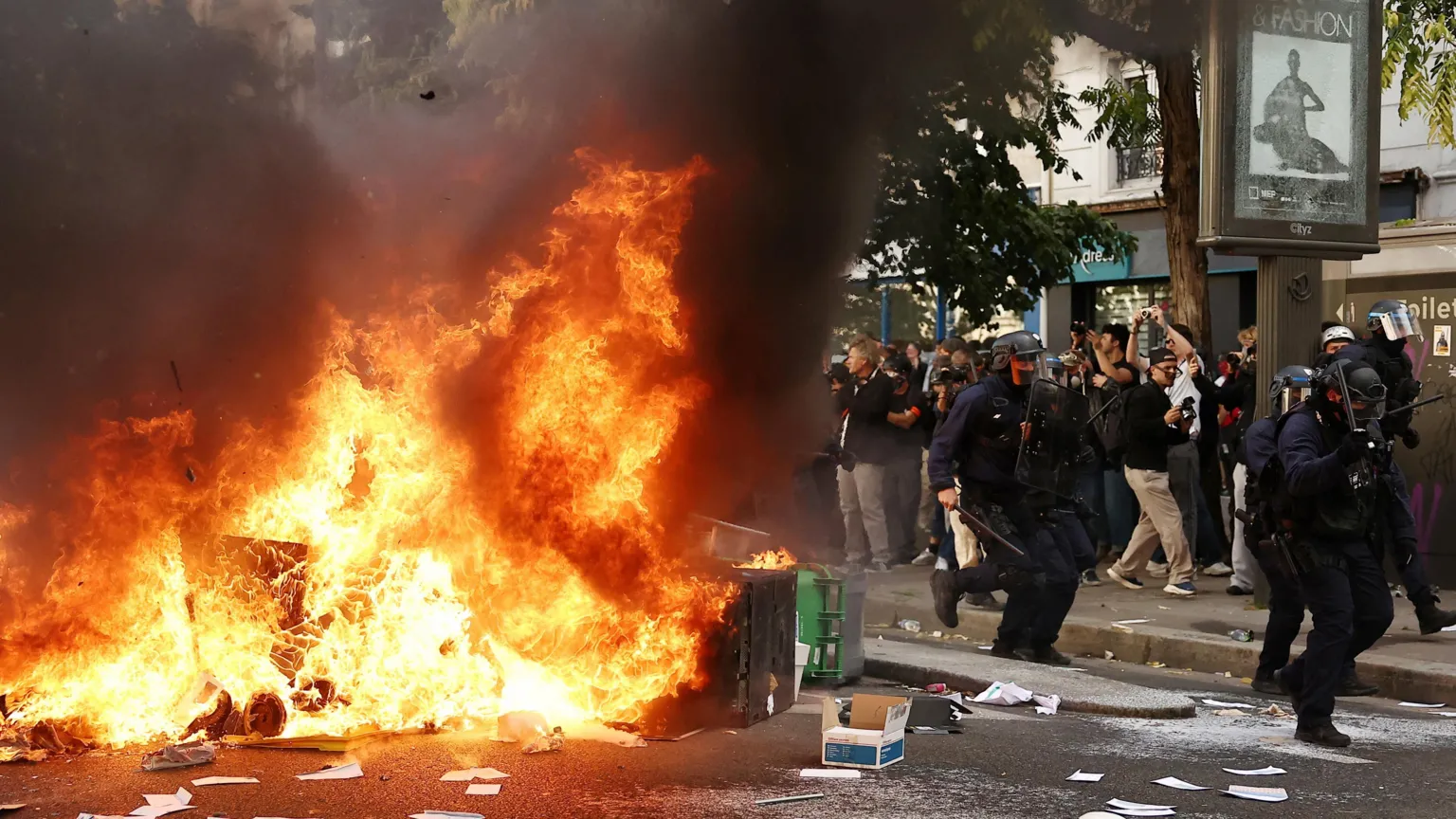
What began as a student-led mobilization for improved schooling conditions has gradually evolved to become a much larger movement, encompassing a broader discontent within the French public, including concerns over the rising cost of living, declining public services and government austerity measures.
Beginning in mid-September, the movement has continued with unprecedented levels of street violence and looting in recent years. Students studying abroad in France through the UC Education Abroad Program (UCEAP) have found their experience to be unexpectedly interrupted by these mobilizations.
Amelia Beving, a third-year UC Santa Cruz student studying applied linguistics, currently attends the University of Bordeaux through UCEAP, taking classes at both the Bordeaux Montaigne University and Sciences Po Bordeaux. She described her initial thoughts on her experience abroad in France.
“Honestly, I didn’t have a crazy lot of expectations. I just wanted to take classes and be able to live in another city and see if I could adapt to a different lifestyle. I like the French way of doing things. I like a lot of things about France, so I feel like I’m pretty happy here,” Beving said.
Beving stated that she lives within the city center of Bordeaux and must commute to campus from her house, which has put her in the midst of the demonstrations happening in her area.
“Whenever I’m walking through town, I see tons and tons of [police] and guys all suited up to go. And the other day, my roommates inadvertently got exposed to some tear gas that was in one of the main plaza areas. So it’s definitely very, very close,” Beving said. “The other week when it was really intense, I could hear sirens going pretty much all the time from my house, and when I walk around downtown, I see all the windows that have been smashed, and I see shops that have been boarded up.”
Beving noted how her personal education experience has faced serious difficulties. Over the course of the weeks of protests, hundreds of high schools and higher education facilities have been sporadically closed or blockaded as a result of student unrest.
“I would say it really sucks. Right now, I’m taking classes at the DEFL, which is the Department for French Language Studies,” Beving said. “Those classes are not canceled, so I’m still able to get to them when the tram is running. But it’s hard to get home in the afternoons if there’s protests because the tram is heavily disrupted.”
The Sciences Po Bordeaux campus was blockaded by a student movement for over a month. During the time of the blockade, students barricaded all of the doors to the administrative buildings and classrooms, and all classes were held online. Beving spoke about how this has affected her ability to access campus resources and connect with her peers.
“It’s pretty much impossible to meet any French students because they’re not on campus, and even certain extracurriculars, like certain workout classes I was doing, are inaccessible because the buildings have been closed, and it’s very bizarre,” Beving said. “It’s very hard to talk to people in a Zoom class. Obviously, it feels like [COVID-19] again at times because there’s just no way to connect with [the] students in class. ”
Despite the unexpected hurdles Beving and other students abroad faced due to the demonstrations, she stated that she still tries to keep a positive outlook on her situation.
“It’s definitely really annoying, and it’s definitely made me get firsthand experience of a very French phenomenon, which is the strikes and the protests, so it’s certainly unforgettable,” Beving said. “I think that eventually it will end, and I think it’s interesting to give us a firsthand account of creating a social movement. And so I’m trying to remain at least curious and not be completely like, ‘This sucks. I hate this,’ but it does suck, and I do hate it. I’m trying to remain not optimistic or excited about it, but just [with the mindset that] this is a learning experience. Even if it is difficult, I’m still learning from it, and adversity builds character.”
Similar to its Bordeaux campus, the Sciences Po Paris campus has faced numerous student blockades and moved classes online for extended periods of time. These shutdowns were sometimes unexpected and therefore not well communicated, causing frustration amongst the student and teaching bodies due to last-minute class cancellations.
A controversial attendance policy at Sciences Po enforces a strict mandatory attendance policy across all registered courses, where exceeding two absences in courses lasting 24 hours or more causes a student to be in “default” status. Students with long commute times or those who experienced public transportation disruptions due to demonstrations struggled to attend class when the campus suddenly announced it was re-opened.
Malu Ramos, a third-year political science major at UC Santa Barbara, is attending the UCEAP program at Sciences Po Paris. She spoke about her personal experiences dealing with the protests centered in the capital and the unexpected transition to online learning.
“It brings me back to [the] COVID days, 6 years ago. So I mean, I know how to deal with it,” Ramos said. “But it also made me realize how not used to it I am at the same time, because I realize that I thrive much better being in person, but I completely understand why everything had to be moved online.”
Ramos acknowledged the inconvenience of the situation, but voiced her belief in the validity of the protests.
“I mean, selfishly, I feel a little bit upset that I wouldn’t be going on campus, but I understand that protests, they’re not made to be comfortable,” Ramos said. “They’re supposed to make you uncomfortable, so you realize the reality of the situation that people are protesting for. I think it’s interesting, experience-wise, that I was personally affected by French protests and French protest culture. But I would also be a little bit disheartened that it would take two more months for the government to realize that they have issues and that they should be focusing on education reform and on helping their citizens.”
Since the beginning of the protests, there have been numerous investigations into officer-related misconduct. Several children have been among the victims of injury and mutilation due to anti-riot techniques utilized by the French police force. This includes a 15-year-old losing a hand to a crowd-control grenade, a 16-year-old losing an eye to a rubber bullet and a 14-year-old fracturing his jaw, losing his bottom teeth and having all his top teeth broken.
Ramos re-emphasized her support for the ongoing demonstrations, highlighting how she appreciates the dialogue that it has created in her classes.
“I think it’s really admirable that these 15- to 18-year-olds are taking to the street to let it be heard, and especially in a moment where French politics, which has been really emphasized in my classes that I have here in Sciences Po, is in a really polarized year because they have elections coming up,” Ramos said. “I condemn the violence, but from what I’ve seen, it seems that a lot of the violence hasn’t been incited by the student side. And it’s really sad to see when the police start physically retaliating.”
A version of this article appeared on p. 6 of the Nov. 12 print edition of the Daily Nexus.