UCSB professor speaks on information disorder and geopolitical connections
November 6, 2026 at 2:00 pm
Associate political science professor Julia Morse delivered a presentation titled, “Information Disorder and Global Politics: How Technology is Reshaping International Relations,” on Oct. 27 in the Pacific View Room as part of the UC Santa Barbara Library’s Pacific Views Speaker Series.
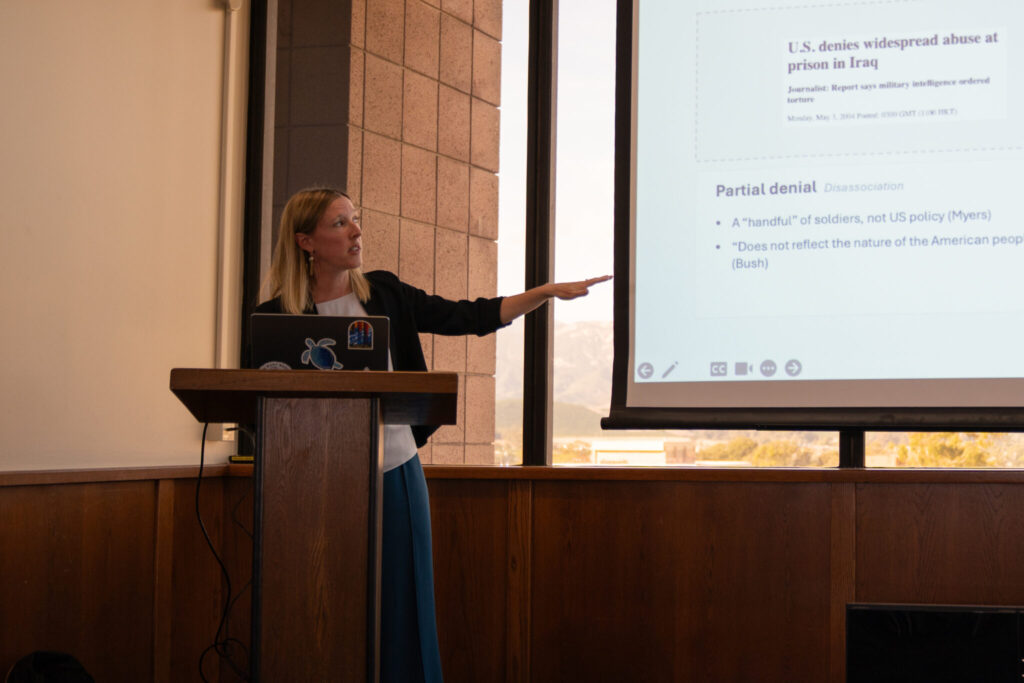
Professor Julia Morse has taught political science at UC Santa Barbara for 8 years and is a non-resident fellow at the Oxford Martin AI Governance Initiative. Information disorder, or a digital setting that permits the rapid spread of false information, is a focus of her research and the subject of the book she is co-authoring, “Damage Control: Lies, Evasion, and the Cost of Breaking International Law.”
Several students and community members gathered in the Pacific View Room, located on the eighth floor of the library, to hear Morse’s expertise. She previewed her talk with some guiding questions, introducing her investigation by posing the question, “[What] do people think about when [countries] break international law?”
“For a lot of people, unless you’re a lawyer, the question of whether [a country] violated international law per se is not the question that really shapes opinions,” Morse said. “It’s a question of how the larger conversation takes place about that behavior.”
She explained that governments employ certain strategies, such as disassociating themselves from their misconduct, denying wrongdoing altogether, or questioning the values behind the laws that find them guilty to influence public opinion.
Morse highlighted examples of political events, such as the Russian invasion of Ukraine in 2022, to demonstrate that, despite there being clear proof of the violation of international law, narratives can prevent society from using the facts to reach a shared conclusion. Morse stated, “It’s not just about the events that happen … there are narratives, there are stories told that influence how people think about political events.”
Morse explains how technology allows for government rhetoric and narratives to circulate. Social media algorithms, which control the facts that one is exposed to, are “very good at amplifying the emotional impact of technology” and spreading narratives that elicit an emotional response.
She added that the addition of artificial intelligence (AI) to the already information-challenged social media landscape has created further confusion about facts.
“Maybe you’re seeing a fact. Or maybe you’re seeing AI-generated content … It might be real, it might not. So even the facts themselves are already up for debate,” Morse said.
The algorithm and AI’s involvement in the media culminates in a situation that Morse characterizes as “information disorder.” She clarified that information disorder is present when an environment has “low barriers to content creation,” which allows the “rapid spread of false or misleading material” and the “amplification of particularly sensational or fragmented narratives.”
Considering the global prevalence of information disorder, Morse claims the ability of international organizations to cooperate is being threatened and contributing to the “undermining of multilateralism,” altering the dynamics of global politics.
Morse explained that misinformation, which she believes international organizations must combat, can even be responsible for accelerating conflict. She illustrated this point by exploring the role that AI-generated deepfakes had in provoking conflict between India and Pakistan in 2025.
“There were videos shown of bombings that didn’t take place. There was so much confusion about what was actually happening. And there’s a lot of concern that that could lead to escalation.”
In the face of information disorder, Morse believes that protecting the legitimacy of multilateral arrangements is crucial. Additionally, she proposes stronger regulations on AI-generated content, as well as “information resilience,” or an increased awareness of how to spot misinformation and AI-generated content, as potential solutions to information disorder.
Ben Sam, a fourth-year political science and history double major who attended the event, said his biggest takeaway was “the implications of how we could go about [creating] policy [to regulate AI] … on a world scale.”
A version of this article appeared on p. 5 of the Nov. 5 print edition of the Daily Nexus.