
Could quantum mechanics underlie conscious thought?
November 5, 2026 at 10:00 am
As a child, I struggled with a mild form of double vision: when looking at objects, I would see a faint second image overlapping the main one. Especially when focusing on people, the fainter image seemed very real, and my childish mind decided I was seeing part of each person’s soul, floating alongside the person’s body.
Much to my dismay, I seemed to lose this amazing power of seeing other people’s souls as I got older and was given eye exercises to improve my double vision. As it turned out, the second image I was seeing was certainly not a soul. However, the idea that there is more to our lived experiences than the biological processes of the body has persisted throughout history, leading to many theories and ideas about what could be behind conscious thought.
What constitutes conscious thought? As we go through life, we constantly take in information about the world around us, draw upon past memories and experiences to make decisions, communicate with others and apply our knowledge to solve complex problems or complete homework, though some of us may be prone to daydreaming instead.
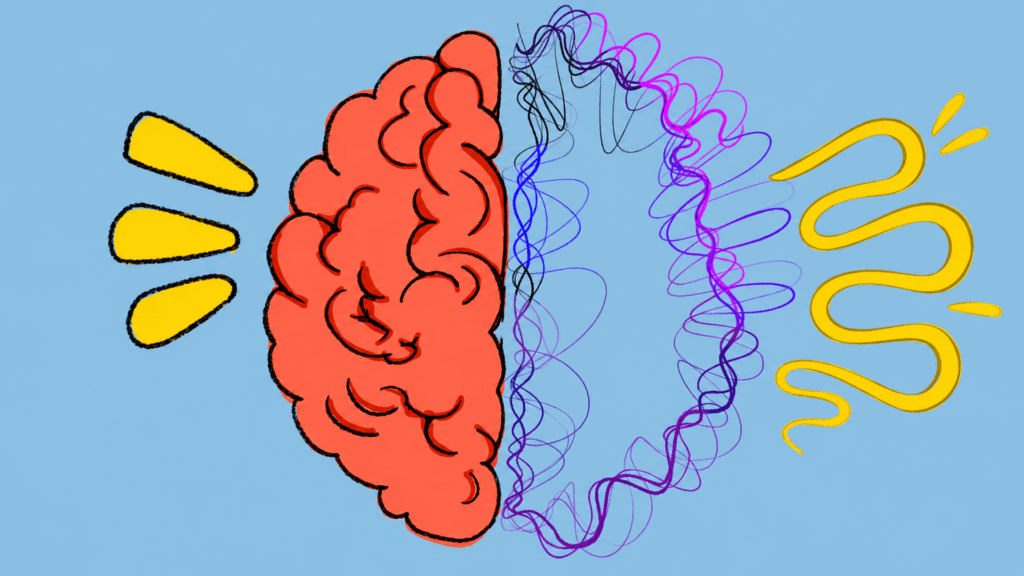
Neurobiology has made significant progress in understanding many of these processes involved in conscious thought, including the functions of various parts of the brain and how they communicate with one another and the rest of the body through electrical and chemical signals. For example, the occipital lobe is responsible for processing visual information, while the hippocampus plays an important role in learning and memory. Our understanding of how neurons communicate has also enabled us to develop medications such as painkillers, which alter the transmission of signals throughout the nervous system.
There may be more to our conscious brain processes than biology can explain, however, and it has been an intriguing and long standing hypothesis that quantum mechanics could play a role in the way that our brain works. Dirk Bouwmeester, a physics professor at UC Santa Barbara, reasoned why the notion that quantum mechanics could be behind our brain processes is so compelling: “We are very good at pattern recognition,” Bouwmeester said. “There are quantum algorithms specifically designed for very efficient pattern recognition.”
Visual pattern recognition is second nature to us, but according to Bouwmeester, “this is actually quite a hard task for a classical computer.”
“We have learnt the power of quantum algorithms, and that power is particular in tasks that are similar tasks that we are good at, so it hints that evolution may have discovered the same principles,” he said.
Bouwmeester, along with his colleagues professor Kenneth Kosik at UCSB’s Neuroscience Research Institute and professor Bradley Chmelka at Chemical Engineering, are investigating the possibility of quantum mechanics behind consciousness. Their research builds on a leading theory proposed in 2015 by Matthew Fisher, a theoretical physicist at UCSB, in a 2015 paper. Fisher suggested that phosphorus nuclei in the brain could become quantum entangled, a phenomenon in which particles share a quantum state such that their properties are correlated, even when physically separated. He proposed that this entanglement could be preserved inside calcium-phosphate structures called Posner molecules, potentially influencing chemical reactions involved in communication between neurons. In this way, quantum entanglement of nuclear spin states could play a role in brain processes.
If entangled nuclear spin states do play a role in brain activity, introducing other nuclei with their own spins could disrupt the entangled states, leading to observable changes in neuron activity.
“If there are too many local disturbances, suddenly the global entanglement is destroyed,” Bouwmeester explained.
The three groups received $2.5 million from Google Quantum AI this September to continue their work towards investigating quantum consciousness at UCSB. Kosik’s group, which specialises in brain organoids, provides the organoid infrastructure to study networks of neurons grown from stem cells, while Chmelka’s group contributes expertise in nuclear magnetic resonance imaging. Bouwmeester’s group draws upon their knowledge in quantum information science in their work and develop precise equipment to study organoids, observing changes in the electrical activity of neurons when exposed to isotopes of xenon.
Without xenon, neurons in the organoids exhibit coordinated electrical activity. “If one fires suddenly, all the others start responding and you get some sort of collective response,” Bouwmeester explained. However, when exposed to anesthetics such as xenon, this coordinated activity begins to break down, while the neurons themselves appear to remain intact.
“The neurons still keep firing, but not in an orchestrated way. We can measure that with electrodes,” Bouwmeester said. “We see that the collective firing falls apart as a function of the pressure of the xenon.”
The group aims to precisely determine how xenon is disrupting communication between neurons. One possibility they are exploring is that xenon’s nuclear spins could play a role, potentially interfering with the hypothesised quantum entangled state. The group is now investigating whether different isotopes of xenon, which have different nuclear spins, produce differing effects on neuronal activity.
Determining whether the observed effects on neuron activity are related to xenon’s nuclear spins, rather than other effects, requires precisely controlled experimental conditions.
“It’s really careful physics experiments that we do with these organoids,” Bouwmeester said. “We build high-quality chambers, we have automated controls of pressures and we analyse with mass spectrometers the gas that [the organoids] are interacting with.”
A challenge for the theory that quantum mechanics could play a role in consciousness is that the proposed quantum states would need to survive on the scale of milliseconds in the brain. However, the warm, wet environment of the brain appears incompatible with this idea, since if quantum states interact with their environment they decohere, meaning that they lose their quantum properties and start to behave like a classical system. In 2000, physicist Max Tegmark calculated that interactions with the surrounding environment would cause quantum states to lose coherence at timescales of 10^-13 to 10^-20 seconds. This decoherence would prevent quantum states in the brain from reliably storing or processing information relevant to our conscious processes.
Fisher proposed a possible way around this problem in the theory he described in his 2015 paper. He stated that nuclear spins are “so weakly coupled to the environmental degrees of freedom” that they could maintain quantum coherence for unusually long periods. His proposed Posner molecules could further “protect the neural qubits on very long times,” with theoretical estimates in the paper suggesting that quantum coherence could persist for approximately a day, which could allow quantum information to survive long enough to influence neuronal activity.
At the moment, Bouwmeester group’s work on testing this quantum brain hypothesis remains exploratory.
“I’m not trying to prove the brain is quantum,” Bouwmeester clarified, “I’m open for all possible outcomes.”
The souls I imagined as a child turned out to have a much simpler explanation, but that’s not to say that there isn’t far more to the way our minds work than is currently understood by neurobiology. Bouwmeester’s group, in collaboration with the Kosik and Chmelka groups at UCSB, will continue to investigate whether quantum mechanics could play an important role in the way we think and process the world around us.
A version of this article appeared on p.11 of the Nov. 5, 2026 edition of the Daily Nexus.