
A new age of directing films: A24 and “Backrooms”
November 5, 2026 at 10:00 am
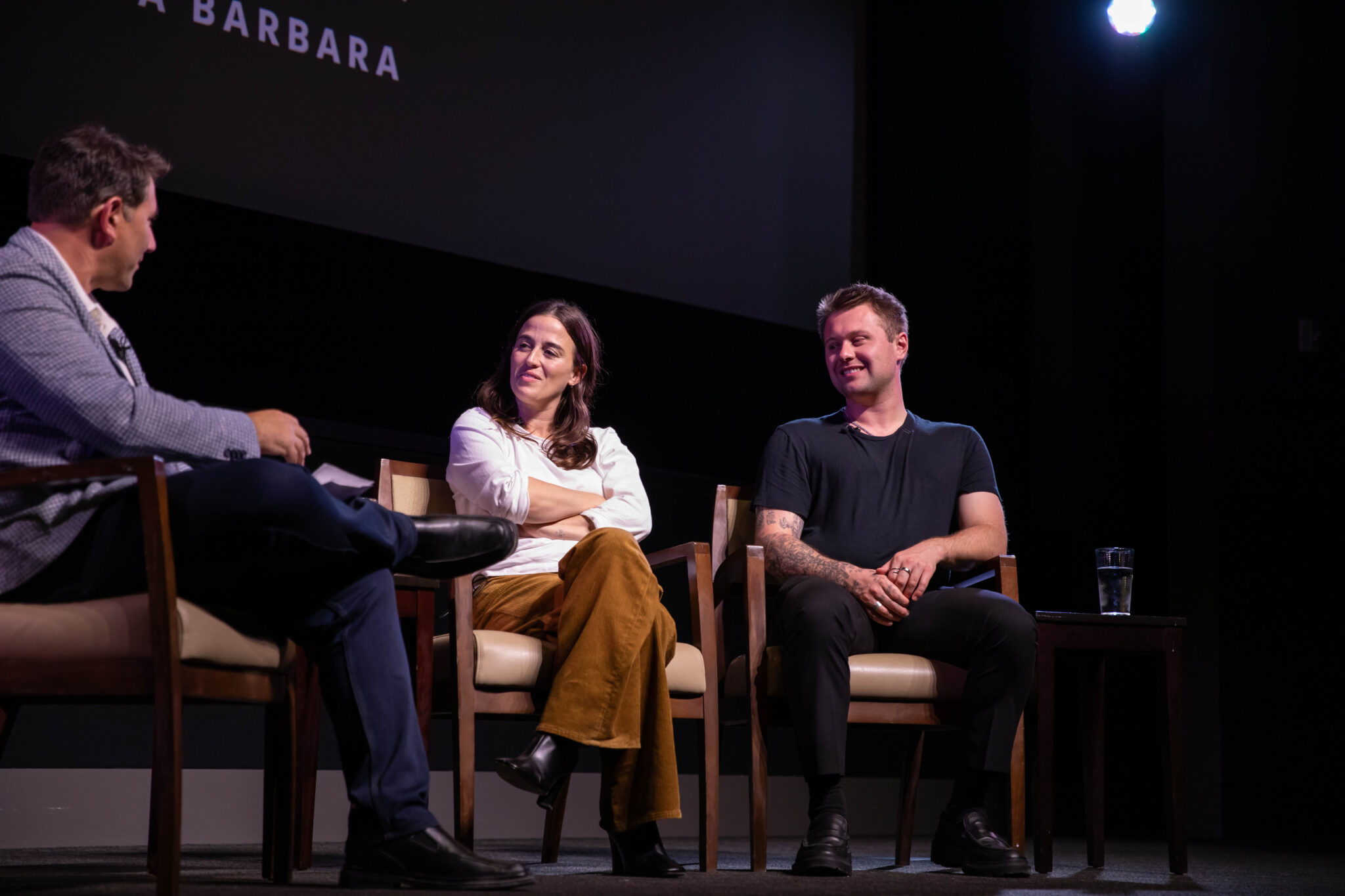
What makes a film unique? What makes a film authentic? “Backrooms” producer Kori Adelson and associate producer Grant Donghia raised these questions in their post-screening discussion at UC Santa Barbara’s Pollock Theater on Oct. 24, where they discussed the making of the film with Carsey-Wolf Center Director Ross Melnick.
During the start of the discussion, the audience was enlightened on the origins of “Backrooms.” Donghia recalled how “Backrooms” director Kane Parsons saw a creepypasta post on Reddit created by an anonymous user in his early teens. Parsons was inspired to take the story into the 3D software modeling platform “Blender,” and he later posted his works on Youtube, which became a webseries that drew in many viewers.
According to Donghia, the concept of the Backrooms caught the film industry’s attention through Dan Cohen — an assistant for 21 Laps Entertainment at the time — and his friend Michael Clear, who discovered the “Backrooms” webseries at the same time. The pair reached out to Adelson, who became interested in adapting the Backrooms concept into film since its aesthetic seemed fresh and new. As a result, Adelson pitched the idea to Noah Sacco, an executive at A24. Adelson’s team later developed a script alongside Parsons. Afterward, the process was described as fast, and all that was left to do was to put the script into action.
By selecting Parsons to direct the film, A24 placed a lot of trust in him, especially considering he was a teenager for the duration of the filmmaking process. According to Adelson, the film could not commence production until Parsons had graduated from high school. Melnick asked what conversations were happening with the production team and A24 executives around the topic of Parsons’ leading role in the production considering his age. Adelson responded by describing Parsons as an “old soul” who is focused, mature and has a deep understanding of his world.
Adelson also claimed that the team never had any reconsiderations about Parsons being the film’s director. In addition, everyone felt that he was “the world” due to Parsons’ deep understanding of the Backrooms universe, leading everyone to feel excited to witness and support his filmmaking. Though, according to Adelson, it was an interesting thing to explain to A24 how the film had a budget of $10 million all while Parsons was living in his mom’s house at the time.
Parsons’ filmmaking made the team eager because his approaches were considered different from existing practices. Melnick acknowledged Parsons as an organic filmmaker — that Parsons comes from a generation that has absorbed video games and short film videos, and an intriguing question he asked was regarding Donghia’s thoughts about Parsons’ use of Blender, CGI and his translation. Donghia explained that Parson’s directing compelled everyone to make the project since he was playing around with a traditional way of filmmaking while also incorporating multimedia, an untraditional way of filmmaking, saying that the way Parsons approaches film was so unique.
One particular aspect of Parsons’ filmmaking process which Adelson found notable was that he pre-made each film set using Blender, mapping out and modeling the layouts of each room shown in the film prior to creating a physical set.
“He can feel that the room doesn’t feel right — it sort of communicates this sense of disorientation,” Adelson said.
Casting director Wittney Horton collaborated with Parsons and the film’s producers in order to select the best actors for the film. The crew was curious about what would be the outcome of pairing a new director with experienced actors — if they paired Parsons with two Oscar-nominated actors. The outcome was proven to be successful given Parsons’ genius and freshness.
“When we’re looking at a first-time filmmaker, you want to give them the best actors,” Adelson stated. “You wouldn’t have thought that ‘Backrooms’ [was Parsons’] first movie.”
Melnick recognized that there’s a “Hollywood waking up” perspective from the press when hit movies with industry newcomers directing them — such as “Iron Lung,” “Obsession” and “Backrooms” — enter theaters and become huge box-office successes. Donghia shared that he was excited about this because audiences want to see new voices in the filmmaking world, and they especially appreciate it when they hear stories from people that aren’t the same repetitive voices. The younger generation seemed to be one of the main focuses he wanted to see sharing their voices, raising the question of how to incorporate the wave of a younger genre in other categories like romance or comedy. A conflict Adelson sees in this question is that there’s a big gap between studios wanting to be risk-averse and what viewers vocally want, but this problem is in the works of being solved. However, without a doubt, there’s progress in the film industry, as Adelson expressed how the “studios woke up” because of the big audience that wants authentic, fresh, cool stuff.
“We’re just trying to tune in to the audience as much as possible and kinda work really, really hard trying to break down those walls,” Adelson said.
Now the big question is this: How can you be original? The answer is honesty, according to Adelson. She explained that she advocates for filmmakers to work against the algorithmic bowl — to work against the sort of safety pole in the film industry despite it being tough because of the universal desire for money and a career.
“I think that’s the only thing that’s gonna work … building and developing your voice into the most authentic version of something you can do. And I think those are the kinds of people we like to work with,” Adelson said. “We always say that you fail as many times being risk-averse as you do being risk-forward, so you might as well be risk-forward. You might as well be cool while you’re doing it.”
Donghia elaborated by explaining that it’s crucial for filmmakers to have a deep understanding of who they’re making their film for. Additionally, he clarified that creating social media content, just as Parsons did on YouTube, is a crucial step in “getting one’s content out there.”
Parsons is said to be doing what he always does, like going away on vacation and thinking about his works, and there has been an implication of the works of a “Backrooms” sequel. The panel concluded with Adelson and Donghia offering encouragement for young aspiring filmmakers to take risks and to be straightforward, perhaps inspiring many to do exactly that. With the surge of hit movies that came this year, there’s hope that the film industry can continue to thrive.
“The young executives are becoming decision makers. The young producers are becoming decision makers,” Adelson asserted. “And there’s an openness to that, so things are gonna have to change.”