
Senate endorses Measure E2026 on I.V. primary ballot
October 28, 2026 at 12:00 pm
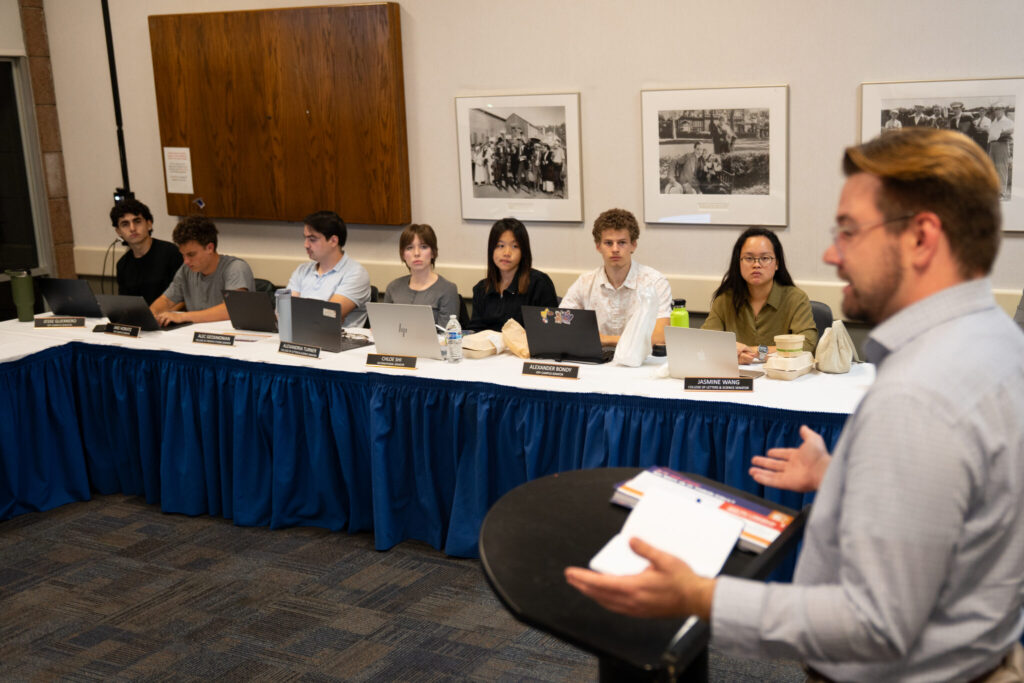
The Associated Students 77th Senate passed a resolution endorsing Measure E2026 — a utility tax increase on Isla Vista residents — at its Oct. 21 meeting.
Measure E2026 is a proposed tax on the I.V. ballot that would increase the utility tax for residents by 6% on trash water, electricity and sewer and 7% on natural gas. According to the sample ballot, Measure E2026 is projected to generate $1.2 million in annual revenue for the Isla Vista Community Services District (IVCSD), which will fund local improvements and services.
Adding to the existing Measure R2018, an 8% tax that was passed in 2018, utility taxes would be at a combined rate of 14% on trash, water, electricity and sewer and 15% on natural gas.
Public Forum
IVCSD Director Spencer Brandt and President Katherine Carmichael attended public forum to convince the Senate to pass its resolution endorsing Measure E2026. The resolution was proposed at the last Senate meeting and was referred to the Advocacy Committee for further deliberation.
Brandt explained that the measure will provide a source of local revenue that I.V. needs to become a city. Throughout the last 50 years, Isla Vista has been unable to reach this status in part due to insufficient tax revenue associated with cityhood.
“Measure E is really all about the future of Isla Vista,” Brandt said. “It’s really time for the new generation to decide.”
In 2016, approximately 87% of I.V. residents voted yes on Measure E2016, which established IVCSD — creating a form of local government for the unincorporated area. However, without cityhood recognition, Santa Barbara County still holds much of the authority for regulations in I.V.
“In order for us as a community to take the steps that we need to form our own city of Isla Vista, we need to have locally controlled revenue that will allow us to even start the application process,” Brandt said.
Brandt estimates that, if Measure E2026 passes, utility bills would increase around $5 per person per month based on a per capita estimate of the tax’s revenue. However, the average amount residents would pay varies greatly depending on utility usage.
Senator and third-year computer science and sociology double major Kyara Vivanco Cortes raised concerns over the financial burden the tax could place on low-income residents.
In response, Brandt highlighted existing utility assistance programs, such as the California Alternate Rates for Energy and Family Electric Rate Assistance , that could reduce some of the burden for eligible households.
“One of the biggest things that we can work together on is the promotion of the existing programs which are super underutilized,” Brandt said.
Brandt argued that the tax is a “small price to pay” in order to potentially create more savings in the long term for renters; I.V. cityhood could potentially allow the community to pursue policies such as rent stabilization.
Carmichael echoed Brandt’s concerns about rent affordability, explaining that she experienced annual rent increases as a graduate student and renter in I.V. She argued that the measure could ultimately help lower the cost of living by giving residents more control over local policy.
Second-year chemistry major Avery Berger emphasized that current residents should consider the benefits the tax could provide for future renters, even if they do not witness those benefits directly during their time in I.V.
“I feel like we should feel a certain level of responsibility to later generations of Isla Vistans that are going to come and certainly see the benefits of that decreased cost of living,” Berger said.
Senator Reports
During senator reports, Cortes presented the results of a survey the Associated Students (A.S.) Outreach Committee conducted to gauge students’ opinions on Measure E2026.
According to Cortes, of the 159 responses collected, 44% indicated they would vote against the measure, 31% indicated they would vote in favor while 25% remained undecided.
However, Senator and second-year physics major Alec GeoSimonian raised concerns about the statistical validity of the survey. He questioned the survey’s distribution and wording and highlighted that respondents could submit the survey multiple times.
Aside from students, the survey was also accessible to local business owners and employees, which GeoSimonian described as “a little bit counterproductive.” He explained that businesses have their own avenues to express their position, whereas A.S. should be exclusively representing the voices of students.
GeoSimonian also disagreed with the survey not including anything about cityhood or what IVCSD stated it plans to use the tax revenue for.
“Personally, if I saw that poll, and I saw nothing about specifically what IVCSD wants to use the money towards, and it just said it’s a utility tax increase and it could go towards public services, I would be skeptical too,” GeoSimonian said.
Cortes clarified that she and the Outreach Committee were “very against” including the cityhood aspect because it was “speculative.” She said that it isn’t certain whether Measure E2026 could definitely lead to cityhood.
Additionally, Cortes explained that the survey needed to be kept anonymous, and limitations on the survey’s distribution channel, Qualtrics, were why they weren’t able verify if individuals responded more than once. She attributed the survey’s shortcomings partly to time constraints and expressed willingness to work with other senators to conduct another before the election.
Passed Legislation
Senators debated whether to proceed with the endorsement of Measure E2026 or postpone the decision to allow for another survey.
GeoSimonian argued that there was already sufficient reason to support the measure without the need for another survey. He highlighted the supporters of the measure that spoke during public forum and the larger attention the Senate’s endorsement could bring to the issue.
Senator and fourth-year statistics and data science major Atticus Gonzalez raised concern that the endorsement may encourage students to vote on the measure without properly informing themselves.
“I see this [endorsement] incentivizing people to just listen to what other people say instead of people doing the actual research for themselves,” Gonzalez said.
After further back and forth, the Senate ultimately passed the resolution with 12 senators in favor, three opposed and four abstaining.
The Senate also passed a resolution establishing a temporary committee on enterprise units. The committee will examine existing A.S. operations that generate revenue and explore additional student services that could provide funding for the association.
Additionally, the Senate passed a bill amending Articles I-XIX in the A.S. legal code and a bill updating the hiring process of department chairs.
A version of this article appeared on p. 5 of the Oct. 29 print edition of the Daily Nexus.