
Quantum gibberish: the buzzword of choice
October 22, 2026 at 9:00 am
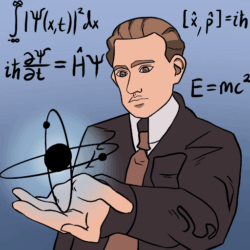
Have you ever heard “quantum” in your favorite TV show or from your favorite superhero and been captivated by the awe of what it entails? Even if you are not pursuing physics, I am sure that you have some conception of quantum mechanics — some vague sense of trepidation, puzzlement or awe. Certainly, quantum mechanics lends itself well to this feeling: the uncertainty principle, entanglement, superposition and wave-particle duality. These principles tell us of intrinsic theoretical uncertainty in the most fundamental fabric of reality. And, let’s face it, we don’t like encountering uncertainty. I could ask you to choose between two nearly identical phrases as to which elicits a more profound feeling: field theory or quantum field theory, consciousness or quantum consciousness, space or quantum space. That very opacity of scientific terminology begets our imagination, giving us free rein to speculate about, and thereby reinforce, the linguistic potency of even nonsensical usage of scientific language.
How, then, do we distinguish between a scientifically warranted term and an unwarranted rhetorical one? Looking at “quantum,” we can define it rigorously within its own scope; borrowing from Merriam-Webster, quantum, as an adjective, means “of, relating to, or employing the principles of quantum mechanics.” Merriam-Webster also lists a second definition: “large, significant.” This second definition would seem to imply that “quantum,” at least, has some claim to figurative usage in a particular context. However, I think you would be likely to agree with me that when someone uses the word quantum, our first thought often concerns something vaguely complex and theatric like symbols revolving around someone’s head as they ponder something deep, rather than something being large. We can now, with a proper definition, hold a magnifying glass to quantum’s particular contextual usage and ask meaningfully about its validity.
Pop culture is full of instances of scientific terms and phrases being used to invoke the recognizable authority of science without always sticking to their original definitions. Screenwriters, especially, frequently utilize science terminology to signal a character’s intelligence or bolster the plot’s perceived plausibility. This is evident in the highest-grossing film of all time, “Avengers: Endgame,” where Tony Stark creates a “Time-Space GPS,” which allows characters in the quantum realm to navigate through time. Art is by no means required to adhere strictly to purely physical reality — science fiction would suffer tremendously if so. However, its use at least suggests that scientific language confers upon some logical foundation, even if divorced from the thorough empirical and mathematical process of science.
But why do we find this convincing? I know that I have at times found some of these phrases engaging, even when I can recognize the disconnect between what is being said and the actual science it is attempting to invoke. At best, this is a trivial ignorance that permits us to enjoy science fiction, but at worst, this seemingly harmless association can be exploited by bad-faith marketing to mislead people about the scientific rigor of projects or practices. This is why science communication is so important; the wider this gap between scientific work and public understanding becomes, the easier it is for scientific language to be mistaken for scientific evidence.
A 2025 study published in Nature Human Behaviour found that “jargon increases satisfaction because laypeople assume the jargon fills gaps in explanations that are otherwise incomplete.” The study found that jargon elicited a positive response even while simultaneously decreasing comprehensibility. This suggests to me that the more unfamiliar we are with the science being referenced, the more room the cultural associations and our own speculative imagination have to determine our perception of it. As long as a word sounds sufficiently complex that we could imagine it remedying some mode of failure, we can be fooled by it. Do not be worried, dear reader, for I have a quantum warp drive for just such an occasion.
To understand what quantum mechanics actually is, we must first know what it is not. It is easy, with a technically demanding field, for people to misinterpret or extrapolate some conclusions from quantum mechanics. “Quantum” has a very close linguistic relation to quantization. This can lead to the misconception that quantum mechanics describes the entire universe as discrete — as if reality has a finite resolution. While it is true that certain quantities, like energy levels in atoms, are discrete, there are also many variables that aren’t discrete, and quantum mechanics does not indicate that space is discrete.
Why, then, is “quantum” so often the word of choice? Quantum isn’t an especially long word with an uncommon linguistic root, but it is culturally loaded, carrying the weight of a rather intriguing 20th-century history. Quantum mechanics is known to defy our everyday intuitions about reality. Perhaps the most significant of these clashes concerns measurement. Experimentally, particles have been seen to behave differently when they are subjected to measurement — most famously in the double-slit experiment, where the interference pattern of particles changes when we put a measuring device on the other side of one of the slits. This helps explain why “quantum” so often serves as a modifier for the mysterious, the incomprehensible and the profound.
The figures of quantum mechanics are themselves also rather larger than life: Werner Heisenberg, Erwin Schrödinger, Paul Dirac, Max Born and Niels Bohr, all of whom were named Nobel Laureates for their contributions to atomic and quantum theory. Heisenberg was only 23 when he formulated the first rigorous mathematical form of quantum mechanics. The field was enough to unsettle even Albert Einstein. He was seriously disturbed by the probabilistic nature of quantum mechanics, believing that the theory was incomplete because all of his experience with classical theories said that if one knew all initial variables in a system, they could determine all future behavior — yet quantum theory disobeyed this principle. When one uses “quantum,” it digs up this turbulent and transformative history — and apparently borrows some of this legacy’s authority in the process.
Quantum mechanics is a remarkably successful theory, and it produces incredible results and models of subatomic particle behavior. It makes it all the more ironic, then, that modern culture has misappropriated “quantum” to lend credibility and mystique to unrelated ideas and practices in order to make them seem more interesting. Quantum mechanics is not under any threat of collapse from the revocation of the word we use to describe it.
Dylan Bennett is not falling for this quantum trap.