
Simply Stated: Researchers discover that the human brain is two separate organs
October 15, 2026 at 10:00 am
For centuries, it has been accepted in neuroscience, medicine and common understanding that the human brain is a single organ. In fact, theories about the structure and function of the brain began as early as 335 B.C. Earlier this year, however, researchers at Stanford Medicine published their findings on a groundbreaking discovery: the brain is two separate organs.
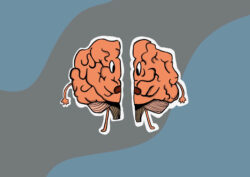
Stanford graduate students Carolyn “C” Dundes and Rayyan Jokhai, advised by associate professor of developmental biology Kyle Loh, led an investigation into brain formation during embryonic development. While studying developing mouse embryos, they identified two different types of cells bound to form entirely different portions of the brain: the forebrain, midbrain and hindbrain.
The forebrain and midbrain are responsible for higher-order thinking, decision-making and processing sensory inputs, while the hindbrain regulates motor coordination and essential processes such as breathing and heart rate. It was found that the forebrain and midbrain originate from progenitor cells — cells that can differentiate into multiple specialized cell types — that express the OTX2 gene, while the hindbrain evolved from cells that express the GBX-2 gene. These genes inhibit each other’s expression, forming a sharp boundary between the functions of these separate brain regions.
Over millions of years, these two systems evolved separately before joining together to form what we know to be the human brain. Dundes and Jokhai also found that this double-origin brain is present in multiple different species, from chickens to acorn worms.
This new discovery has great implications for the treatment of neurodegenerative diseases — especially ones that impact the brain stem, like amyotrophic lateral sclerosis (ALS) and spinal muscular atrophy (SMA), which tend to significantly reduce patient life expectancy. Previously, research on these conditions had been hindered by the fact that scientists were struggling to create hindbrain neurons in the lab.
This study revealed that the previous methods of creating hindbrain neurons — likely, attempting to coax forebrain/midbrain progenitors into becoming hindbrain cells — were unsuccessful because forebrain and midbrain progenitors are fundamentally different from those of the hindbrain and therefore incapable of becoming the latter. With this newfound knowledge, the researchers were able to develop functional hindbrain motor neurons from human pluripotent stem cells for the first time, carving out massive potential for research on treatments for neurodegenerative diseases.
The human brain is an amazing and complex structure that helps us think, create and innovate while keeping us alive behind the scenes. The next time you’re making a difficult decision or struggling to wrap your head around something, just know that you have two brains to help you out.
A version of this article appeared on p.11 of the Oct. 15, 2026 edition of the Daily Nexus.