
When Film Keeps it Reel, We Get Loud: UCSB’s 35th Annual Reel Loud Film and Arts Festival
By Yogita Sharma and Daisy Hernandez
June 27, 2026 at 8:53 am
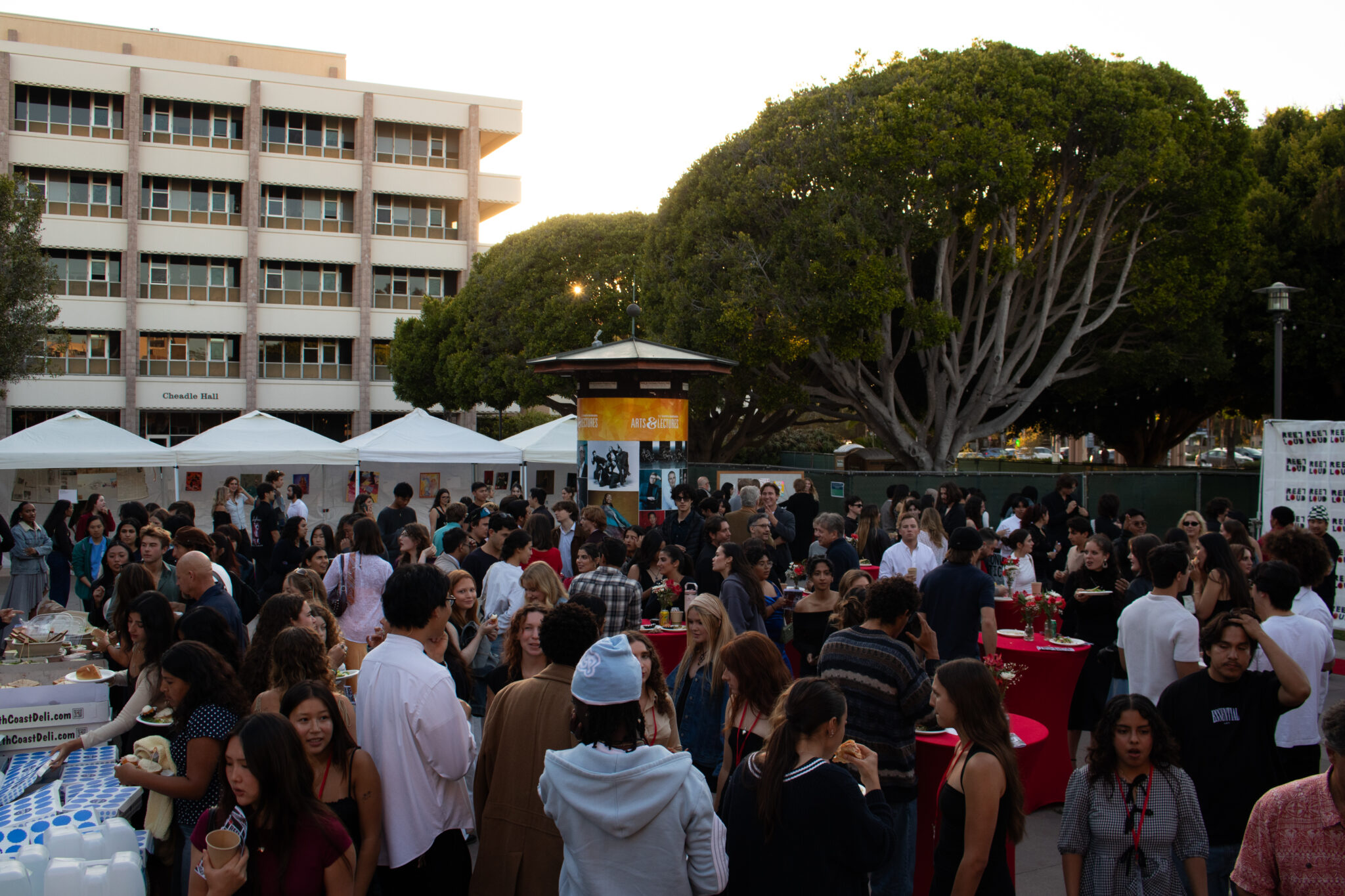
The mystery at this year’s UC Santa Barbara Reel Loud Film and Arts Festival didn’t solely revolve around the stolen trophies, it centered on how dozens of student filmmakers, musicians and organizers managed to pull off one of UCSB’s most ambitious creative events.
The 35th annual Reel Loud Film and Arts Festival returned to Campbell Hall on May 29 with a “Whodunit” theme, pairing student-produced silent films with live musical performances. Throughout the evening, detectives chased suspects, horror scores heightened suspense and musicians transformed silent films into fully realized stories.
For many participants, the festival represented months of work before finally reaching a wider audience.
Venue Coordinator Bryn Merrill, a third-year film and media studies major, said planning began during fall quarter, with organizers spending months coordinating musicians, filmmakers, marketing efforts and event logistics.
“It’s been a project in the making,” Merrill said. “We had an obstacle with the school and the school’s funding for this project, so that was a little frustrating … working with [Associated Students] has been difficult too, so I don’t feel as supported by the institution.”
Despite those frustrations, organizers repeatedly returned to the sense of community Reel Loud creates.
Rafael Sierra, a second-year film and media studies major, received the night’s Scott Wells Golden Reel Award as the writer and director of “A Stop of Nothing.” He remarked on the interdisciplinary coordination of the festival.
“One brilliant, special aspect of all this is the live music, not just the films but also the intermissions, all the different bands that got to play, the a cappella, all super talented artists and it was super cool that we mixed film and musical arts,” he said.
That crossover was evident throughout the evening, from solo piano performances and rock bands to a cappella groups and electronic musicians. Every performance became part of the storytelling process, turning silent films into live collaborative experiences.
Even accomplished industry professionals recognized the value of that environment.
Academy Award-winning Film Editor and UCSB alum, Andy Jurgensen, attended Reel Loud as a judge for the first time since his student years.
“It all starts with taking the first class,” Jurgensen said. “It doesn’t happen overnight … I look so fondly at making these little shorts and the stories you have that we still reminisce about 20 years later. I’m going to see a friend tomorrow and we’re for sure going to talk about our Reel Loud days.”
Former Radio Links Hollywood President, News Director and Radio Broadcaster Lori Lerner Gray presented a short public service announcement about the risks of colon cancer along with the Scott Wells Golden Reel Award in memory of her son, Scott Wells — a UCSB film and media studies alum who died of colon cancer in 2012.
“When Scott died, we decided to gift the University and the students, so I’m here to present the Scott Wells Golden Reels Award,” she said. “I’m really encouraging these young people to continue to follow their passions, follow their dreams, it’s challenging but it always has been … I know that the world is very complicated now but I think we’re going to do ok being here and seeing all of you.”
While audience members experienced the polished final products, many filmmakers described productions shaped by problem-solving and improvisation.
Fourth year film and media studies major and director of “Out of Time,” Kammy O’Brien, taught herself visual effects while simultaneously serving as the writer, producer, editor, costume designer and a production designer.
“At the beginning of this process, did I know how to do it? Not at all,” O’Brien said. “Do I know how to do that now? Yeah.”
Then came screenings of student made films “Muse” and “Driftaway,” with bands covering well-known songs like “Weird Fishes / Arpeggi” by Radiohead. After a quick comedic intermission, the MC duo hosts ended with a sigh of disappointment, pun and the name of the next performing band, Good Grief.
After a successful run of Daft Punk covers, the band transitioned into playing music for “Bandwidth,” their self-referential silent film depicting tiffs between their members moments before they head on stage to perform. This meta performance facilitated conversation through their instruments with screeching guitars shouting back and forth with an annoyed keyboard.
This dynamic performance preceded additional student works “Don’t Smoke in Bed” and “Rabbit Hutch,” where both featured solo piano performances. “Rabbit Hutch” took the Best Musical Performance Award for the night.
“In Her Shoes” brought lively, more lighthearted energy back into the audience with the piano’s playful exaggerations sticking out in the three person band.
“Mi Corazon” featured an a cappella performance, the film itself consisting of an animated skeleton traversing the streets of Isla Vista, being the first technically bilingual act of the night, excluding the abstract music speak performed by “Bandwidth” for their own film earlier.
Then came “The Attendant” — written, directed and produced by Santa Barbara City College student Joseph Alzubaidee — which was the night’s Audience Choice Award winner.
Before the film could fully begin, technical difficulties interrupted the screening. The audience rallied behind the performers with one person shouting, “You got this,” and the theater erupted into cheers and applause of support.
The band started over even as the screen struggled to cooperate. When the projection finally returned, the audience was already on the film’s side.
The film blended purple-blue visuals into a comedic drama, a story that slowly revealed itself as an allegory for addiction. The panicked sequence ended with Radiohead’s “Exit Music (For a Film)” swelling as the main character met a wall and was forced to confront the smoke of his last Lucky Strike cigarette. The moment turned the film from playful chaos into something much more real.
Alzubaidee said the road to the performance was anything but smooth.
“My piano player, I got her two days ago and she learned the song in 48 hours,” Alzubaidee said. “And then my bass player dropped today due to unforeseen circumstances, so I had to find another bass player five hours before the show.”
Despite last-minute obstacles, the film received one of the strongest responses of the night, with several audience members rising for a standing ovation.
“Anything is possible if you put your mind to it,” Alzubaidee said. “I’m 18 years old, but my mind is older,” throwing in a cheeky “Shook Ones, Part II” reference.
“Love of the Game” put their own unique spin on the music obligation by integrating a live DJ, ending the film with a reference to Kobe Bryant’s iconic poem, “Dear Basketball.” Their remarkable efforts culminated into the Best Edit Award.
“HAMMER DEATH” followed with the all too relatable, test-anxious reality of finals week fast approaching.
The festival’s top honor went to “A Stop of Nothing,” which won Best Film and Best Cinematography. Sierra said the best part of the night was seeing his film placed alongside the work of other student filmmakers.
“Every single one of those crews and those filmmakers smashed it out of the ballpark,” he said. “It was truly an honor to have my work up there on the screen with theirs.”
Roisin Casey, a second-year film and media studies and Italian double major who worked as the film’s art director and costume designer, said watching the audience respond was especially meaningful after spending so much time behind the scenes.
“It’s one of the most fulfilling feelings to see your work come to fruition on the big screen,” Casey said.
For Sierra, the festival’s strength came from a combination of film and live performance.
“It’s such a great display of how all the arts can come together and unify into this really cool festival,” Sierra said.
By the end of the night, the mystery had been solved, the awards had been handed out and Campbell Hall was still buzzing. “Love of the Game” cut sharply enough to win Best Editing. “Rabbit Hutch” had played its way into Best Music. “The Attendant” had survived technical chaos to win over the crowd. And “A Stop of Nothing” had left with the three of the festival’s awards.
But for the students who spent months bringing Reel Loud to life, the evening represented something bigger than trophies, it was proof that with enough creativity and collaboration, a silent film can make quite the statement.