
NASA directors talk research, funding and future at UCSB
June 11, 2026 at 9:26 am
National Aeronautics and Space Administration Directors Richard Cook and Troy Asher spoke as part of UC Santa Barbara’s Coastal Conversations series on May 26.
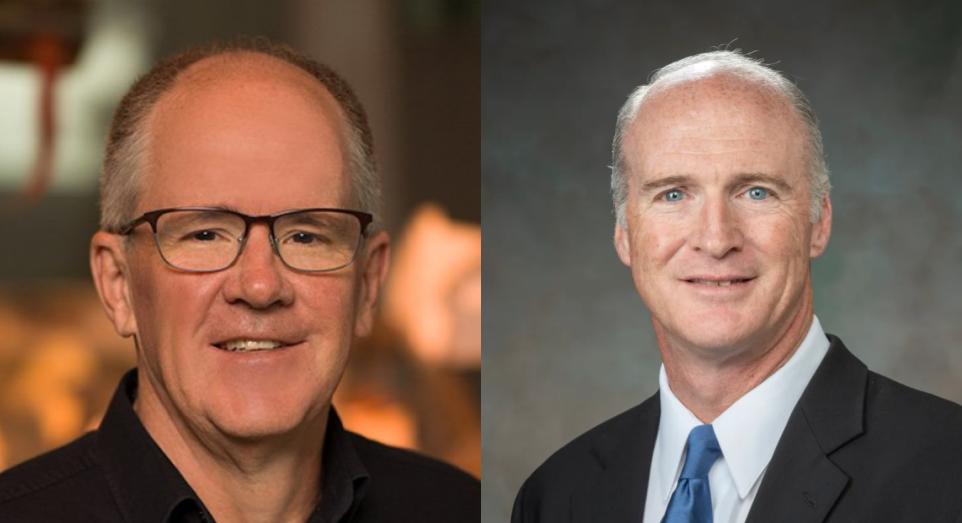
The speakers discussed a variety of topics, largely focusing on the National Aeronautics and Space Administration’s (NASA) future goals, the value of innovation and collaboration in NASA’s work and the importance of space exploration. Moderators and speakers also discussed the impact of politics and federal policy on NASA’s operations and funding, as well as the tradeoffs between public and privatized space exploration.
Cook is the associate lab director for strategic integration at NASA’s Jet Propulsion Laboratory, and Asher is the acting center director at NASA’s Armstrong Flight Research Center. The talk was moderated by third-year mechanical engineering and physics double major Eddie Barajas, and fourth-year political science, philosophy and Germanic and Slavic studies triple major Josie Penix.
A large share of the conversation centered around NASA’s future space exploration goals. Cook spoke about his wish to finish the Mars Sample Return (MSR) mission, which aimed to collect rock and dust samples on Mars and return them to Earth for extensive analysis. This mission was in progress for several years, but was ended by a compromise on a Congress spending bill amidst concerns about the mission’s high cost in proportion to NASA’s science budget.
“The challenge of Mars Sample Return is [that] it’s hard enough to send something to Mars just to go one way. We’ve kind of gotten good at that over the last two or three decades, but to bring it back really represents a big step forward,” Cook said. “And if you think about how hard it is just to bring back a basketball-sized capsule of rocks, can you imagine taking humans there and back? It is a challenging problem.”
Despite these difficulties, Cook said he sees a potential way forward by using modern industry capabilities to streamline NASA’s process and allow the agency to focus on the most challenging aspects of their work.
“Imagine taking [a rocket] to Mars, getting it to survive the time there, getting it to survive the cold temperature and then launch and then finding the capsule that gets put up into orbit around Mars. That’s the part that NASA should really be focused on,” Cook said. “There’s other pieces of it where I think we can rely on industry to do more of that. We need to push harder to do things differently.”
Barajas mentioned that NASA last went to the moon in 1972, and asked how NASA motivates itself to keep pace and continue working on developing projects.
“There’s not always an economic incentive to keep doing it,” Cook said. “Part of the challenge in everything we’re doing now is to not turn the next decade into 1972, where we decide we’ve gotten what we wanted to do. We need to sustainably build for a future economy in low Earth orbit, or on the moon, or wherever. In the end, that’s what drives progress: economic benefit. So we’ve got to keep pushing in that direction.”
Cook discussed the idea of developing a lunar base, or a long-term human settlement on the moon.
“There are lots of reasons that it’s good to think about having a lunar base,” Cook said. “It’s good to have the National Space Policy focused on that because it makes it really clear; certainly, we are in a race for national or international leadership and we need to step up to that. But I also think there are economic benefits to building a permanent lunar base, not just in terms of developing industry here on the Earth, but hopefully eventually tourism or energy or other things like that on the moon. Prioritizing that and focusing on that is a sustainable thing.”
The speakers emphasized the importance of incorporating younger workers into NASA’s workforce as part of the agency’s vision for the future.
“I’m really excited about where NASA is going, and I hope all of you guys are too. It’s kind of a whole new age,” Asher said. “A lot of us have been around for a long time … Changing the culture requires really turning over into the younger generation. I think that’s what’s super important.”
Barajas asked the audience to raise their hands if they had applied for a role at NASA, and multiple members of the crowd raised their hands. He then asked if any audience members had secured a position, and almost no hands were raised. The speakers responded that it is difficult to meet NASA’s hiring standards and discussed the value and tradeoffs of pursuing a master’s degree or a doctoral degree in order to work at NASA.
“I do think that the amount of education you can absorb in four years is actually limited. There’s just too many other things you have to take, and so I think that extra year or two is super important,” Cook said. “I’m less convinced about a [doctoral degree], only because a lot of people who do it become very narrow in their focus … A master’s is a good balance between working and spending too much time in school.”
Asher said that he feels the choice depends on one’s research goals at NASA, adding that fundamental research can require comparatively more education than applied research.
Asher, who served as an officer and pilot in the United States Air Force for 20 years before retiring in 2008, also advocated for the benefits of military experience when pursuing a NASA career.
“What I see most from people who come from military backgrounds is that the military really teaches leadership,” Asher said. “We get people who know who they are. They know how to lead other people. They’re very effective team members. They know how to work on teams. All of that gets drilled into you in the military after a couple of years, and you come out as a very strong team member.”
Barajas asked how NASA addresses workforce competition with private industries, where companies often pay employees and interns far more than a government agency like NASA is equipped to pay. Asher said that NASA does lose talent to private industry but that there are good reasons to work for each type of company.
“What we’re building at NASA right now is something that I hope will be attractive to people,” Asher said. “In my case, coming out of the Air Force, I could have gone and made two to three times more money than I make working for NASA. But then again, I don’t get to fly … The lifestyle is different. The work environment is different. Sometimes that bigger paycheck may or may not be worth it, depending on the environment you’re working in.”
Cook added that NASA plays a unique role because its goals and projects are not motivated purely by business factors, but also by their drive to explore and develop new scientific tools and skills. He said that, while working on projects like the experimental supersonic aircraft X-59 may not be attractive to commercial companies from a business perspective, NASA is motivated to pursue these projects. Once NASA accomplishes something, he said, other companies can follow in their footsteps and build upon NASA’s work.
Barajas asked about the time and effort NASA must spend advocating for funding from Congress, which provides nearly all of the agency’s primary discretionary budget authority, or the legal permission that allows government agencies like NASA to spend money on programs that they choose. Cook responded that while politics have some impact on their operations as a government agency, he does not feel that NASA is excessively impacted by happenings in the political sphere.
Cook expressed that he feels both major political parties support NASA’s work and its advancement of America’s status and capabilities, and that NASA”s work is “surprisingly bipartisan.”
The speakers also discussed NASA’s response to funding changes. Asher said that while it can be difficult to cope with shifts in funding, he feels that NASA is able to remain motivated despite uncertainty.
“You have a team that’s working on a project, dedicated to it sometimes for a number of years, and then you’re at the mercy of a funding cycle. So that’s a stressful part of what we do in an organization like that,” Asher said. “I think it’s important to keep your resilience and tenacity up and stay the course … This is what our administrators call the golden age of exploration right now.”
Barajas asked the speakers what project they would want to work on if NASA hypothetically possessed unlimited funding. Cook responded by recounting a mission he worked on previously which involved a lander on Europa, one of the moons of Jupiter. “A Europa lander was going to look for the potential for life in the subsurface ocean of Europa,” he said. Cook expressed that he is interested in searching for extraterrestrial life.
Both speakers testified to the value that NASA places on teamwork, describing NASA’s work and successes as deeply reliant on trust and collaboration.
“Once you see all of that work you just did, and it was maybe painful and long with a lot of long nights and early mornings, but then you see that thing go and you realize it took a team effort and you were part of that, that makes it all worth it,” Asher said.
Play solitaire and experience one of the world’s most iconic card games, featuring simple rules, addictive mechanics, and countless unique layouts that keep every game fresh and entertaining.