
Lisa Phillips advocates for survivors of sexual violence, speaks against Jeffrey Epstein
By Levi Kauffman and Iris Guo
April 15, 2026 at 11:54 am
TW: This article contains mentions of sexual assault.
Podcaster and sexual assault survivor Lisa Phillips shared her story of recovering from sexual abuse and seeking justice on April 8 at Isla Vista Theater. Around 250 people attended to listen to Phillips speak about the abuse she experienced from Jeffrey Epstein and answer questions.
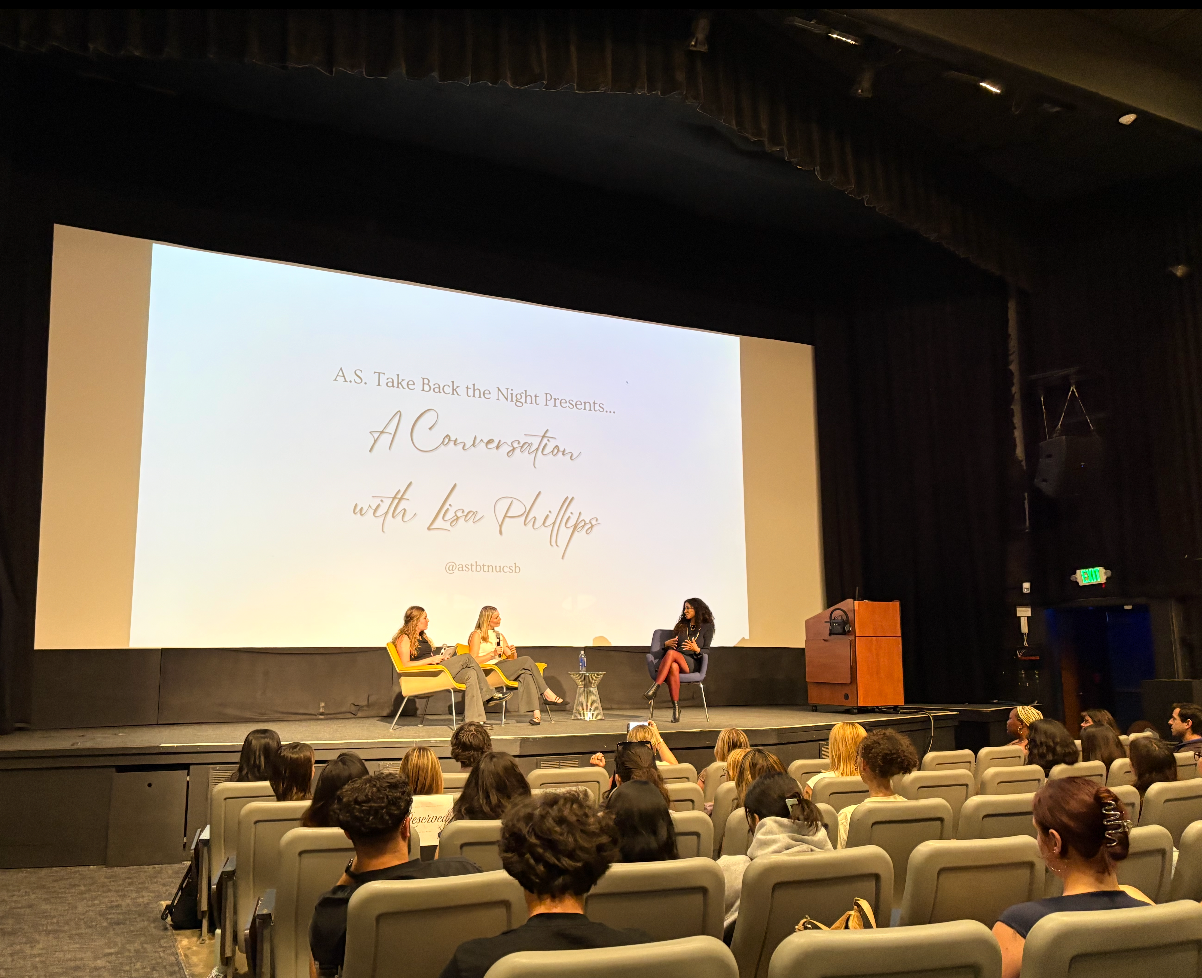
Associated Students Take Back the Night (TBTN), a student group dedicated to ending sexual violence, hosted the event. In honor of April being Sexual Assault Awareness Month, TBTN is hosting several events throughout the next few weeks to educate students. TBTN co-chairs and history of public policy and law and sociology double majors, fourth-year Kayla Goodin and third-year Cameron Curtin, moderated the discussion.
According to TBTN campus outreach director and second-year feminist studies and global studies double major Valerie Tan, it was a “one-off” to have Phillips visit UC Santa Barbara and share her story.
“Lisa was so willing and excited for opportunities like these to speak about her story and remind everybody that [college age] is one of the prime ages for sexual assault to take place,” Tan said.
At the turn of the century, Phillips was working as a model in New York when a fellow model invited her to convicted child sex offender Jeffrey Epstein’s island, Little Saint James, where she was first sexually assaulted by him. For the next couple of years, she would continue to be regularly assaulted by Epstein while working under Ford Models, a highly prestigious agency at the time.
According to Phillips, Ford Models hired her based on a recommendation from Epstein, a tactic she now describes as “grooming.” She described the modeling industry at the time as “kind of a sex trafficking ring.” Phillips also explained that Epstein’s sex trafficking operation involved victims recruiting other girls and women, which is how she became acquainted with Epstein.
“The 14-year-olds were brought by other 14-year-olds. The 20-year-olds were brought by other 20-year-olds. That’s the way he operated it. It was like a genius plan to make you feel like you’re complicit and that you were part of the problem,” Phillips said. “I’m very good friends with a lot of Epstein survivors and unfortunately, most of them were brought in by other friends or other people the same age as them. So it’s a confusing thing, but we all have accepted the fact that we don’t blame them for it.”
Phillips said she chose to keep quiet about her experiences to protect her career and out of shame. Despite separating herself from Epstein in the late 2000s and starting a family, Phillips described the emotional release she had upon finding out about Epstein’s death in 2019.
“It was a moment where I just started crying and I was hyperventilating and I didn’t understand that weight that was finally lifted off my shoulders,” Phillips said. “I was scared of him all those years, so it was a time where I said, ‘Okay, I need to start figuring things out.’”
Shortly after Epstein’s death, Phillips would join other survivors like Virginia Giuffre to begin speaking about her experience and advocating for justice. She was able to find a supportive community among other survivors, which has helped her cope with her trauma and understand that “there is no real perfect survivor.”
“When you have something that you’re maybe ashamed about, something that happened to you, you need to find the right people to talk to,” Phillips said. “You can’t judge survivors anymore, you just can’t, because you don’t understand the grooming that goes through. Child abuse and domestic violence and serial predators and college campuses, that’s usually kind of a grooming process. That’s a false pretensive that you don’t have to be ashamed of anymore.”
Phillips was asked about how the media can impact survivors coming forward, to which she said that she believes recent years have been the “first time in American history” that people have begun to pay attention to survivors of sexual violence.
Over the past year, the Department of Justice has censored and withheld many files related to the Epstein case, including after the passage of the Epstein Files Transparency Act in November 2025. In light of this, Phillips said that justice would be a “deeper understanding and education” around sexual violence. She also urged the next generation to use the resources at their disposal to make a difference in empowering survivors.
“I have a voice because I put myself out there on Instagram. I’m not trying to be an influencer, I’m trying to influence you to do something. It’s a shift right now and you have the power right now to make the changes,” Phillips said. “I think you just have to find that you’re in power somehow and it just starts by kind of owning your true, real story about yourself.”
Following the discussion, members of TBTN asked various questions submitted by attendees. An attendee asked Phillips about how people can recognize grooming. Phillips responded by saying that these situations can be similar to Stockholm syndrome, as victims may be threatened and manipulated by abusers to remain silent, and encouraged victims to tell anybody they’re close to about what has happened to them.
“[Abusers may] say something to get you on their side, so that keeps you silent, because grooming and sexual abuse only happens in silence,” Phillips said.
Another attendee asked what Phillips believes to be the best way for the public to advocate for survivors, and said that offering support and empathy over social media platforms is a good way to support them. She emphasized that attending rallies and contacting local representatives can be impactful, as this could lead to the passing of legislation that could enable survivors to pursue justice against their abusers.
The event concluded following the Q&A session. Goodin and Curtin recognized that audience members may have experienced sexual violence, and reminded them that they are not alone and that there are resources for them on campus, including UCSB Campus Advocacy, Resources & Education Center (C.A.R.E.).
“Approximately 13% of all students experience rape or sexual assault on campus, 26.4% of female undergraduate students, 6.8% of male undergraduate students, 21% of nonbinary students and that’s just what goes reported,” Curtin said. “We hope that this conversation has begun to elevate survivors’ voices and create a culture of consent at UCSB.”
A version of this article appeared on p. 4 of the April 16 print edition of the Daily Nexus.

