
SBSHC provides alternative affordable housing to students
May 22, 2026 at 11:15 am
In the midst of a housing crisis, students may stress about securing housing in Isla Vista. With the average rent of a one-bedroom apartment in Isla Vista exceeding $2,000, some look to alternatives in the form of a housing cooperative.
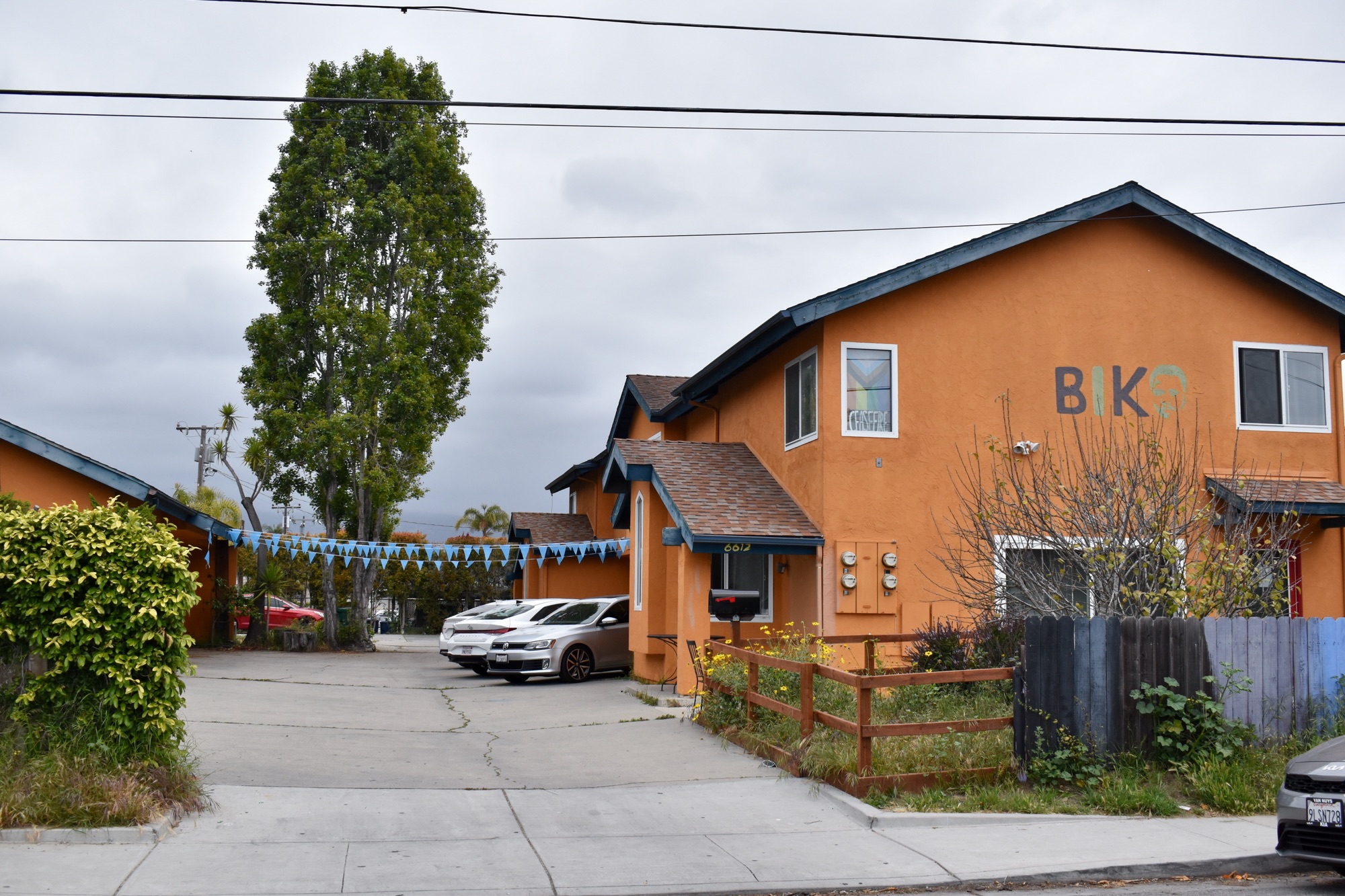
The Santa Barbara Student Housing Cooperative (SBSHC) is a non-profit organization that aims to provide affordable housing to all students living in I.V. SBSHC houses students through their five houses: Biko, Dolores, Manley, Merton and Newman.
Marcelino Sepulveda, SBSHC’s executive director, explained the cooperative is best for students looking to find community along with a place to live.
“We’re a good fit for community-oriented students,” Sepulveda said. “Students who are looking for more than just a place to sleep, who value shared meals, collaboration, meaningful relationships and participating in community life.”
In I.V.’s housing market, SBSHC works to keep member dues below the average local rental prices. According to Sepulveda, the co-op looks at multiple measures of affordability, including I.V. rents, UC Santa Barbara dorm rates and federal housing standards. He said member dues “average approximately 70% to 80% of comparable I.V. rental rates” and around “60% of UCSB dorm rates.”
The co-op also keeps costs lower through flat-rate utilities, shared purchasing, general-use food funds, furnished common spaces and internal rent grants for members in financial need. Four of the co-op’s properties also have solar panels, with utility costs “socialized across all of the houses.”
“We’re a nonprofit, which means that anything, any profit that is generated is invested back into the organization,” Sepulveda said. “Nobody is profiting off of it. So all of the benefits go back into the services that we provide.”
Anbareen Schefa, SBSHC’s director of member services, explained that the co-op only has about 95 bed spaces, however they usually have the most availability during summer. She also emphasized that the co-ops only offer single or double spaces, in contrast to other properties that may advertise lower costs in exchange for overcrowded rooms.
“It’s not like we’re just artificially deflating our rates by saying, ‘Okay now there’s 60 people in this house that’s meant for 20 people,’” Schefa said. But living in the co-ops also requires more participation than a traditional apartment. Sepulveda explained that members take on house roles such as treasurer, food shopper, maintenance manager, board representative, house president and chore manager. They also contribute to house meetings, community work days, shared meals and chore systems.
“This is what differentiates us from other housing providers,” Schefa said. “It’s actually baked into your lease that you need to take on a leadership position within your house — that you need to do chores [and] you’re gonna be attending house meetings.”
The way the houses are governed also reflects this collective structure. SBSHC has a board of directors elected from within its membership. The board is responsible for setting the fiscal year budget, updating policies and signing financial statements. Schefa explained that “on a day-to-day level,” residents help manage the operations of their own homes.
“When you move in, you’ll get elected into a role,” Schefa said. “Everybody does a little bit of something to keep things going. You can think of the phrase, ‘Many hands make light work.’”
According to both directors, creating a sense of community is an important part of the co-op. Schefa lived in the co-ops from 2013 to 2017 and said she is still close with many of the people she met there. She currently still lives with the first roommate she was assigned to in the co-op, now over a decade later.
“I’m still really close in community with a lot of the people I lived with,” Schefa said. “I think [that] is a testament to how close you can really become with people that you live with in the co-ops.”
Each of the five houses has its own culture and theme. Merton is an interfaith-themed house, while Biko has been known as a people of color-identifying house. Staff emphasized that these identities developed through student leadership and the communities within each house but they are still open to all students.
Though each house has its own identity, Schefa described the co-op as an “interdependent community” rather than five disconnected spaces. Members collaborate across houses, and the organization is designed to keep the houses connected.
Sepulveda emphasized the students who live in the co-ops see themselves as a “resource to the community at large.” He explained the origins of the co-op came from students demanding housing during the ‘70s.
“I think the co-ops are a testament to the actual power that students do wield and that they do hold,” Sepulveda said. “We’ve grown from a handful of students who were visioning for something better, and we’ve housed thousands of students in those 50 years [since SBSHC’s creation].”
A version of this article appeared on p. 5 of the May 21print edition of the Daily Nexus.
Back when I was attending UCSB some (56) years ago, one could rent a summer two-bedroom apartment on Sabado Tarde for just $50/month! Can you believe it?! Room, board, books and tuition ran just $1500/year! Of course, the going minimum wage was just $1.35/hr. and a gallon of gas ran about 50 cents. Homes In prestigious Hope Ranch were going for around $50,000.00. Now, the campus is jam-packed with buildings, crowding out much of its original natural ambience. From my perspective, UCSB has lost a little bit of its unique charm. Is this really PROGRESS? Those were the good ol’… Read more »
Just remember why this facility exists in the first place—for the military industrial complex!
The Final Countdown–The Ultimate Tragedy of the Military Industrial Complex The sky is a cracked eggshell, leaking its yolk over assembly lines that hum like fevered bees. Men in pressed uniforms stitch shadows into the hems of their jackets, pretending not to hear the ticking. I wake to the metallic breath of morning, the sun a blind searchlight sweeping across continents of unspoken grief. Factories cough out their iron lullabies, each note a promise of ruin polished to a shine. Children draw crayon soldiers with hands too small to hold the truth. Their mothers fold laundry, pairing socks like matching… Read more »
Funny–I see some of my old streets from Anaheim and Walt Disney Elementary School here—Brookhurst, Ball Rd., Gilbert!
I hope that the Angels and Texas Rangers are still able to play at the BIG A this evening. GO HALOS!
Orange County Fire officials have confirmed that the tank’s internal pressure is rising. From my viewpoint, it appears that it is not leaking fast enough for the pressure to subside internally–it’s going to explode.
This is a highly flammable MMA.
Chemical formula: C5H8O2.
The internal pressure in the tank is climbing roughly 1o/hour, hitting presently 90oF.7,000 gallons are currently inside the tank. The Governor has declared a state of emergency in Orange County. This has all happened because greedy housing developers have built so close to this facility!
The boiling point of the MMA is less than half that of water, so it is critically getting close to its boiling point, In another day or so, it should boil. It is an exothermic reaction, meaning that it releases heat in a
“runaway spiral effect.” We shall all soon see if the tank actually explodes or just leaks the 7,000 gallons into the surrounding groundwater system. Either way, this is a colossal tragedy. The local
police have since established a crime tip line.
Correction: it is an exothermic reaction–it is solidifying, ready to explode, like dynamite.
GKN Aerospace is a major supplier for:
NASA
U.S AIR FORCE
U.S. NAVY
DEFENSE CONTRACTORS (Lockheed-Martin, Boeing, Northrop, etc.).
Happy Memorial Day to all those out there in cyberspace!
Way to shine on your way to “COSMIC SYNCHRONICITY”!
“As ye sow, so shall ye reap.”
GKN Aerospace paid nearly $1million to settle 2021 environmental
violations! Dozens of law firms in Orange County say that they are going to file class-action lawsuits!
While they’re at it, maybe ICE should be there checking legal staus!
The temperature inside the tank has now maxed out the temperature gauge @100oF–officials have no idea now how hot it really is inside!
The crack that they discovered won’t help–they’re just trying to allay the public fears at the moment.They desperatrly need to puncture sustantially the bottom of the tank fast!
Research shows that methyl methacrylate is toxic to the unborn fetus!
Rest assured a lot of expectant mothers in that area will be filing lawsuits attempting to bankrupt this corporation.Will this company be left off the hook by filing bankruptcy? I bet they do and taxpayers will be left holding the bag! Very,very sad state of affairs…
Maybe grizzled old J. Marc McGinnes and his EDC will eventually get
involved with one after the smoke clears. At this point in time, I most certainly hope so! It’s a very high-profile case and he likes those especially! I wish him the best, as always. I can hardly wait for July to come upon us in splendor!
The CEO of this parent company made $60 million in bonuses in just 2024 alone! Why isn’t he helping fund the shelter costs for the 50,000
people displaced?!
So glad to hear this morning from officials that the threat of a BLEVE
is now off the table–the internal temperature now sits @93oF. What a relief for millions of people!
What is wrong with you- you arent a student dont go here and yet spend a huge amount of time ranting and raving on the college newspaper about nothing. Please get help
5/27/26 Wed.-12:47 PDT
2.2 temblor strikes just one mile from the tank fiasco!
COSMIC SYNCHRONICITY here? This is beyond the realm of mere concidence!
Depth of temblor-13.50 miles. The Caltech.edu waveforms show me serious anomalies below 20.0 km! Only I am privy to those secrets! I read them like a dolphin or snake!
The facts always speak for themselves, Anonymous–they have a strange devious way of leaking slowly into the collective unconscious.
I have really nothing more to say at this point.
Since the Council of Nicea (325 AD), mainstream Christianity, after brutally butchering thousands upon thousands of First and Second Century Gnostics, has denied to this day the “living Christos” within each of us, much to our present dystopian detriment, eh? Look now what is upon us! A new war against Iran has thus begun today!
The conflict with Iran is progressing through an archetypal cycle of sudden shocks and volatile negotiations, driven by a Mars-Uranus
activation reflecting rapid technolofgical warfare and geopolitical
turbulence.
Sudden strikes and standoffs are triggered by hard aspects bewteen Mars and Uranus, leading to technological and asymmetric warfare tactics.
Looking at this in greater depth, may I suggest, “The Astrology of the Iran War,” by Emma Love Arbogast?
Early July is now being flagged as a potentially very dangerous window!
Uranus moving into Gemini impacts all major players. The US has Uranus @8o Gemini. Uranus in Gemini corresponds to the most intense wars that the US has ever fought (i.e. Civil War and WW II).
The Mars-Uranus conjunct will occur this coming July 3rd.
80% of the people living on the Indian subcontinent believe in astrology!
Wow you are bat shit crazy.
Housing cooperatives can be a practical option when rents keep climbing faster than student budgets. A friend lived in a co-op during college and liked having lower costs, a built-in community, and a schedule for household responsibilities. It was not luxurious, but it felt stable and welcoming. While helping her compare financial options, I came across Specialized Loan Servicing reviews and realized how important it is to understand every housing-related agreement before signing. Co-ops work best when expectations are transparent and everyone contributes fairly. For students, that balance of affordability, support, and independence can make a stressful semester much easier.
I appreciate seeing student housing solutions expand, as finding mental space to heal through emdr therapy relies on having a safe, grounded home base.