
CALPIRG’s continued passion for a changed world
May 21, 2026 at 12:28 pm
When walking between the UC Santa Barbara Library and the Arbor, passersby are often stopped by students in bright blue shirts reading “CALPIRG” and holding clipboards with requests to “sign this petition.”
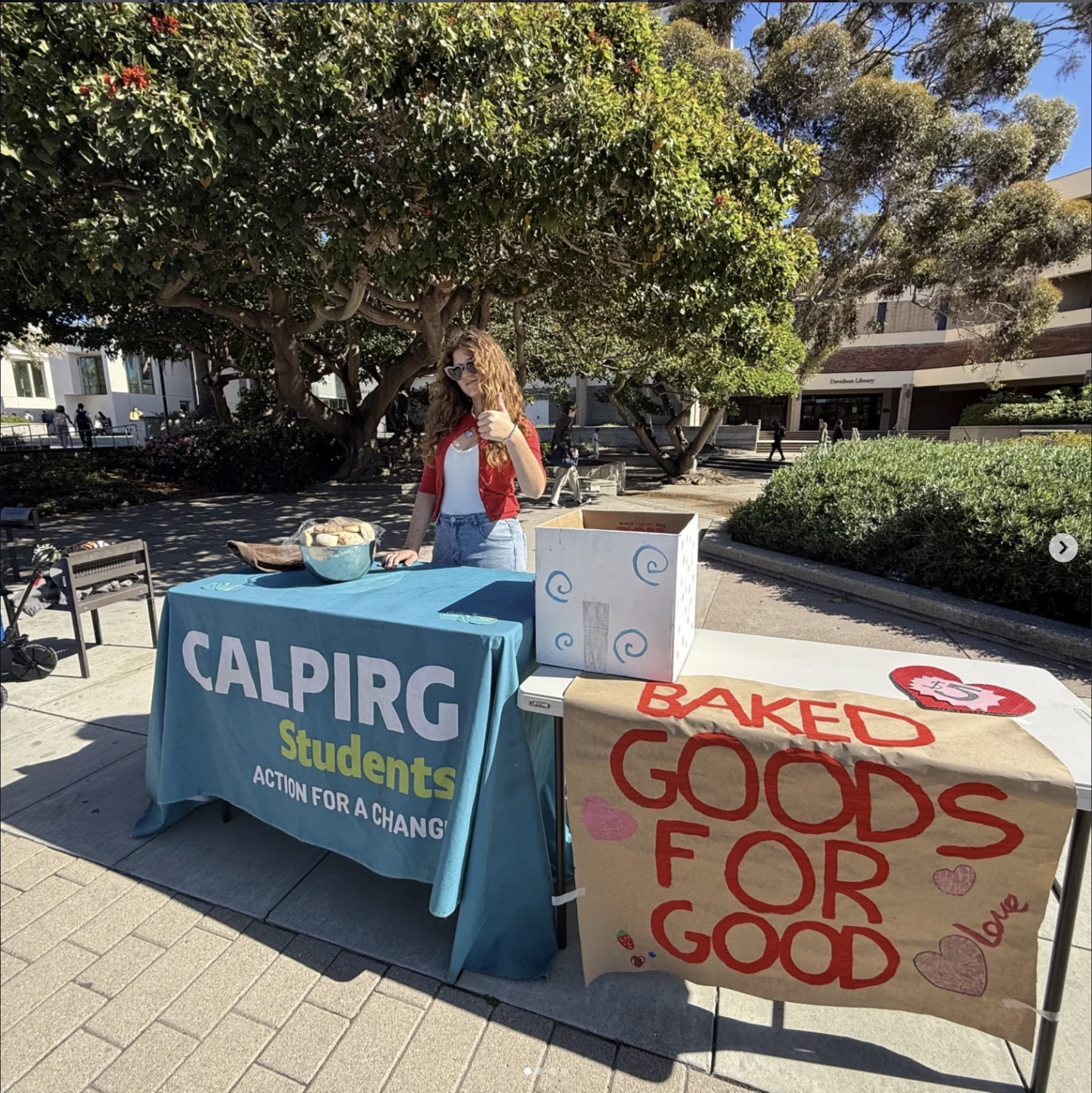
These volunteers dressed in blue are members of the California Public Interest Research Group (CALPIRG), a grassroots activist organization that advocates against issues relating to the environment, democracy, hunger and public health. CALPIRG’s Statewide Board Chair and fourth-year political science and economics double major Jake Twomey emphasized their mission to “mobilize social networks.”
“I think one of the things that separates us from a lot of clubs [on campus] is that we do organizing, which means we want people not just to themselves.” Twomey said. “We want to be able to reach everybody on campus. We’ll always have another way to keep making a difference.”
Prior to becoming statewide board chair, Twomey has volunteered at UCSB’s CALPIRG chapter since his freshman year, taking on a variety of different positions. Twomey said he’s witnessed a high number of students passionate about making social change even outside of those who join CALPIRG.
“I think one of the things that makes me most proud as a student at [UCSB] is that we have one of the most thriving political activist scenes [of] the UCs,” Twomey said. “Between our environmental groups [and] political groups, I think the campus spirit is very much like ‘gung-ho’ about getting involved — doing something to make the world a better place.”
Through CALPIRG’s lobbying efforts, California issued SB 1053 which banned all single-use carryout plastic bags on Sept. 22, 2024.
CALPIRG gathered community support for the bill for over a year prior. Twomey explained that the plastic industry was “running attack ads on the bill on public television.” Even so, CALPIRG’s campaign prevailed and the ban went into effect on Jan. 1, 2026.
“I think [the plastic bag ban] specifically, we all have a lot of pride over because we were one of, if not, the biggest groups working on this,” Twomey said. “We had put in the most outreach to students and members of the community, and it was something that we had significant industry opposition [from].”
Per CALPIRG’s site, it often faces opposition from “powerful special interests,” having experienced federal pushback on their campaign against reopening the Sable Pipeline. In March, President Donald Trump issued an executive order that prompted the Texas-based oil company Sable Offshore to reopen its system of pipelines that run off the Santa Barbara coast.
While CALPIRG continues to fight the pipeline’s reopening, Twomey emphasized the peak of their efforts against Sable occurred when the issue was being discussed on the local level. On Jan. 28, 2025, CALPIRG started its campaign against the Sable Pipeline responding to an initial plan to reopen it with several executive orders that were aimed to increase gas and oil production.
“[The Sable Pipeline] really has changed a lot since we started working on it. At first it felt very much like a county-level issue, so getting the county planning commission and the county itself to put [a] halt to the pipeline,” Twomey said. “That at first was the big target, and we were really successful in that.”
Twomey extended credit for the early success of the campaign to the efforts of different groups on and off campus, as well as community organizing.
“The community really mobilized and showed that they didn’t want this pipeline in their backyard,” Twomey said.
According to Twomey, the pipeline has now “turned into a national issue,” with discussions to reopen the pipeline reaching federal levels. Although CALPIRG is currently “not the most active member in the coalition [against the pipeline],” much of their efforts in ocean conservation focus on expanding California’s marine protected area network.
“Marine heat waves have caused our kelp forest to die off more than 90% across the entire coast. Which if that sounds really alarming, it’s because it is,” Twomey said. “We know the way that we can provide resilience is just by leaving the areas alone [and] making sure that they’re not burdened by extra fishing practices or pollution.”
NASA research conducted in 2021 showed 95% of kelp forests had disappeared along the Northern California coast, with severe declines in Central and Southern California due to warmer waters. According to research conducted at UC Los Angeles, “marine protected areas” help kelp stay resilient against rising ocean temperatures.
Twomey stated that CALPIRG has consistently fought for expanded marine protections over the last three years. He explained they have been lobbying for their expansion at Fish and Game Commission meetings where decisions about marine protected areas take place.
“We actually brought a ton of students from [UCSB] to the hearing on May 5 and May 6, and that was really exciting,” Twomey said. “We were able to mobilize a lot of the community in support. We actually even had students from UCLA drive up to make sure that went well.”
Another success for CALPIRG was their efforts to register students to vote during the 2024 presidential election. UCSB registered the most students out of 200 California higher education institutions.
“There’s something that [UCSB] does called ‘Storm the Dorms,’ and we help volunteer for that. All the new freshmen when they’re doing their dorm orientation, we have a section where they’re able to register to vote,” Twomey said. “[And] a lot of tabling. Making sure that we’re really vocal all the time, and … being able to kind of walk them through that.”
He emphasized how UCSB’s pre-established network of campus organizations called the “Gaucho’s Vote Coalition” — which CALPIRG helped create — allowed them to successfully register students.
As CALPIRG advocates for democracy, its internal system runs the same way. All decisions are made by the student body, and each of the eight University of California (UC) chapters elect a board to discuss “big decisions” for the organization. CALPIRG chapters work on statewide and national campaigns, while also focusing on local and campus level campaigns.
“We have some service campaigns [where] we work on addressing hunger and homelessness just around Isla Vista. We’ve also worked on conservation campaigns for the local area,” Twomey said.
While much of CALPIRG’s work can be seen through lobbying for policy changes, Twomey emphasized most of their service campaigns work on providing immediate responses to the community.
“I think it’s great to try and get at the more systemic sources of hunger and homelessness, but most of our campaigns are in a very immediate sense,” Twomey said. “Making sure that local food pantries have what they need. Making sure domestic violence shelters have clothing and hygiene products — very much immediate and local.”
CALPIRG is also currently working on their “Make Textbooks Affordable” campaign. Twomey explained that the UC system has been “tinkering with programs that would automatically charge each student between $100 and $200 every quarter for course materials.”
“I don’t know about you, but there was never a quarter where I naturally paid that much. And so I think making sure that students are aware of this, as something that could potentially be coming [to the UC system], students are able to mobilize,” Twomey said.
Whether it’s lobbying against plastic bags to save “hundreds of thousands of plastic from entering our waste system and environment” or providing local support at UCSB and I.V., CALPIRG aims to mobilize the community to create the change they want to see in the world.
A version of this article appeared on p. 4 of the May 22. print edition of the Daily Nexus.
This was a very in-depth article, and I quite liked it. 9/10 from me
The FoxNews-whaching republitards what voted for Trump hate the enviroment and they drive around all day in there monster truck’s what emmitt greenhouse gases’s like hydragen, oxygin, and helium. They our morron’s and they our hate-filled idoits and I hate them. Hear in Santa Barbara we our proud democrat’s and we now that globel warming is reel. We now that the police and the milatery our corrup. We now that we need medacare for all. We now that the rich do’nt pay ANY TAX’S. We now that IT TAKE’S A VILLIGE. VOTE FOR DEMOCRAT’S
What an inspiring read! CALPIRG’s dedication to social change is truly commendable. As someone who has worked on grassroots campaigns, I appreciate how you highlighted the importance of student engagement in creating real-world impact. However, I’d love to hear more about specific challenges faced while mobilizing students and how they overcame those obstacles. It’s fascinating to think about not just the “why,” but the “how” behind such passionate activism! Keep up the amazing block blast free work; your efforts definitely resonate in our communities!