

CORRECTION [3/24/2026, 3:59 p.m.]: A previous version of this article stated that R.A.W. was founded following the Oct. 7 attack on Israel. The article has been corrected to state that R.A.W. was founded in response to Israel’s military siege of Palestine following the Oct. 7 attack.
CORRECTION [3/18/2026, 11:16 a.m.]: A previous version of this article stated that AJP was founded following the Oct. 7 attack on Israel. The article has been corrected to state that AJP was founded in Spring 2023. Additionally, a speaker’s name was omitted out of privacy concerns.
Around 100 students, faculty and community members gathered on March 13 for a teach-in hosted by Academics for Justice in Palestine and Researchers Against War. The four-person panel discussed academic freedom, UC Santa Barbara’s ties to defense contractors and actions people can take towards divestment.
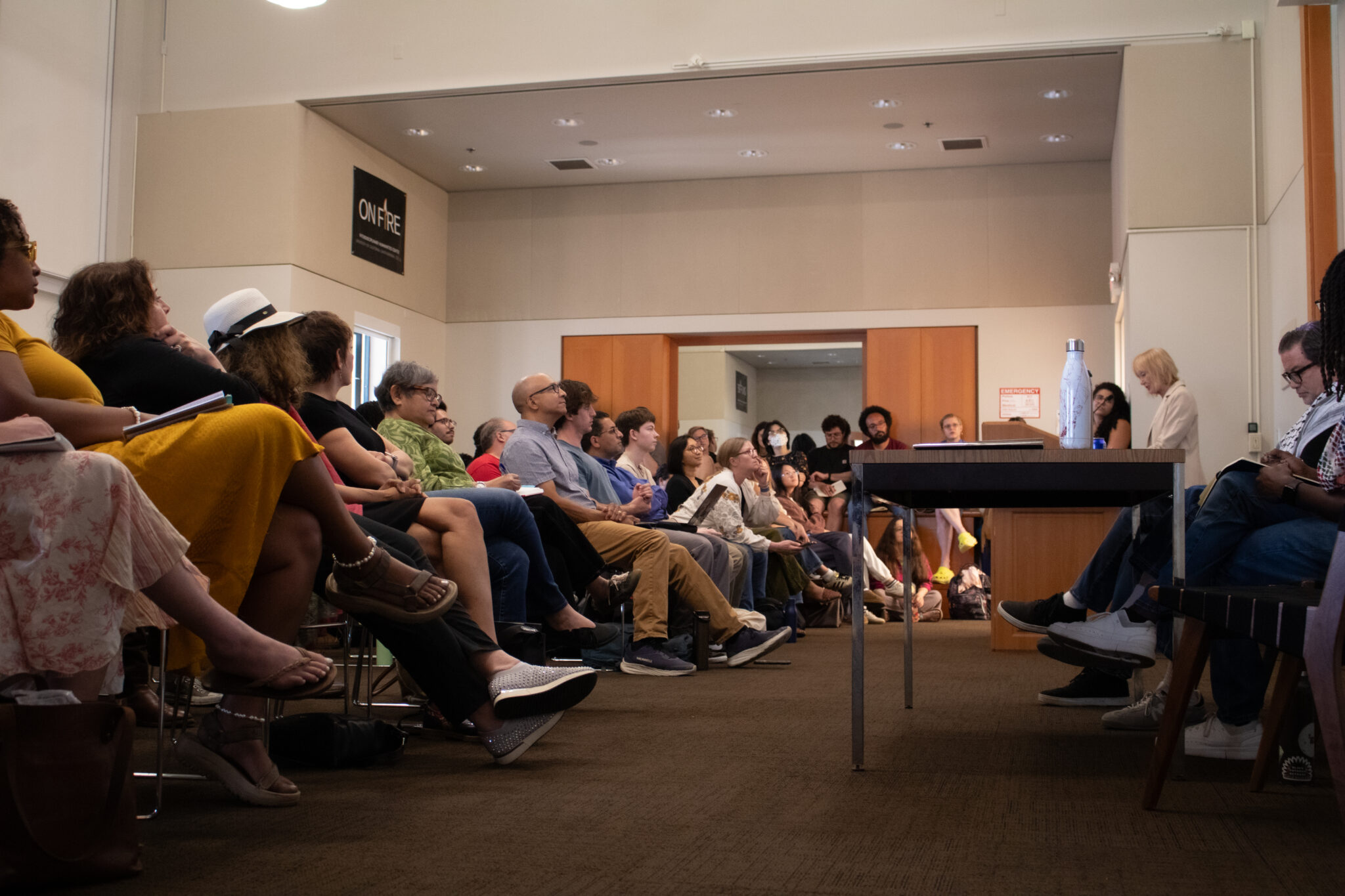
English professor Julie Carlson discussed actions attendees could take to protest the University’s support of “the logic and enactment of genocide” by Israel. Sherine John / Daily Nexus
Academics for Justice in Palestine (AJP) was founded in Spring 2023 while Researchers Against War (R.A.W.) was founded as a response to Israel’s military siege of Palestine, which is now recognized as a genocide by a United Nations commission. The siege intensified after the Oct. 7, 2023 attack on Israel by the Palestinian militant group Hamas, which resulted in nearly 1,200 people killed and 251 hostages taken. In response, Israel has killed an estimated 75,200 Palestinians living in Gaza.
Environmental studies professor and AJP member David Pellow moderated the event and said that teach-ins are a great way to promote “back-and-forth” conversation while discussing difficult topics.
“It’s also a great way to just try to build community and it’s also kind of very low stakes,” Pellow said. “In the sense that there’s no homework, there’s no prep work that needs to be done. You just need to come listen and engage.”
The teach-in featured a panel made up of English professor Julie Carlson, assistant professor of sociology Caleb Dawson, communication professor Walid Afifi and a UCSB graduate student and R.A.W. member who asked to remain anonymous. Held in the McCune Conference Room, each panelist gave a presentation covering a variety of topics.
Carlson spoke first and discussed two concrete actions attendees could take to protest the University’s support of “the logic and enactment of genocide” by Israel. A September 2025 United Nations Commission of Inquiry determined Israel’s actions in Gaza constitute a genocide.
She first introduced the UC Move Your Money campaign, which first aims to get 10% of UC faculty to divert 10% of their retirement savings to the UC Social Equity Fund, which is divested from weapons manufacturers and prisons. The campaign’s second goal is to create a “No State Violence Fund” that would be fully divested from “prisons, the criminalization and militarization of migration and borders, apartheid, genocide and war.”
According to R.A.W., UCSB received around $584 million from the United States Department of War from 2005 to 2022 and around $23 million from private military companies, the most of any UC, during the same period. Additionally, 18% of all research funding at the University comes from “military sources.”
Carlson also urged for the protection of several hiring initiatives including the UC’s President’s Postdoctoral Fellowship Program, a diversity hiring initiative, and the hiring of fellows via a special search waiver. She said that these moves violate the UC’s tenets of “excellence and shared governance” and should be protested.
“Not only is there no excuse for this move, there has been no rationale given for abolishing the President’s postdoc designated search waiver. Leaving one to assume that, at best, this is an instance of anticipatory obedience to the Trump administration attacks on [diversity, equity and inclusion],” Carlson said.
Dawson spoke next, explaining how global struggles impact everywhere, even at UCSB. He highlighted the rollback of diversity, equity and inclusion (DEI) initiatives and how the UC receives millions of dollars in military research funding.
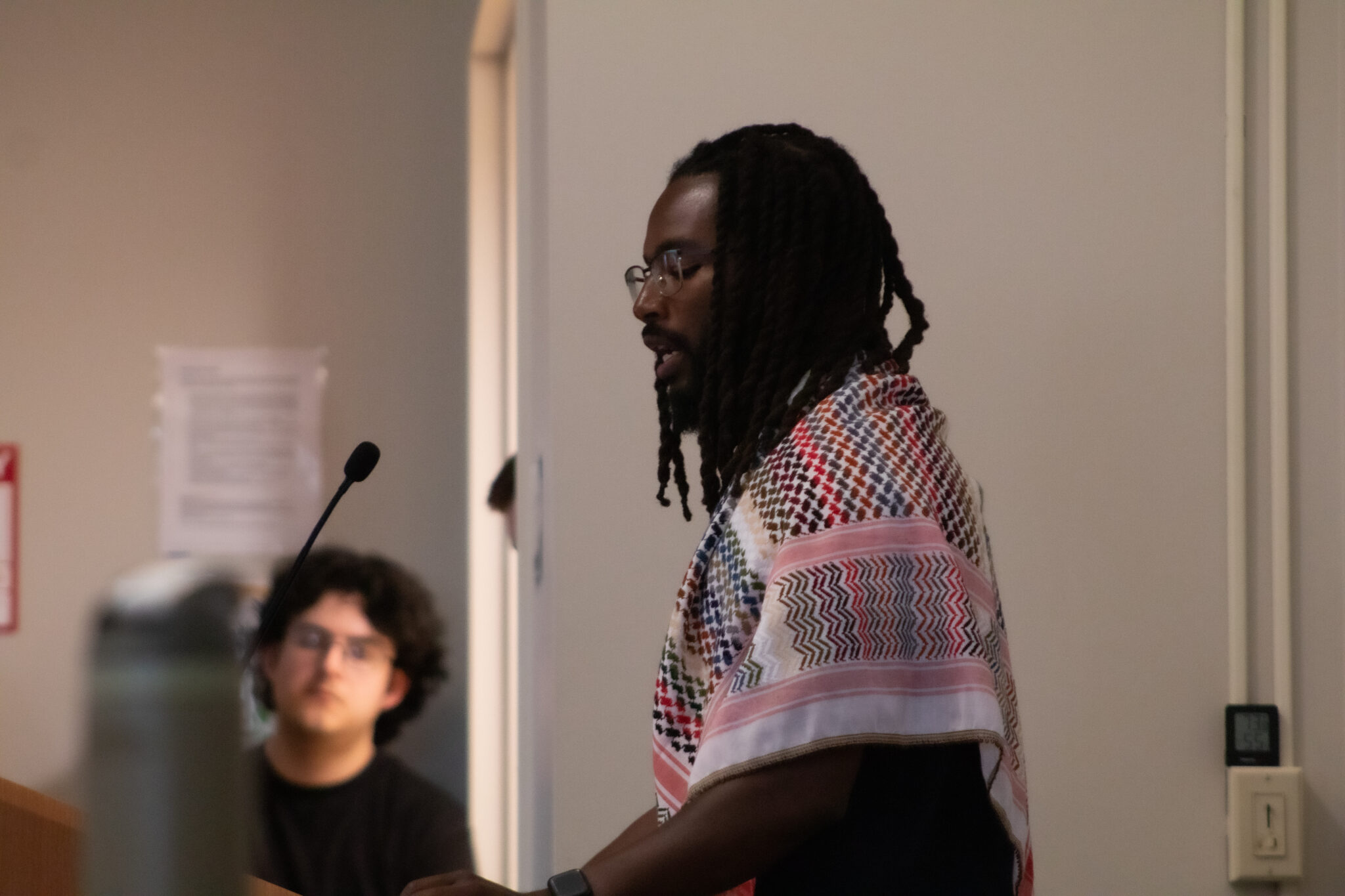
According to R.A.W., 18% of all research funding at UCSB comes from “military sources.” Sherine John / Daily Nexus
“What are we doing here at this privileged university in a luxurious beach town, while the U.S. and Israel continue to genocide Palestine, occupy and terrorize the people in Lebanon and wage an illegal regional war against Iran. What are we doing here if the Epstein files reveal the profound sexual abuses of our economic and political elites?” Dawson said. “What are we doing here when it feels like the fight is somewhere else? In reality, the fight is everywhere, including here at the University.”
Additionally, Dawson called for protecting “high-profile targets” of anti-academic attacks, building “underground” beyond what the state sanctions, acknowledging the weariness of constantly being alert and taking risks, among other things.
Afifi presented next, beginning by giving an update on the current situation in the Middle East. According to him, at the beginning of the American-Israeli strikes on Iran, which have since escalated into an ongoing war, bombs were falling every two minutes.
He then discussed the meaning of academic freedom in an institution where some subjects of research are “systematically subjected to erasure, displacement or suppression.” He pointed to the “Palestine exception” to academic freedom, citing the Heritage Foundation’s Project Esther, which calls for the removal of pro-Palestinian curriculum from college campuses, among other things.
According to Afifi, Palestine Legal, a legal advocacy organization for pro-Palestinian activists, received approximately 1,100 requests for legal support related to repression on college campuses against Palestinian advocacy characterized as antisemitic speech. Additionally, he said that over 3,000 student protesters were arrested and or disciplined in the two years following October 7.
Afifi and Pellow clarified that they see anti-Zionism, or opposition to the Zionist political movement, as distinct from antisemitism. The Anti-Defamation League recently raised UCSB from a D to a B on its 2026 Campus Anti-Semitism Report Card.
“We see Zionism primarily as a political movement, a movement with a really, really strong and positive origin which was Jewish people need to be protected,” Pellow said in an interview with the Nexus. “Our view is that if any community is being harmed none of us are safe, and so we have to stand up against anti-semitism.”
Lastly, the graduate student representing R.A.W., presented on UCSB’s direct ties to private military funding.
“As this panel demonstrates, and as we know from student-led movements for Palestine and against racist policing, U.S. militarism and [Immigration and Customs Enforcement] terror, the University has not been fully captured by the interests of imperialism and U.S. war,” the graduate student said. “As students, workers and educators at a university that is deeply enmeshed in the military-industrial complex, we have a unique and particular role to play in resisting the militarization of research and higher education.”
The panel then took time to answer questions from the audience. One attendee asked about ways the panelists have politically organized and gotten involved. Carlson said people could get more organized to “easily mobilize solidarities” and Dawson added that in-person interaction is vital.
The graduate student concluded by stating that severing the University’s ties with the military and military contractors does not have “an easy fix.”
“It’s a huge and seemingly insurmountable problem, but I think the difficulty and the level of complicity that this University presents us with is an opportunity to have us radically rethink what higher education is and how we might face it from our specific positions,” the graduate student said.



















What a bunch of psychotic, elitist morons. You are all completely retarded terrorist professors!
While I would have phrased it differently, you are completely correct. I am continually shocked at how easily UCSB students are manipulated.
What stays with me in stories like this is how much universities shape more than classes or careers. They also shape whether people feel free to ask hard questions, connect struggles, and speak with moral clarity. I’ve always felt teach-ins can be powerful because they slow everything down and make room for thought instead of just reaction. Even in ordinary life, people need spaces where ideas can be challenged without fear. I was reading https://psi-exams.pissedconsumer.com/review.html recently, and it reminded me how often institutions are judged by whether people feel heard inside them. Conversations like this matter because academic freedom affects… Read more »