
IHC announces new bachelor’s degree program with Corcoran State Prison
May 22, 2026 at 11:08 am
UC Santa Barbara’s Interdisciplinary Humanities Center announced a new Bachelor of Arts program for incarcerated individuals at Corcoran State Prison. With the first cohort being admitted for Fall 2027, the University joins the UC-wide Leveraging Inspiring Futures Through Educational Degrees program.
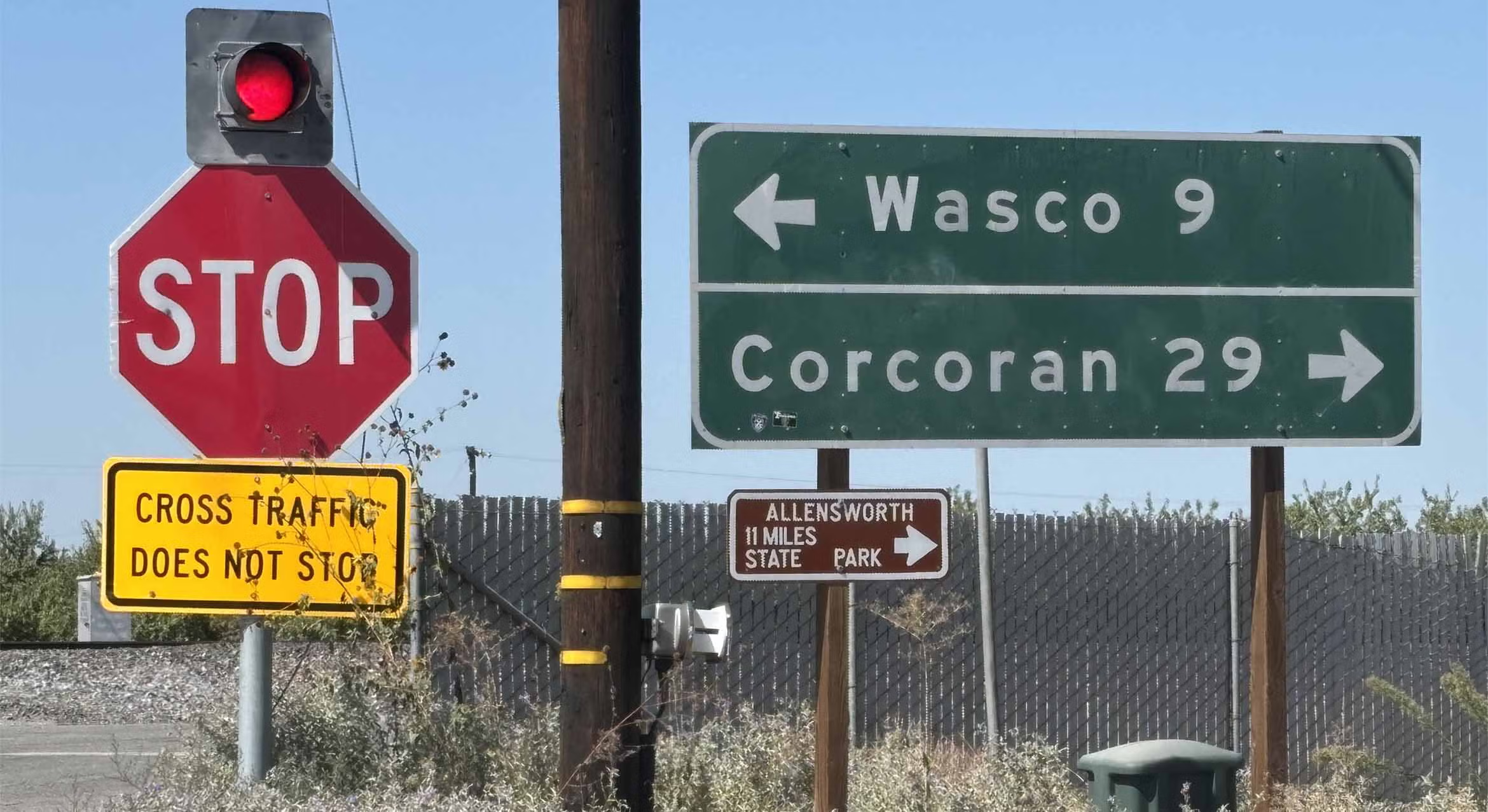
Leveraging Inspiring Futures Through Educational Degrees (L.I.F.T.E.D.) is a UC Irvine-based prison Bachelor of Arts program that has expanded to UC Riverside and now UCSB. The Interdisciplinary Humanities Center (IHC) has joined the program to offer a comparative literature degree to inmates at Corcoran State Prison. The program’s students will take four courses per quarter for six quarters.
IHC and UCSB L.I.F.T.E.D. Director Susan Derwin said the center specifically decided to offer a comparative literature degree because of its “flexible” interdisciplinary nature. Derwin emphasized that the degree’s humanities and social sciences courses offer knowledge “very beneficial for future career pathways.”
“It also aligns with the rehabilitative project of reflection and interrogation and inquiry. And the study of literature really gives you insight to the compelling questions and concerns and motives that drive human beings across time and cultures, and it expands one’s sense of experience throughout the world. So these are all just very empowering prospects for all people,” Derwin said.
California has 95,827 people in prison, the second largest state incarceration population in the U.S. Nearly 30% of U.S. incarcerated individuals have never graduated from high school, while only 4% of formerly incarcerated individuals hold a bachelor’s degree. According to Derwin, individuals who are educated in prison are 43% less likely to return to prison within three years than incarcerated individuals who don’t participate in educational programs.
“When you’re incarcerated, that kind of exchange among a shared interest in something like education or a question in a class is harder to come by because you’re in an institution that really doesn’t cultivate the individuality of each person,” Derwin said. “So the educational space enables all students, and in a carceral situation, it’s particularly salient and important to really expand their horizons and possibilities and ways of really understanding their own position in the world.”
While Derwin noted the rehabilitative nature of education for incarcerated individuals, she also stressed the importance of social support systems that enable individuals to fully realize their education.
“It starts with education embedded in a supportive social environment. In other words, in order to be able to take advantage of one’s education at any level, you have to have a home where you get a space where you can sleep enough, where you are provided with enough nutrition, where there’s stability,” Derwin said. “So education is the great lever of mobilization, but the challenges we face go beyond education. We have to create the supports and the stabilities in our local communities, so that students can take full advantage of education.”
For Derwin, being director of L.I.F.T.E.D. enables her to be part of a program that directly aligns with her belief in accessible higher education for all. She specifically underscored the impact that literature education can have on students.
“It helps me do my work, because my work is to teach people and I’m interested in teaching all people,” Derwin said. “ I really believe in the transformative power of literature to unlock possibilities and make life better for all people, because we all live in the humanities and use the humanities as a way of representing ourselves in the world, as a way of being in the world.”
While UCSB’s participation in L.I.F.T.E.D. has just launched, Derwin hopes the program will continue to expand to offer as many programs as possible in all prisons.
“There are great programs [and] degrees offered by the Cal State system now, and the community colleges offer associate’s degrees. But I believe that the third tier of UC education needs to be available to all incarcerated people across the state who are qualified and interested,” Derwin said.
Beyond personal benefit, Derwin highlighted that program participants will be able to utilize their degree to uplift the communities they are part of.
“The people who are in this program have, by and large, overcome tremendous social obstacles, and are so interested now in becoming leaders in the communities in which they return and supporting the neighborhoods that haven’t had full access to all of the social supports that we’re talking about,” Derwin said. “So this does help feed into a possibility of lifting up and altering the people who are caught in that cycle, which has nothing to do with the people, it has to do with the structural conditions that create that cycle.”
A version of this article appeared on p. 5 of the May 21. print edition of the Daily Nexus.
