
SBResiste volunteer accuses I.C.E. agents of using excessive force while observing detention
By Lucy Wellons
May 14, 2026 at 10:00 am
A core member of the rapid response volunteer network SBResiste, Ana Garcia, was involved in a violent altercation with United States Immigration and Customs Enforcement agents while responding to a reported sighting at the Secure Continuous Remote Alcohol Monitor of California office on West Carrillo Street on April 30. The organizers say the incident reflects a broader escalation of violence towards volunteers monitoring enforcement activity in Santa Barbara.
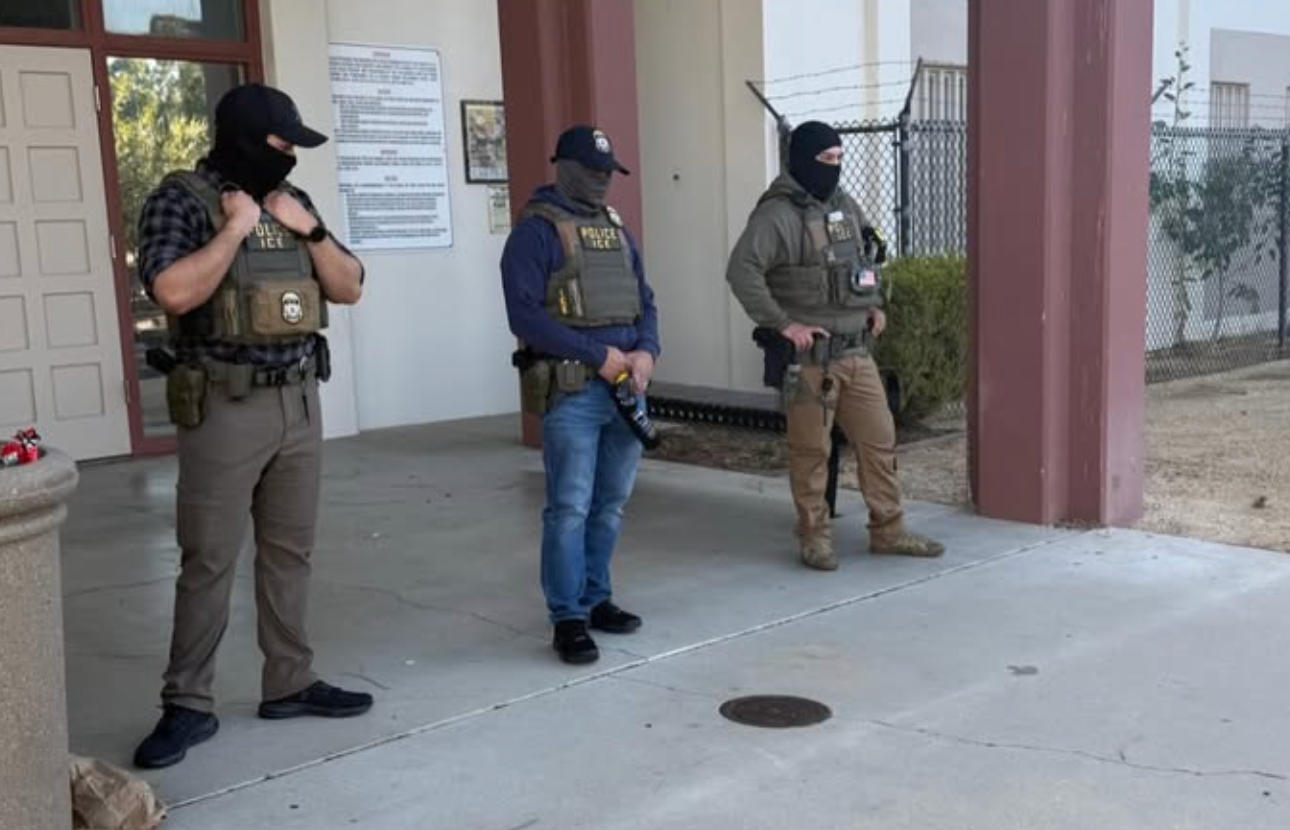
Garcia arrived at the scene after a tip through the SBResiste rapid response network, a Santa Barbara-based grassroots organization that aims to protect immigrant communities in light of aggressive United States Immigration and Customs Enforcement (I.C.E.) activity. She had initially planned to meet up with someone monitoring a different I.C.E. vehicle, but received another report about the presence on State Street and Carillo Street and decided to investigate alone before additional responders were able to arrive.
After searching the area, Garcia entered a building and spotted I.C.E. agents ascending the stairs to the Secure Continuous Remote Alcohol Monitor (S.C.R.A.M.) office and followed them to observe and document. As she began walking up the stairs to reach the I.C.E. agents, she claimed that they immediately accused her of impeding their activity.
“Before I even made it to the top floor [the agent] started accusing me of impeding. I was like, ‘I’m not impeding. What are you talking about?’ and I just kept walking up the stairs,” Garcia said. “He waited for me at the top and started pushing me before I even made it onto the platform. So I muscled my way up onto the platform because I didn’t want to get pushed down the stairs. He was pushing me super intensely, saying, ‘Don’t impede. Don’t impede.’ I was like, ‘I’m not impeding. I’m walking,’ — I wasn’t even recording.”
According to federal law, impeding an I.C.E. officer involves active physical obstruction, assault, resistance, opposition or intimidation of officers during enforcement actions. Filming or observing I.C.E. officers is protected by the First Amendment under the condition that it does not prevent them from working.
Garcia continued walking towards the I.C.E. agents at the top of the stairwell, before the agent who was accusing her of impeding physically restrained her against the wall, allegedly punching her in the side and shaking her repeatedly. She noted that the officer accused her of fighting back during the incident, but she denied this claim.
“At some point during that interaction, he was like, ‘Are you crazy? Are you hitting me?’ And I was like, ‘No, I’m defending myself because you’re using excessive force for no reason, I’m doing nothing. I’m by myself, there’s nothing going on here,’” Garcia said.
According to Garcia, the agents at the scene called for her to be arrested, but the agent restraining her, whom she identified as the supervisor of the Santa Barbara I.C.E. force, refused. She responded by asking the agent, “Why? Because your excessive force is going to get you in trouble.”
While Garcia was being physically restrained, another agent attempted to pepper-spray her. The spray struck the wall instead, but agents left the residue behind after the incident. Because the pepper spray was deployed in an enclosed space, S.C.R.A.M. employees had to wear masks for the remainder of the day and clean the area themselves, according to Garcia.
“We talked to the lady at the S.C.R.A.M. office, and she was wearing a mask. The whole building still smelled really intensely of the pepper spray. I spoke to the woman, and she started crying, and was like, ‘We don’t work with I.C.E. Nothing like this has ever happened before,’” Garcia said.
After the initial confrontation, the agents exited the S.C.R.A.M. office with the individual who was detained in their custody. According to Garcia, after the agent released her, she followed them down the stairs and taunted one of the officers, who then turned around and pepper-sprayed her directly in the eye before leaving the scene.
“I probably should have just been quiet because I was by myself and didn’t have backup. But sometimes you can’t help yourself, you’re just a fucking asshole and I hate you, and you’re kidnapping somebody, and I’m beat up over here. What’s all that I have left? Cutting words,” Garcia said. “Big mistake, because then he turned around and pepper sprayed me right in my face. It hit my eye, pretty directly, and that one totally fucked me up. I couldn’t breathe.”
Under the Department of Homeland Security (DHS) and I.C.E. use-of-force policy, an authorized I.C.E. officer may use force only when no reasonably effective, safe and feasible alternative appears to exist and may use only the level of force that is objectively reasonable.
In a SBResiste statement, the group said they believe the agents who attacked Garcia felt “emboldened” by the fact that she was alone. Another core member of SBResiste, who chose to remain anonymous, spoke about the importance of keeping eyes on I.C.E.
“The reason they were so empowered and emboldened to be so violent was because they knew that there was no one else there. No cameras, no form of accountability. They felt like they could hurt her because they just knew that there wasn’t gonna be any consequences for them,” the anonymous member said. “When there are more people, more rapid responders or people keeping their eyes on what is happening, these agents act less violently.”
Garcia said that she felt more encouraged to continue working with SBResiste after her interaction with I.C.E. at the S.C.R.A.M. office.
“I grew up in an area that is more diverse, has a bit more crime. And so that part doesn’t scare me at all. That’s normal stuff. I’m terrified of a fascist government takeover,” Garcia said. “For me, the alternative is much worse than fighting.”
The anonymous member agreed with Garcia, emphasizing the importance of pushing back against I.C.E.
“I think a lot of people are seeing the violence that is being enacted on rapid responders, Renee Good, Alex Pretti and beyond that. Just the amount of repression that these organizers are facing in other places has scared people. They think that if they do something, they will get hurt. But the truth of the matter is they will hurt us regardless of whether we do something or not,” the anonymous member said. “That is how fascism works, and the only hope we have of preventing them from hurting anybody is if we push back and say that this is not okay.”
The interaction between Garcia and the I.C.E. agents followed a pattern of increasing presence at the Santa Barbara County (SBC) Jail. In the weeks leading up to the incident, I.C.E. officers were reported to be at the jail multiple times a week. SBResiste has been monitoring these sightings and condemns the actions of the agents.
“We’re not defending any person in particular or any crime in particular. We are defending the right to due process. None of that is happening. So when I.C.E. goes into the jail and kidnaps somebody from there who’s being released, that is a violation of due process. And so we are concerned that if we allow them to take that step, that creates a pathway for them to then violate my due process and your due process. And so it’s not about protecting any individual necessarily. It’s about protecting the rights that we all deserve and that are enumerated in the Constitution,” the anonymous member said.
According to SBResiste members, the confrontation with Garcia reflects larger concerns about the methods I.C.E. agents use during operations. They alleged broader patterns of I.C.E. working with law enforcement to discourage and intimidate observers by making misleading or legally inaccurate statements about their rights.
In a recent statement, the Santa Barbara Police Department reaffirmed that the organization does not engage in immigration enforcement. They stated that their role in federal immigration actions is guided by their “commitment to safety and respect for all.”
Garcia described an experience she had with law enforcement after following an unmarked I.C.E. vehicle that was allegedly driving recklessly into an elementary school parking lot. After parking next to the agent’s vehicle, she said that a Ventura County sheriff came to speak with her.
“[The sheriff] was very intense and was trying to tell me that I needed to give him my driver’s license and all this stuff. And I was like, ‘for what?’ And he [said], ‘because, I’m pulling you over,’ blah, blah, blah. And I was like, ‘No, I’m parked, so try again.’ And he [said], ‘you have to identify yourself.’ I was like, I actually don’t, unless you have a legal reason,” Garcia said.
Garcia went on to describe that seven other sheriff’s vehicles arrived, and she spoke to two other deputies who pressured her to give them her information. She said that the incident eventually ended because they could find no legal reason to make her identify herself.
The anonymous member also described an event where they observed I.C.E. take a man on a stretcher due to injuries sustained while trying to escape detainment outside of the SBC Jail. They stated that a sheriff came up to them and began questioning their presence.
“A sheriff walks up to me [saying], ‘What are you doing here?’ Trying to ask me all these questions. And then I remembered my rights, and I [said] ‘Am I being detained?’ He’s like, ‘No, but you could be.’ And I [asked], ‘Am I free to go?’” the anonymous member said. “We’re not being detained, so I walked away, and that’s literally all I had to do, because he did not have any legal basis to make me answer any of his questions.”
The SBResiste members highlighted these interactions to emphasize the importance of knowing your rights while interacting with I.C.E. agents and law enforcement. They claimed that their rapid response volunteers are taught how to safely observe enforcement activity, document interactions, stay in groups and stay calm when questioned by officers.
“The first time anybody encounters an agent it is frightening. You have physical, bodily reactions to seeing this masked person with a gun in your neighborhood trying to steal one of your neighbors. I think the first time I saw an I.C.E. agent, I was terrified. I froze, and I was like, ‘You could just kill me right now’ — it’s very scary to understand how much power they have,” the anonymous member said. “We’re always trying to be there in a group for safety reasons and also if anybody starts panicking, they can back off.”
The pair expressed their frustrations with the public’s perception of SBResiste and other rapid response networks, noting that what is visible online is only a small portion of the broader efforts around community organizing and that videos of responders “saying all sorts of nasty shit” to officers is not representative of their work.
“They assume that is all we do and that all you can do if you join this organization is go out there and get in an agent’s face, and you have to say snarky shit to them. That is not even half of the labor that people put into this,” the anonymous member said. “We’re trying to build a better society, and a better society needs everybody’s input, and everybody has something to bring. I really want people to understand that even if you are too frightened to go and potentially put yourself in physical danger, that is not all we do. No matter what you do, we really, really need you.”
Additionally, the members spoke on the broader implications of the violent incident involving Garcia and how they hope the public will react, emphasizing the importance of continued observation and community involvement to hold I.C.E. agents and law enforcement accountable. They emphasized that they believe situations involving I.C.E. are “getting serious in a way that [is] very concerning,” and that there is a lack of accountability for officers, demonstrated by agents’ interactions with Garcia.
“I want people to understand that no matter how privileged they think they are and how safe they think they are, the violence that you are allowing again, the violence you allow to happen to other people, will eventually come back around and hit you,” the anonymous member said. “The rights that we allow them to take away from other people, the way that we allow them to treat people that have the least rights in our society is a test run for what they can do to the rest of us, even if you did not care at all for the people that were being harmed, you should be worried.”
A version of this article appeared on p. 7 of the May 14 print edition of the Daily Nexus.
Ooh, that poor misled baby. Sorry that the left brainwashes people into actually working against their own safety by trying to protect violent illegals, most with criminal records, from being deported. Sorry, I can’t help her.