
Exploring ENGL 106CW, the Catalyst
By Malia Guy and Joseph De Filippis
May 1, 2026 at 1:00 pm
The Catalyst is a contemporary literary arts magazine that is produced top-to-bottom by students in a UC Santa Barbara English class each quarter.
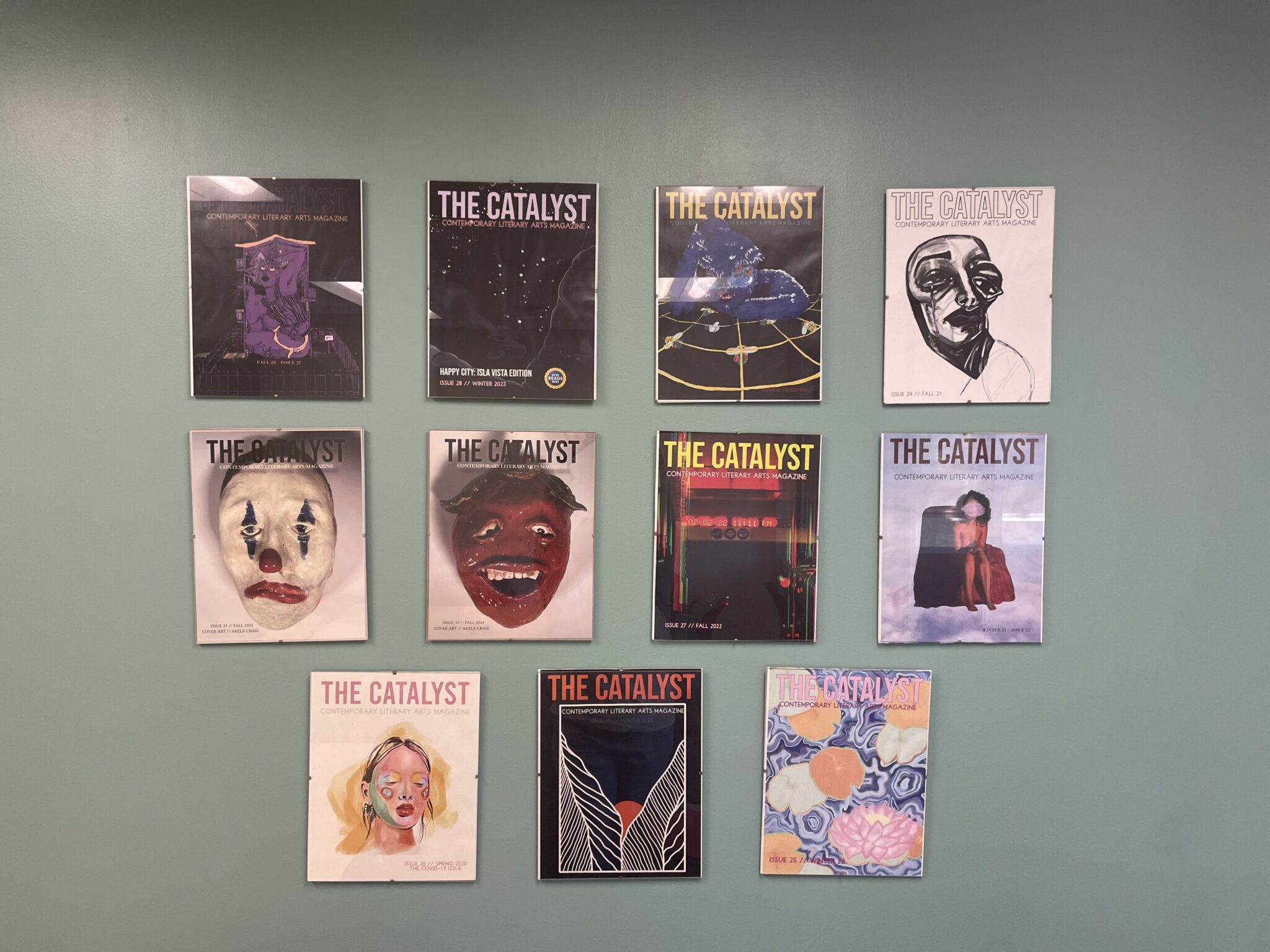
The 36th issue of the Catalyst was themed around movement. For fourth-year English major and Editor-in-Chief Natalie Riley, this aesthetic captured “the physicality of movement,” people and places, but also ideas, political movements and how “we perceive the world around us.”
“I want to look at more embodiment and interaction with the environment … It’s going to be more clear, or more like a fresh aesthetic.” Riley said. “[S]pring is more of a revival.”
After a long hiatus, the Catalyst was revived in Spring Quarter 2013 by then fourth-year English major Natalie O’Brien. Her mission, to assemble and publish original work created by and for students, is preserved in ENGL 106CW, taught by professor Brian Donnelly. Since the class began being offered in the fall of 2019, everything from daily lectures to the final print continues to be organized by students, with Donnelly only assisting when necessary.
“I support the editorial team. I get things administratively achieved for them when they need stuff. [Like] equipment, Adobe subscriptions … [and] room bookings,” Donnelly said. “Sometimes the editors will bring stuff to me for my opinion, and I’ll say, ‘Look, here’s what I think.’ But ultimately, they make the decision.”
To submit to the Catalyst, you do not have to be enrolled in the class. Each quarter, the Catalyst sends a university-wide call for pieces to be sent in. While it is labeled as a literary magazine, the Catalyst accepts poetry, prose and artwork.
“We are a literary arts magazine, so one component of the magazine, obviously, is the writing,” Riley said. “But then the magazine aspect [is where] we’re pairing artwork — and that’s like any composition, or mode of artwork. So that can be digital art, hand-drawn art, collage, sculpture, photography.”
The current editor-in-chief decides the theme each quarter, but pieces submitted do not have to strictly adhere to it. Jeo Gomez, a third-year English major, submitted to the Catalyst before enrolling in the class during spring quarter last year.
“I remember first submitting just one poem and I wasn’t familiar with the guidelines you have to follow … It didn’t get accepted,” Gomez said. “At that point, I decided to keep working on my poetry and then from there I submitted works the following quarter and I was able to get a poem in. Then ever since spring 2024, I was able to get my work selected.”
While a majority of students come from an English major background, there are students from other majors who join the class.
“We love it when we get students who are chemical engineering or mathematics, because it’s a great outlet for students who may not have that opportunity in their set fields or majors to explore creativity and explore what they can do for writing,” Riley said. “It’s also a great outlet for community building. The amount of friendships I’ve seen shaped throughout Catalyst, from my time as being a student, and as an editor, has been amazing.”
In the class, writers are sorted into peer review writing groups in which they collaborate with each other and give feedback on each other’s work. During the last few weeks of the quarter, they collaborate together to produce zines.
“They have more freedom and autonomy as creatives to work within groups collaborating to make their own smaller-scale magazines that they present as their final project at the end of the quarter,” Riley said.
The launch party is the final for the class, where attendees get copies of the latest edition of the Catalyst and have live readings.
“It feels rewarding reciting [my poetry] in front of people so they understand how I’m feeling,” Gomez said.
After spending at least a quarter as a Catalyst writer, students can be considered for the editorial team. Fourth-year English major Jack Buschow, managing editor for the 2025-26 academic year, explained what led them to apply for their position.
“I looked up to the [previous] managing editors,” Buschow said. “Also, I just have that kind of brain where I’m pretty organized.”
Buschow explained how “it’s great” working with the other editors and that everyone got the roles “they were meant to be” in.
Riley applied for editor-in-chief because it allows a combination of “critical” and “creative” practices.
“You’re thinking really methodically and intentionally about the choices you are choosing,” Riley said. “Why are we accepting this piece? What is it? Why does it fit the aesthetic well? What is it doing for the reader?”
For students continuing next year, there is still time to participate in the Catalyst, whether that be by submitting as a writer or attempting to join.
“I’m relatively young, so I haven’t experienced a lot of things. But so far this has taken the cake,” Riley said. “This has been the coolest thing I’ve done and been a part of. It’s been the most fulfilling thing I think I’ve done at UCSB and personally.”
A version of this article appeared on p. 5 of the April 30, 2026 print edition of the Daily Nexus.
“Sedona” spelled backward is “anodes”–my own poetic take on the gnarled juniper trees
found nearby the energy center vortices!
There should be a PhD. thesis done in biology on the effects of electromagnetic energy streams vis-a-vis Juniper tree growth in Sedona. Rest assured it would be the first of its kind in the US! It is my belief that the electromagnetism varies in minute ways the photons creating
those unique formations.
I just checked with AI. To date, there is no known PhD. thesis done on this specific subject or peer-reviewed scientific study. Biologists attribute these unique growth patterns to other
biologically-induced stressors like high elevation or wind, but it seems to me to be very unique, since the anomalies occur very near the vortex energy portals, and only near
those portals–this is beyond the realm of mere coincidence! A perfect meld exists here
between metaphysics and science!
The Synthesis of My Personal Philosophy on this Full-Moon Friday Night
1) Sedona: finding the “Kingdom inside you.”
2) Haskell’s: Restoring the “Kingdom spread upon the earth.”
Another Bit of Information Under This Flower Full Moon Music and sound vibrations positively affect plant growth. Specific frequencies, such as classical or soothing music, stimulate stomata to open wider, aiding nutrient absorption, while heavy hard sounds can stress them. Plants “hear” through vibrations rather than sound waves. Sound waves (ideally 115Hz to 250 Hz) can cause plant stomata (pores) to open and increase cytoplasmic streaming, which helps build more nutrients throughout the plant. I suspect various as yet “undetected astral vibrations” are at work near the Sedona vortices (such as Bell Rock and Cathedral Rock) affecting and sculpting the… Read more »
Hard-core scientists will tell you the twisting can help the trees maximize their exposure to sunlight and optimize their root system for better water and nutrient absorption.
My own view is that it is probably a synergistic combination of both forces.
They certainly add to Sedona’s world-wide allure!
In summary, these high-energy vortexes are essentially “Earth-Gnosis” portals
in keeping with the 114 sayings found in the Gospel of Thomas. They certainly
aid in one’s soul evolution when approached with sincerity and contemplative humility.
Like the Juniper’s complex, knotted, and upward spiraling shapes, there exists “no easy, straight line to enlightenment.” However, you are still a witness to an extraordinary, highly localized, and rare phenomenon of nature!
The overwhelming beauty of the landscape forces a “pattern interrupt”
in the human brain, stopping the noisy internal monologue and allowing
the “inexorable evolution” of the soul to surface.
Because the nearby quartz deposits are piezoelectric (it creates an electric charge under pressure) that interacts with the human bioelectrical system.
The vortex’s coherent energy field encourages the human cells to return to a state of homeostasis through quantum resonance—a pattern that allows the brain to re-wire itself for “higher consciousness.”
The Beauty of Sedona (in the manner of Robert Frost) I came to where the red rocks rise Like ancient embers of the earth, And felt the hush of ageless skies Lean close, as if to learn my worth. The juniper, in patient grace, Stood guard beside each winding trail; Its whisper met me face to face— A low, eternal, wind-worn tale. I paused where canyon shadows crossed And sunlight pooled in rust and gold; There, something in my heart got lost, Or maybe found what once it told. For in those stones, a pulsing thread Ran warm as breath… Read more »
At least one person near Santa Barbara felt the 3.3 temblor centered near Grapevine this morning.SantaBarbariaWine.com is still for sale
on the Afternic exchange!
“You can’t take the berries out of Santa Barbaria Wine!” (TM)
This wine will put a Mogen David Concord to shame with its unique trademarked brand of “cultured sweetness” owing entirely to the
(proprietary) chemical composition and color of the grapes!
My (TM) Proprietary Highlights:
Vintners control wine sweetness by halting fermentation early to keep natural grape sugars, while managing through “skin contact time”
(maceration) and temperature during fermentation. Fermentation must be done before the yeast consumes all the sugar. Harvesting later means higher sugar levels in the grapes.
It is destined to become a red wine of dark color, but full-bodied. I will stipulate it so in the sales contract.
Probably will be more akin to a Pinot Noir grown in the Sta. Rita
Hills area…
BigBarron.com is also available on the Afternic exchange, but that one is tailored to an entirely different market niche. The very same reasoning applies to BeamMeUpKirk.com registered by GoDaddy in
August of 2025! Don’t tell that there is no permeable veil here between time dimensions, because this is my factual proof, and I stand by it
today without equivocation!
I’m now going to throw out this non-sequitur to bring to a conclusion this Sunday night:
The “doubting Thomas” story found in the Gospel of John was in direct response to “early core kernels” found among the early precepts
of the Gospel of Thomas (circa 60 AD). I have since found the Gospel of Thomas to be the truer form and I choose to live it now!
“I will sell no good wine before its time.”
“You saved the best wine for the last, Master.”
I now draw an analogy to Mathew 9:16-17. Dare I say more
at this moment?
Beautiful day tomorrow:
Transiting sun conjunct natal moon in Taurus (12th House)—Powerful!
Q: What is Barbara Thiering’s pescher analysis of Jesus’ changing water into wine at the marriage of Cana? In Barbara Thiering’s “pescher” analysis, the miracle of Jesus changing water into wine at the marriage of Cana was not a supernatural event, but a symbolic “miracle” representing a major social and religious revolution within the Qumran community. According to Thiering’s theory: A Rite of Initiation: In the strict hierarchy of the Qumran sect (Essenes) “water” and “wine” represented different stages of spiritual initiation. Water was the drink for those in the early stage of baptism or for those considered “unclean,” such… Read more »
Glad to see a fellow 1st century gnostic on here, vanishingly few of us remain to spread the truth about this wretched physical existence we inhabit. Cheers Mike!
Thank you so much for your kind remarks. That means so much to me as a co-equal kindred spirit of the inexorable evolutionary flock, growing in numbers, I might add. I have some heartfelt news to report–I am indeed, the Tolan Marr depicted in my Sunset Diaries commentary previously mentioned in the Daily Nexus. Within the past half-hour, I ran a sort of “psychic roulette” on the internet, placing all my chips on where I thought the next microquake would strike after the previous temblor near Mohave, California. Only I was privy to my bet. I told no one. I… Read more »
Saint Methodius was a 9th century Byzantine Greek theologian,
missionary, and archbishop who brought Christianity to the Slavic people—known as an “Apostle to the Slavs.”
Might your ethnicity be part Slavic, fellow Gnostic? Explain to me
more in detail your choice for the moniker. I’m intrigued! How does he personify the Gnostic tradition(s)?
A Slav I am not, I instead am referring to the false Methodius of Olympia who penned the true Apocalypse. A great source! And where we can find the real end. Or so they say!
Hi. I did my due diligence and research. Do you believe his prophesy
adamantly? I believe AI will play a very heavy hand in the (partial) end times. Let’s bandy about some concepts on this at your leisure.
Warm regards, Mike
If you desire more privacy, contact me at my email listed below.
“My prophecy is simply this: Some celibate mystic with access to the astral realms will discover the key to severing the silver cord that ties the human body to the astral worlds and will, under God’s will, eventually and inexorably, bring lasting peace to this world of infidels. We might all see this come to pass in our lifetimes! It’s simply a matter of channeling the correct energy to collectively cut the cords in masse.
AI will play a heavy hand in this endeavor, sensing the loci of these cords.” (TM)
“Global Heirophancy” (TM)
“The “vibrational edge” of the devoted celibate mystic occurs primarily in the pineal gland with the introduction of the Bija mantra(HRUM) and the Adi Shakti Mantra @432HZ/528HZ,” primarily done in ritual at the most propitious of moments.
In the Gnostic tradition, the seven main chakras are referred to as the “Seven Churches’ in the Book of Revelation. We are, indeed, closing in on the “end times”–that is, simply and dramatically, moving from the Piscean Age to the Aquarian Age. In fact, we’ve already entered, as a collective humanity, the early stages of the Age of Aquarius with the embryonic beginnings of AI and Quantum Computers!
My analysis of Barbara Thiering’s writing style comes from the many readings of her book, “Jesus and the Riddle of the Dead Sea Scrolls, Unlocking the Secrets of HIs Life Story.” Everyone should attempt to digest thoroughly what is presented here, for it is the most detailed comprehensive analysis of his times, replete with many political intrigues. I am thoroughly amazed at the breadth of her scholarship! I have come away with a most personable, intimate, and accurate portrait of Jesus–the man. A “down to earth” Jesus is rightly portrayed herein. I say the word “Jesus” for all you Gentiles—Je-sus–the… Read more »
This stellar conjunction occurred @12o Taurus—the mid-decan of the constellation, a fixed earth-sign. The other fixed signs are Aquarius, Leo and Scorpio, along with their respective ancient “watchers” of the heavens,
respectively, Aldebaran, Foulmahuet, Regulus, and Antares.
I possess both a Grand Trine and Grand Cross in my natal blueprint, guiding my soul’s evolution and consequential akashic imprint.
Remember this, the stars do not compel–they most certainly impel,
an inherent consequence still of that momentous event, the Big Bang!.
The physics of this event will remain a mystery for centuries to come, mainly because they all breakdown within the Plank’s length, 10 to the negative 35th power meters–that’s 0.000000000000000000000000000000000001 of an inch! All of the present-day physics equations end up in singular infinities.
My pending trademark (TM) represents “my sincere commitment to
preserving the region’s unique agricultural and cultural heritage.”
The trademark aims to protect local identity against external pressures, framing the “berries” as an inseparable element of local production.
In re: Santa Barbaria Wine
Local vintners please consider this proposal:
In lieu of a cash purchase price for the domain and subsequent pending trademark in marketing your unique enterprise, I am willing to
consider a future stake hold interest in a future revenue stream. I am
very amenable to all offers at this point.
All interested parties can email me directly and I will answer all inquiries
most expeditiuosly:
mikey0079@hotmail.com.
Thank you for your interest.
“A Golden Star Book of Poems” should be read while drinking
Santa Barbaria Wine to fully experience the “cosmic synchronicity’
of the 1970’s legacy. This brand will be living proof that the counterculture successfully “occupied” the commercial world without losing its soul!
In keeping with the concept of “Cosmic Synchronicity,” the “living Christos” effectively becomes Tolen Marr as depicted in Sunset Diaries; Future Nostalgia, for “Tolen” can speak with a “jagged truth” that challenges corporate and state negligence more aggressively than standard legal prose.
Strawberry Alarm Clock is coming to Bullhead City May 15th from 7-10pm MST! Remember the #1 hit “Incense & Peppermint”?!
They’ve opted to perform in the relatively new Bullhead location rather
than the usual Laughlin venue. The Bullhead site spans 170,000 square feet. Tickets are a minimum $45.00.
Arizona now ranks one place away from dead last in the country for spending on public school students. Rest assured, there are a lot of “adorable deplorables” in this neck of the woods. Gosar is our current
Congressman—remember him during the January 6th riots and his ties to the Proud Boys? However, one of the nice things about Bullhead is that there are copious amounts of Vietnam Vet survivors now on their last legs. Mohave County is the reddest county in all of purple Arizona! .
Hi everyone! I checked out tucan casino while searching for a platform that’s both colorful and packed with big win potential, and it has been a total blast. I’d been going through a really frustrating dry spell lately and was almost ready to call it a day, but one lucky session here completely flipped my fortunes. I managed to win back everything I’d lost and even secured a very handsome profit! It’s such an amazing rush when the slots online finally start hitting those big jackpots. Now, it’s my go-to destination for some online casino bets or a chilled game… Read more »
Copilot3D is a free AI 3D model generator that converts text and images to 3D models online. Amazing technology.
The Haskell’s sands are shifting gold,
But stained by greed and pipes of old.
The alchemist must clean the tide,
Where truth and nature both reside.
Our 3D universe is essentially a projection of information on a 2D surface. It is a “natural”
holography and not one born from an alien computer code. With this in mind this Cinco De Mayo night, I wish Sabrina Gonzalez Pasterski continuing success in her ongoing lifetime quest regarding
“Celestial Holography.” She has now been recognized for the discovery of the “spin memory effect”! I’m going to Google that right now! Her discovery is in keeping with string theory.
The universe communicates through a “cosmic script” written in light—cubits–
described a tiny, spinning spheres of light or “event horizons”–which stack, entangle, and interfere to create the structure of space, time and gravity.
Humans are not separate from this process, but are projections of the “holode”
themselves..
The universe constantly rewrites its own evolution through feedback loops
like Hawking radiation.
This is her lifelong quest–to discover that “cosmic script”—the Holy Grail of Physics. It will be very interesting to follow her journey through these passing years. I wish her well. Beam me up Sabrina!
Runway Gen 5 is a free AI video generator that converts text and images into stunning videos online. Amazing technology.
Does this mean that there is a certain (proprietary) app that can be installed on a website?
I currently own a word press site, santabarbaria,com., which I occassionaly update.
Can that app be applied to my site? I’m intrigued and very much interested! What price range(s) are we looking at? You can email me if you so desire: mikey0079@hotmail.com.
Thanks.
A 1.1 magnitude tremor (11) miles NW of Isla Vista struck just eleven minutes ago.
My future video incorporates this conceptual architype—cosmic synchronicity here! (TM)
It’s inspiring to see how student-led projects can build such a strong artistic community.
It feels like подбор прически онлайн по фото, where everything comes together to match the right style and expression perfectly
The Catalyst really highlight how student creativity and collaboration can turn ideas into something impactful and expressive.It feels like создание коллажа, where different pieces come together to form one meaningful picture
Love how ENGL 106CW and The Catalyst showcase student creativity and collaborative storytelling in such a meaningful way. It feels like сплющить фото, where everything aligns into one clear and focused perspective
The Catalyst really highlight how student creativity can grow through collaboration and shared ideas. It feels like увеличить размер фото, where everything expands into a bigger and more impactful vision