
Senate hears BWHC concerns, proposes student housing at Centennial House site
By Jack Dindia and Wynne Bendell
April 29, 2026 at 3:00 pm
To remain transparent, Jack Dindia did not write the public forum section as he has a professional relationship with a board member of Black Women’s Health Collaborative, along with a speaker during public forum. Additionally, Samantha Dillon serves as the DEI Chair of the Daily Nexus.
The 76th Associated Students Senate heard concerns from the Black Women’s Health Collaborative over a significant proposed budget cut and alleged anti-Blackness within the Association.
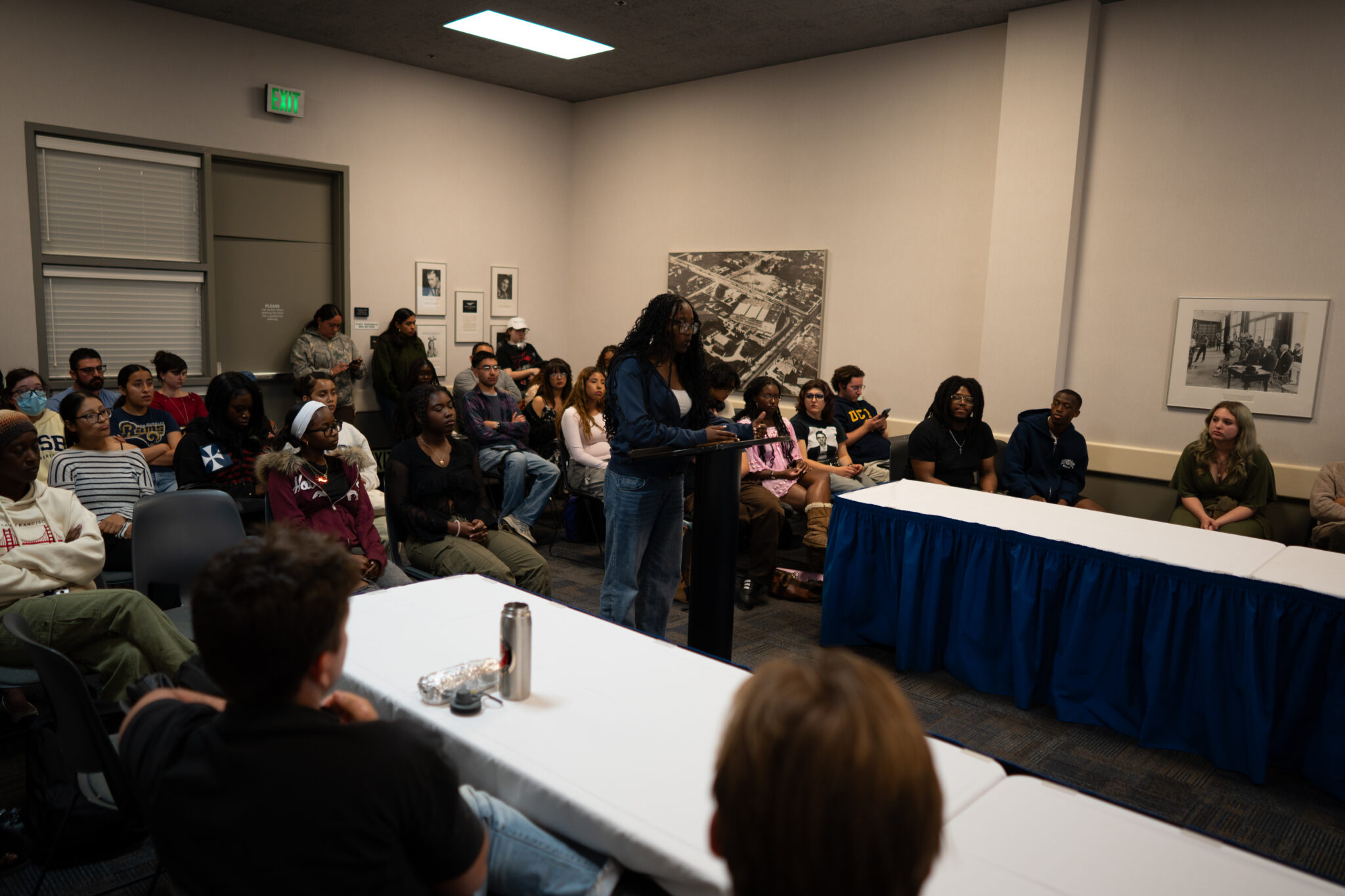
Public forum
Several members and supporters of the Associated Students (A.S.) Black Women’s Health Collaborative (BWHC) expressed concerns over the finance committee’s recent budget proposal for the 2026-27 academic year, which included a 63% decrease in their annual budget. Many members also expressed their frustrations over alleged anti-Blackness within the Association as a whole, due to the proposed cut in combination with an inactive advisor for two quarters.
The BWHC requested a $124,800 operating budget for next year and received a proposal of $33,000, only $9,600 of which was allocated for special projects. As the only A.S. entity that specifically serves Black students on campus, BWHC Co-Chair and third-year communication major Fatoumata Kéré emphasized how many different Black organizations they financially support. With the proposed budget, the BWHC would have to stop funding those groups and significantly cut back on its own events.
“All of the emotions we express here today are real-life struggles that we have been forced to deal with on our own, because we are overlooked as a marginalized organization,” Kéré said.
BWHC’s Co-Chair and third-year sociology major Queen Allah said the budget proposal was “disrespectful” and would essentially take away the BWHC’s power to do any work within A.S.
“This is not just a reduction, it’s an effective removal of our ability to operate as a [Board, Committee and Unit (BCU)] on this campus,” Allah said.
A.S. President and fourth-year Spanish, communication and global studies triple major Le Anh Metzger presented her own budget proposal which included $99,000 for the BWHC. The Senate will deliberate and approve the official A.S. budget at its Week 5 meeting.
Next, the UC Santa Barbara chapter of the Young Democratic Socialists of America (YDSA) Secretary and third-year feminist studies major Alexandria Ewing presented the Senate with a future funding request of $500,000 for its sanctuary campus campaign. YDSA is currently in negotiations with the University to implement its demands, but needs external funding for the Dream scholarship and other demands.
Then, A.S. Living History Project Chair and third-year history of policy, law, and governance major Samantha Dillon requested that the Senate consider reinstating its budget, after it was completely cut by the finance committee’s proposal. The group was on hiatus for three years but was reinvigorated this year. Dillon emphasized that they need a budget to continue their work of documenting student activism.
Legislation adopted
First President Pro Tempore and second-year political science major Evan Sussman, Senators fourth-year history of policy, law and governance major Yuchang Jiang, fourth-year sociology major Mira Than and fourth-year history of policy, law, and governance major Vanessa Manakova introduced a bill to standardize A.S. departments and BCUs. The bill would standardize the internal structure of A.S. by clearly defining departments and BCUs, as well as clearly tracking BCUs’ meeting minutes. The Senate went on to adopt the resolution.
Second President Pro Tempore and fourth-year political science major Melanie Jones and Senator and first-year physics major Alec GeoSimonian introduced a bill to establish A.S.’s support for building student housing at the Centennial House site. The bill, which was initially authored by Internal Vice President and fourth-year history and global studies double major Enri Lala, with his Chief of Staff and second-year comparative literature major Casey Carnow, would repurpose previous Chancellor Henry T. Yang’s former on-campus home, the Centennial House, into student housing.
Following the purchase of a $7.8 million chancellor residence by the UC Regents, GeoSimonian argued it is a “no-brainer” to transform the Centennial House space into student housing now that it is vacant. Senator and second-year political science major Erica Sherkin brought up concerns with building housing on this site, considering its proximity to the lagoon and having a construction site near the Research Experience & Education Facility (R.E.E.F.), a prime location for aquatic research.
GeoSimonian responded by saying he doesn’t see this as a “barrier,” and suggested that the California Coastal Commission won’t “make a big deal out of it.” Lala also spoke in support of building housing on the site without disturbing research.
“We’ve sent people around the moon and back … We can absolutely figure out how to isolate a building site such that it does not disturb people across or people doing research below,” Lala said.
The Senate adopted the bill.
Later in the meeting, Than introduced a resolution to commemorate UCSB’s “epic victory royale” in “March Yakness” on the college social media app Yik Yak. After discussion on its timeliness and relevance, the resolution was passed.
Senator and fourth-year political science major Keizo Ono, along with Senator and third-year economics and philosophy double major Noah Luken, introduced a resolution condemning the Save Student Services fee initiative. Ono said the resolution is not an attack on the specific services, but rather represents undergraduate students who may be “burdened” by the fee increase. The Senate adopted the resolution.
GeoSimonian and Sussman introduced a bill to condemn Executive Order 14391, which granted the United States Secretary of Energy the power to invoke the Defense Production Act of 1950, which led to the restart of the Santa Ynez Unit oil pipeline on the Santa Barbara coast. The Senate adopted the resolution.
Legislation proposed
Sussman, along with Jones, proposed a bill to formally codify the appointments tracker in legal code. The bill would appoint the Committee on Committees an appointment tracker to prevent “excess burden” being placed onto the Senate. The bill was referred to the executive committee.
Next, Jones and Sussman proposed a bill to reassign the executive swearing-in ceremony to the spring State of the Association, as it would allow the new A.S. executives and the 77th Senate to be within their roles by the Tuesday before the next senate meeting.
GeoSimonian raised constitutional concerns, arguing that the A.S. constitution states the transfer of power begins after the adjournment of the Senate’s last meeting. Sussman clarified that the swearing-in would be ceremonial and not an official transfer of power.
The bill was referred to the executive committee after Senator and second-year chemistry major Nadine Malhis recommended reaching out to the elections board to ensure executive candidates are aware of the change.
Senator and fourth-year history and global studies double major Neo Harter proposed a bill in collaboration with second-year applied math major and Secretary of the Outreach Committee Luke Lopez to purchase 12 whiteboards for the UCSB Library.
Harter said he spoke with students who had been affected by the “scarcity of whiteboards” in the library. The bill requests $15,000 from Senate Unallocated to order 12 LibBoard whiteboards. While Sussman said the idea was “phenomenal,” he said the bill would be a “quarter and a half” of the cost toward late-night study, which he said the library is not yet “willing to use [their] money for.”
Harter explained that the bill wouldn’t give money to the library, but rather gift the whiteboards.
“This whiteboard project doesn’t give us significant negotiating power,” Harter said. “They’re not going to change their position because of this … the only thing that’s going to change is us potentially doing it or not.”
The bill was eventually referred to the advocacy committee.
A version of this article appeared on p. 4 of the April 30, 2026 print edition of the Daily Nexus

