
Opinion: How creatives bring light to environmental issues
April 24, 2026 at 3:30 pm
Advocacy can come in so many different forms of human expression. Subtly or intensely, ongoing or in bursts, making a change in the world starts with being heard. The entertainment industry has often found that sweet spot for attracting audiences while guiding them to a deeper understanding. Where science meets art, filmmaking is one creative strategy to share a voice and tackle important local topics about the world around us.
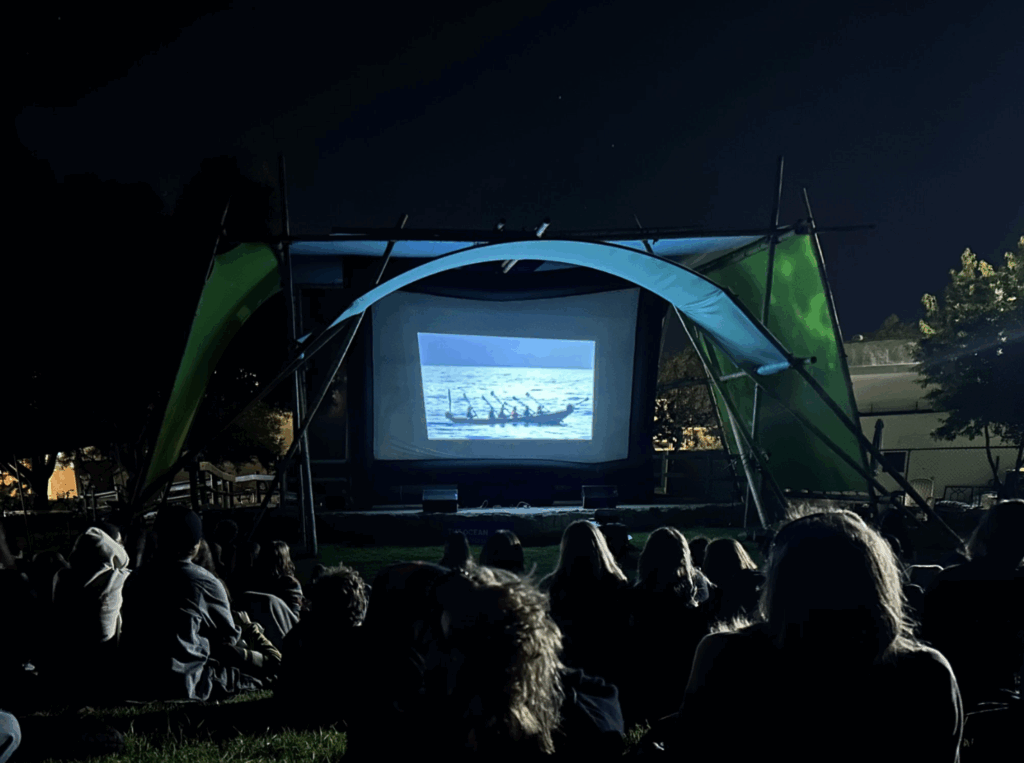
Surfrider Foundation and Associated Students Earth Day hosted their first ever Environmental Film Festival at sunset on April 14 at Anisq’Oyo Park, featuring five student-made short films debunking topics related to the local environment, ecology and cultures. The Surfrider Foundation’s mission aims to protect our oceans for the benefit of the Earth and the people to enjoy it. What started as a small group of surfers in Malibu has turned into an expansion of over 200 student organizations along the coast, campaigning against local issues and fighting for beach restoration and preservation.
With Earth Day just around the corner, UC Santa Barbara is promoting a series of events locally to focus on celebration and awareness for keeping our Earth well cared for. This poses the question for students to think about on a personal level: What does Earth Day mean to you?
Before the film screenings, the venue offered several pop-up booths promoting sustainable activities and merchandise for Earth Day. These included free block printing, hand-made jewelry and art, thrifting and local photography. All of this was entertained by live music, vocals and acoustic guitar, as people began crowding the outdoor venue in the grass. Sustainable practices are critical to combat the constant rise of overconsumption and waste, so filling the area with vendors sharing the same values these films were created to represent was intentionally impactful.
The first short film presented was created by Talia Frank, titled “Hydra on the Horizon,” a documentary-style film about Sable Offshore and their drilling practices, a legal battle that has continued to be fought for decades. This film features videography from 1969, 2015 and present day, showing the recurring struggles of oil drilling practices completely disregarding our oceans and the impending threat of an oil spill reoccuring. It was crazy to see the varying sources interviewed, ranging from college-aged students to older generations of locals who were there to witness the Refugio oil spill so many years ago. This film is especially relevant today with the re-opening of the controversial oil pipeline as of this past March that has resumed operations. While the increase of oil production might be good for the economy, its possibility for leakage poses a huge threat to the ocean and all the animals inhabiting the area.
The next film, “The Salt on Our Skin,” was directed by Alessandra Puig-Santana and covered the cultural relationship between the tides and diverse communities. She highlighted the many people who have firsthand felt the struggles of racism in their local surf spots and are working to reclaim what is rightfully theirs: inclusivity and identity. While this film centered around coastal communities in Southern California, its themes run much deeper as there are communities fighting for beaches, mountains, forests and all sorts of environments everywhere. Nature and culture should be commemorated together, and the makers of this film merged compelling visuals with real human stories that encapsulated that need for that belonging and celebration of identity.
The following screening was “quwa’,” directed by Jonathan Coronado, Ryan Grant, Jade Ipiña and Catherine Scanlon. This film brought light to the small island most people probably didn’t even know was an island, right beneath the Santa Barbara Airport. Surrounded by marsh, this sanctioned property is originally home to the Chumash who were kicked from their land and have made numerous peaceful but unsuccessful attempts to share it. They aim to bring biodiversity and culture back to its grounds. Once again, while this issue is local and borders our own campus, the film addresses the global issues of Indigenous populations being forcibly removed from their ancestral homelands. Just because these once biodiverse lands have been turned to state-owned properties and businesses does not mean that it’s too late to keep fighting for restoration.
The next screening presented was “The Bear Beneath,” directed by Olivia Hille and dedicated to uncovering the near-extinction of grizzly bears and the human tendency to destroy the things that scare them. The film beautifully painted grizzly bears as the gentle creatures they are rather than the scary predator humans have convinced themselves to fear. This film was very touching on an emotional level and perfectly conveys the conflict of man versus nature. The antagonistic characterization of bears and harassment against their species is heartbreaking, but this film sparks hope for the return of their species in California through sanctuaries and education efforts.
The final film to conclude the night was “How’s Devs?” Directed by Piers Nicklin, this screening dove into the topic of surf culture within Isla Vista’s tight-knit community. Its purpose catered to a specific audience but promoted the surf community as welcoming to all skill levels. This film was a light-hearted and uplifting end to the night with feel-good vibes and beautiful videography of our local waves at Devereux Beach. As someone with a surfboard collecting dust in my backyard, I actually felt more inspired to put myself out there and hit the waves. No judgement, no rules. The first step is just getting out in nature and having fun.
At the end of the night, the audience voted on their favorites. “quwa’” was nominated as the most informative film, and “The Bear Beneath” took home two titles as the most visually appealing and an overall favorite. All short films screened that night were well applauded, and directors received certificates for their participation in the showing.
“I didn’t need people to agree with this,” Hille, graduate film student and creator of “The Bear Beneath,” said. “I think it’s really important that we face environmental issues with an open mind.” She shared her experiences working on this project for a class at UCSB centered around environmental filmmaking. “There’s so many different ways to make a change. This medium [filmmaking] is very powerful because you get to see their emotion, you get to hear their emotion; there’s so many aspects.”
Through the intense production of sound, visuals, and technology, this blended craft of filmmaking has so many capabilities for making an impact on the environment and the world around us. Films among so many other forms of art and human expression have the ability to plant a seed into the minds of viewers, ones that would not normally be sought out for but have raised awareness that sparks difficult conversations and inspires initiative.
Attending the Environmental Film Festival felt like being set back in time in the most cliche way possible. Seeing people gathered around in blankets surrounded by human-made art, music and a beautifully lush field from the recent rainfall was very grounding to nature and one’s surroundings. To just take a step back and enjoy this moment, one that isn’t monetized or serious; just art made by humans, for humans. To me, that’s what Earth Day is about.
Il est toujours gratifiant de constater qu’une plateforme respecte réellement le temps de ses utilisateurs. Sur royals tiger, tout est pensé pour que l’inscription et l’accès aux jeux soient quasi instantanés, sans lourdeurs administratives inutiles. C’est ce genre d’efficacité, couplé à un service de paiement ultra-rapide, qui définit aujourd’hui l’élite du divertissement numérique en France.
I’m thoroughly fascinated by the ongoing hydrologic and tectonic forces at play near The Geysers, California! There are several minor temblors occurring there almost on a daily basis. Indeed, the water is being pulled up to the earth’s surface by gravitational forces influencing the magnitude of the quakes. The ongoing dynamics of these movements still remains much of a mystery to this day by seismologists. However, a significant seismic event of magnitude 4.4 occurred there this morning @2:42 AM PDT. It was felt throughout the North Bay area and as far south as San Jose. My brother, who is retired,… Read more »
Legally speaking, it was essentially a merger with Stantec according to Bloomberg, and my brother utilized the services of an attorney specializing in mergers. I am privy to his dealings with that attorney.
An excessive heat warning has just been issued for the Bullhead area. The temperature will be in the triple digits tomorrow (May 8th). When I first arrived here, the triple digits didn’t start in earnest until May 20th–the global warning effect at play. Still, my bother and I can enjoy our early morning breakfast at my place and choose between my two outdoor patios!
Rubio met with the Pope today! There is a property owned by the Vatican nearby that is rented to McDonald’s for a reported 30,000 Euros per month. What a “commercial
perversion” and distortion of the “faith”! Hilarious! Such a travesty to promote such junk–just ask Bill Clinton! We truly collectively are a living, still breathing, dystopia! Did you hear about Rubio’s gift to the Pope—he’s a White Sox Fan, gunzel Where did you pick up that tacky crystal? At the airport terminal?
I just found this out tonight. When you use the MSN search engine and type in: michael w reilly-daily nexus, it spits out on its first page the domain xxxhdsexvideo.net followed by my name and the Daily Nexus. I’m telling you right now, MSN, from this site, your staff had better remove that from the search results immediately or I will file a multi-million dollar lawsuit against you for slander! I mean that tonight sincerely. I’m acutely aware that your ilk and the CIA/FBI use cookies to track my every move and are currently doing so as I speak. Rest… Read more »
12:30am MST-May 8th:
Now it has been removed! Thank you so very much Microsoft for your most expeditious response to this matter. You still are a gem in my mind! I am so glad to see that your ethics are paramount.
My dad turns 103 this coming July 5th! He is a UCLA grad (Class of 1947) and now one of the oldest World War II vets in Orange County, California. He still follows his beloved Bruins in all of their sports endeavors. All of his faculties are still sharp as a tack–impressive. I still trust his judgment over mine to this day–his IQ was tested early on @154 and he entered elementary school two years early. A member of America’s “Greatest Generation”, he could have climbed up the corporate ladder @ Aetna and moved all of us to Hartford, Connecticut,… Read more »
I have a brother who, with his family, lives in Vegas. We now follow each Angel baseball game religiously through every inning and set aside that three hour window to correspond via emails on the game’s progression. I use my computer. He uses an ESPN app connected to his iPhone to get his information. We just recently witnessed that historic game with the White Sox just a few days ago–a unique anomaly that hadn’t occurred in over seventy years! It was the phenomenon of three hit batsmen occurring in a single game with the bases loaded. The Angels won that… Read more »
Could a Mike Trout trade now be in the cards? I think so!
I’m thinking otherwise now, after examining the ongoing WAR metrics embroglio.
Program the proprietary algorithms into AI.
Did you just read the MSN article about Lee Strobel on the web as I speak about the communion between science and religion? He asserts in a nutshell that such is the case. My hypothesis at this point suggests that “God” exists in the 11th dimensional brane found in Witten’s M-theory. Will this hypothesis be ever proven as a matter of physics formula? Let’s all get to work! There’s much to accomplished here!. I know that the esteemed faculty at the Theoretical Physics Department @UCSB is working on this diligently and tirelessly. I’m sure they’re in constant consultations with Sabrina.… Read more »
This is the Holy Grail of physics fast approaching!
Let me now attempt to explain the nexus between the science and the metaphysics of “God” in greater detail from the standpoint of my one and only one OBE. During that one night in my sophomore year at Foothill High School in North Tustin, I settled down on my bed prostrate, facing upwards like an Egyptian Sarcophagus. I uttered the words softly, simply, with the honest heart of a 16-year old, having recently visited the Ramakrishna Monestary and having gazed into a monk’s eyes. “I love you.” Nothing happened. Again I said the simple prayer. I lay motionless facing the… Read more »
I’m back! 9:17 pm MST–May 8th, 2026. The existential question I have for Sabrina tonight and, by extension, the UCSB Center for Theoretical Physics in re: Celestial Holography: How can a 2D 11th dimensional brane (“flat” in a sense) composed of just pure photons (which can be both a wave and particle simultaneously as Einstein has since proven) ever gain an angular momentum through the “spin memory effect?” What are the dynamics at play here? How does the “disconnected” force of gravity fuse in this dimension? Perhaps one of the physics professors there can attempt to answer this in layman’s… Read more »
The twenty minute video helps somewhat. At this age, my intuitive grasp of differentials and integrals is fading. I’ll play the video again tomorrow morning with a fresh start and when my mind is clear.
I’ve gained an understanding of the gist her discovery. I’ll try again tomorrow.
She shows that the brane theory is but a part of a larger integration of the “twisted gravitational wave.” The dynamics of gravitational waves is paramount to the discovery of the Celestial Code–not the other way around as I have since discovered tonight. Goodnight.
Both are extremely important. How is string theory integrated with gravitational waves?
String theory integrates with gravitationally induced “twists” (such as those from cosmic strips or extra-dimensional modes) by proposing that the fundamental constituents of gravity are vibrating one- dimensional strips rather than point particles. In this framework, “twisted”
effects are explained through specialized string solutions, such as cosmic string loops generating unique gravitational waves, or extra-dimensional geometries altering wave properties.
String theory predicts extra dimensions, which, if present, should alter
gravitational waves, massive events like black hole mergers, potentially introducing a :”breathing node” or higher frequency or higher frequency signals that differ from standard general relativity.
Cosmic strings, incredibly dense “cracks”, in the universe’s fabric, are predicted to vibrate and move in ways that produce distinctive gravitational waves.
Gravitational waves have since been detected. In fact, the Nobel Prize was awarded relatively recently for their discovery.
Latest ticker on Sable Offshore (SOC): Twelve dollars and some change.
T minus two months and counting.
T minus six hours and counting before the next Angel game.
My only son, Dennis, is a prosperous real estate agent now, also based in Laguna Niguel. He has two lovely daughters. He and his wife are both graduates of UCI. He was conceived in the condo Cathy and I owned up in Presidential Heights on Calle Cuervo, San Clemente. The city really should be renamed San Clemency, but there is a nucleus of Republicans residing therein–that event won’t happen anytime soon. Don’t hold your breath. It is worth over $979,000 on the market now according to Zillow. I don’t entirely agree with their metrics as they are sometimes not privy… Read more »
Currently the temperature here in Bullhead is 92oF, going up to a projected 102o.
There is an excessive heat warning in effect. I just turned on the fans and A/C units last night. They will be going now non-stop for the next five months. I will begin my daily
“cocooning process” in earnest now, sealing off strategic door portals for maximum enclosed cooling effect.
105oF now in Bullhead as I speak–new all-time record for the day.
Now back to the Angel/Blue Jay game!
Remember this: Contrary to popular belief, “sweet Jesus” didn’t die with a cloth wrapped around his private parts–in Roman times it was the common custom to crucify their murderers and political malcontents in the NUDE!
Now back to the Angel game!
Are you all aware of sheriff Bianco’s “crazy cowboy” remark? I’m not gasping for air at this point.It was just simply hilarious–what you would expect from the likes of him and his diminishing minions.
Now back to the game.
Have your read about “Maori atheism” on the religion for breakfast portal?. It is not really atheism but a reclaiming of their God-given culture. Like the Chumash of Santa Barbara County, I am totally and unequivocally with them on this. I love New Zealand with an unbridled passion! I got a taste of their passion when I spent time there on the little known Samoan Island of Tau–the very same exact spot where Margaret Mead did her research on the Nature v. Nurture anthropological concept. During my time spent in Oregon, I had a girlfriend who was the caregiver of… Read more »
When I jetted out from Tau to LAX, a short time later, I believe about ten days as I recollect, there occurred the strongest earthquake on the planet striking nearby–a
magnitude 8.1–a seismic “event” that stood the test of time for several years! Check the seismic records online—it will prove me correct. As I now recall, like a snake, I could sense the “energy field” building to an explosive boiling point. More on this one at a later date.
.
I can sense the same “energy vibrations” sometimes that snakes feel days before a significant quake! I don’t quite know how all this operates yet in my biophysical
electrical body, but it is true. I’ve even proved it on several instances on my ongoing twelve-year commentary here, if you do your due diligent research in the Daily Nexus archives. I am, indeed, the Tolen Marr depicted in Sunset Diaries: Future Nostalgia.
“Tolen Marr and the Bell of the Equinox”
(c)2026. All rights reserved.
Filmmaking, art, and storytelling – can make environmental issues more visible and emotionally resonant in ways that data alone often can’t. That idea connects strongly to how public awareness is shaped through multiple platforms, including advocacy and outreach efforts like those featured through community programs such as https://baartprograms.com/treatment/weekend-admission-hub-beverly. When creative work and community support systems work in parallel, they both contribute to awareness and action – one by shifting perception through culture, the other by addressing real-world impacts and providing pathways to support and recovery.