
(Back) to the moon and beyond: Artemis lifts off
By Anvi Murarka
April 24, 2026 at 3:24 pm
As Disney’s Buzz Lightyear famously declared, the goal of space travel is “to infinity and beyond.” NASA’s Artemis program is a serious attempt to make this a reality. Named after the Greek goddess of the moon and hunt, Artemis honors the legacy of NASA’s Apollo program that first carried astronauts to the moon in 1969, while charting an ambitious new course. While Apollo made history with a race to the moon, Artemis is designed for a more enduring mission to create a sustained human presence in space along with a deliberate path towards Mars.
Unlike the brief surface visits of the Apollo era, Artemis is laying the groundwork for a lasting human presence on and around the moon. Central to this effort is the Lunar Gateway, a small space station that will orbit the moon and serve as a staging point for surface missions and future journeys beyond. Complementing the Gateway are plans for reusable lunar landers and surface habitats, which will enable extended stays (even up to three months!) and ongoing scientific research in areas such as space weather and solar radiation in ways that simply were not possible before.
Artemis unfolds as a sequenced series of missions, each increasingly ambitious. The first, Artemis I, was launched in November 2022 and sent an uncrewed Orion spacecraft on a journey around the moon and back. After traveling nearly 1.4 million miles over 25 days, Orion made a dramatic return to Earth, enduring temperatures approaching 5,000 degrees Fahrenheit during reentry before splashing down safely in the Pacific Ocean off the coast of Baja California. It was a triumphant conclusion to a mission that proved NASA’s Space Launch System and Orion spacecraft are ready for the demands of deep-space travel.
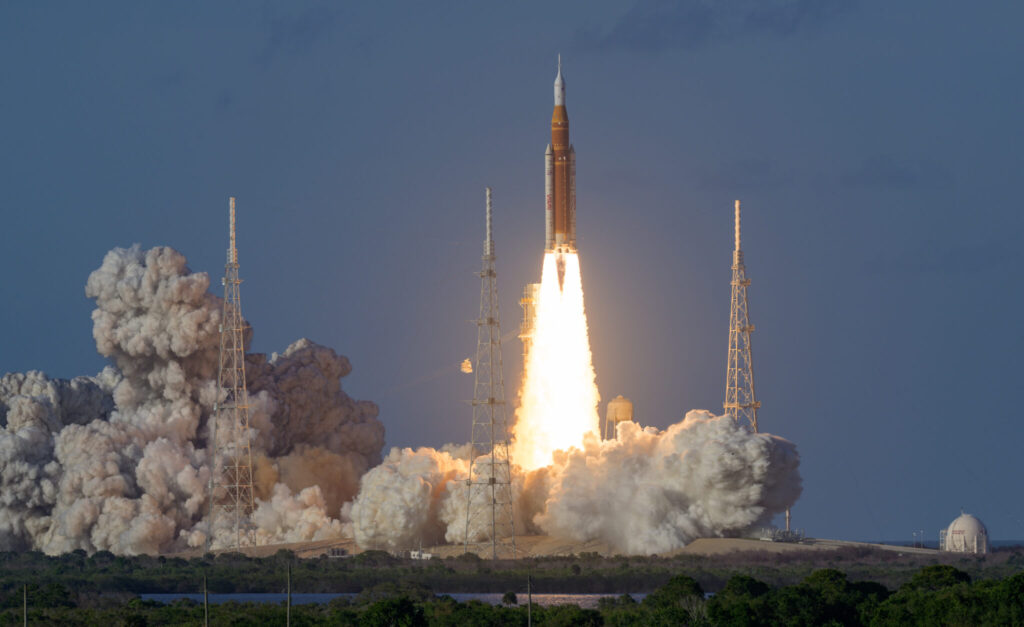
Artemis II carried that achievement further, placing astronauts aboard Orion for the same trajectory and marking the first time humans have ventured beyond the moon since the Apollo era. Its crew members helped validate the life-support systems and operational procedures that deep-space travel demands, such as EVA suit leak checks and manual piloting. Artemis II concluded on April 10, 2026, when the Orion capsule splashed down in the Pacific Ocean off the coast of San Diego – carrying Commander Reid Wiseman, Pilot Victor Glover, Mission Specialist Christina Koch and Mission Specialist Jeremy Hansen safely home after a nine-day mission that set a new record for the farthest distance humans have ever traveled from Earth. The crew also proposed naming two newly observed lunar craters. The crew suggested “Carroll” in honor of Wiseman’s late wife who passed away from cancer, and “Integrity” to honor their Orion spacecraft.
The program’s most celebrated milestone, Artemis III, will land astronauts near the moon’s South Pole, a region of exceptional scientific interest due to the presence of water ice in its permanently shadowed craters. This mission will also make history by landing the first woman and the first person of color on the lunar surface, a meaningful reflection of NASA’s commitment to a more inclusive future for space exploration.
The Artemis mission delivers significant scientific promise. With the right technology, the ice discovered could even be converted into oxygen and hydrogen, supporting human life on the surface and even serving as fuel for missions reaching further into space. From fresh lunar samples, detailed geological surveys and even an in-depth study of the moon’s South Pole, the mission can reshape our understanding of how the moon (and Earth) came to be.
What an inspiring article! It’s amazing to see how the Artemis program is pushing space exploration forward and inspiring a new generation to dream bigger about the future of space travel.
drift boss
Hello folks! While trying out a new discount shopping platform over the weekend, I really did not want them storing my personal mobile info forever. Using a temporary phone number enabled me to capture the registration code instantly and finish setting up. For handling quick web registrations anywhere in the United Kingdom, it is an extremely handy way to protect privacy.