
Empty pews and oceanic feelings: Gen Z’s search for a secular god
April 16, 2026 at 9:00 am
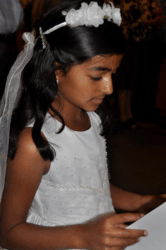
When I was 14 years old, I volunteered at my church’s annual charity auction. Among baked goods, various artwork and vouchers for local businesses, a reserved parking spot and front-row seats in the pews for Christmas Eve Mass was up for sale. I remember thinking this was genius — my family was always sure to arrive at Mass at least 30 minutes in advance to secure a spot. Not even a good spot, just space for four people to sit together in a pew.
This Christmas, just seven years later, my dad arrived at Christmas Eve Mass 10 minutes late and he was able to find parking and a seat in the front half of the church without issue.
This isn’t a story unique to my hometown. Pews are emptying, churches are closing. It’s become undeniable — America is secularizing.
Admittedly, it’s a bit bizarre for me to be raising alarm bells about this because I’m not particularly religious.
I grew up in a church-going family, and I spent my most formative years in Sunday Mass and weekly youth ministry. But as we got older, life got in the way and we eventually stopped going to church. One by one, my parents and older sister fell out of their faith, but I clung to mine through adolescence, insisting that my mom continue to take me to youth ministry, even if we weren’t going to Sunday Mass anymore.
New York Times Opinion writer Jessica Grose said in her five-part column on the secularization of America that many shifted away from Christianity because they didn’t agree with the political leanings of the church. And while I don’t doubt that that’s true, it wasn’t my story. I went to a Bay Area Catholic church that was, all things considered, pretty woke — they were expressly pro-gay, had a big focus on community service and tended to stray away from conversations about abortion or contraception. So, while I knew that considering myself Catholic contradicted my politics, I was rarely confronted by it.
The reason I lost interest in the church wasn’t because I was struggling to invest in the community, but rather that I had invested more than I realized.
I felt very strongly that there was power to communal worship; it was impossible for me to not feel it when we prayed together. That took me much further than my belief in Jesus Christ or any of the other particularities of religion.
Author Fredrik Backman, who’s probably the closest thing I have to a spiritual leader these days, captured this feeling quite well in his latest book, “My Friends”: the ever-contrarian Joar exclaimed, “I don’t even think all the people who go to church every Sunday believe in God. I think they just need company. To feel that they belong to a group.” And the sensitive hero of the story responded, “But I don’t think that means that God doesn’t exist, Joar. I think maybe that’s what God is.”
I probably wouldn’t have agreed with that in 2019, but I did in 2020, when the magic of gathering in physical space was taken away altogether. I realized that for me personally, the magic was more in the church than in Christ himself, so I slowly fell out of my faith.
There are, of course, many other kinds of communal gatherings that feel divine — Isla Vista is full of them. However, a church community has many qualities that are extremely difficult to find anywhere else. As Grose wrote, “A soccer team can’t provide spiritual solace in the face of death, it probably doesn’t have a weekly charitable call and there’s no sense of connection to a heritage that goes back generations.”
Not to say there haven’t have been attempts — Grose recently wrote about one, the International Association for Near-Death Studies (IANDS) annual conference, where scientists, survivors and grievers gather to discuss the under-ratedly thin line between life and death: “[I]t’s an open question whether the organization can grow to serve as a substitute for a mainstream religious community for more than a select few. When you do not have the connective tissue of a church building or the Old Testament, it is that much harder to maintain an ongoing spiritual relationship.” IANDS is aiming to bridge that gap by increasing their online presence.
This lack of organization also severely hinders the political power of the non-religious. As sociologist Mayer Zald explained, organized religion unites people in routine and belief, which means religious leaders have a passionate audience — spiritually bonded and ready to mobilize. If America is secularizing across partisan lines, the resulting power imbalance is non-random and highly consequential.
But yes, before 2020 I was deeply enchanted by the figure of the church. It made me feel connected to my family in India, who had been practicing Christianity for generations. I was obsessed with my youth group leaders, who were some of the only adults in my life I could really talk to other than my parents. And I felt a sense of power and solidarity when we raised our voices together in prayer.
However, community can’t be all there is to it. Because until I was 15 years old, I would pray every single night before bed. That was something I found to be distinctly powerful, even though I was all alone.
My post-pandemic lack of spirituality was in large part because of the fact that I had never been faced with death or grief, so I didn’t have a good reason to deeply consider other dimensions of life. That all changed my freshman year of college, when I lost someone very close to me. The only thing I could think to do was to go to church. And to my surprise, I found myself believing in God again. Not because I was taught to or because everyone around me did, but because in the face of immense grief, I genuinely didn’t feel like I had any other choice. And I once again truly believed that there was something in the air that I could feel more strongly within the walls of a church.
I remember that feeling vividly, and I’m thankful for the comfort that it gave me in those times. But in the years since, my Christian faith subsided once again. I don’t feel a strong connection to the physical church anymore, but this sense that there was something abstract and eternal behind the sky — that has remained.
This was a confusing in-between, and I couldn’t really put it into words until I read “Civilization and Its Discontents” for a comparative literature class. In it, Sigmund Freud describes his friend’s theory that religious energy is derived from an “oceanic feeling,” an inherent sense of connectedness to all natural things and an awareness of an eternal force: “One may, he thinks, rightly call oneself religious on the ground of this oceanic feeling alone, even if one rejects every belief and every illusion.”
I’m not here to argue whether you, personally, should or shouldn’t have this feeling. Freud, to my disappointment, thought that an inability to detach yourself from the universe is correlated with “infantile helplessness” and “limitless narcissism.” In Aldous Huxley’s “Brave New World,” a book I can’t help but bring up, John “the Savage” insists “it is natural to believe in God when you’re alone — quite alone, in the night, thinking about death.” A sentiment that implies a completely secularized society is unnatural, occurring only in a dystopia like that of the novel, where everyone is too numb and chronically occupied to have abstract thoughts about the nature of the universe.
The reports of America’s “dechurching” may give the impression that we’re approaching that dystopia, but I don’t necessarily think that’s the case. At least in my immediate circles, I’ve noticed an uptick in people of my generation reaching for alternate manifestations of the divine.
The Women Center’s choice for their fall Feminist Book Club was “The Witch Studies Reader,” which is indicative of this trend in and of itself. But maybe more convincingly, the chapter “Religion and Magic through Feminist Lenses” cited a 2018 Pew Research Center study where 29% of respondents said they believe in astrology and 42% said they believed “spiritual energy is energy located in physical things like mountains, trees, crystals.” The authors concluded, “Not everyone doing tarot or astrology fully embraces magic as cosmology. But engagement in such practices is one of many indications that secularization is not the linear and progressive force theorized by Western social scientists and many second-wave feminists.”
The chapter continues that academics should abandon their binary perspective on religion versus magic, and I would argue that believers and non-believers should do the same.
A few weeks ago, I was chatting with a man selling crystals on State Street and I asked if he could feel their energy. He said he absolutely could, and that if I held one in my hand and meditated I would feel it too. I think it’s very likely that he would feel something similar if he were holding a Rosary instead, as would Catholics with a crystal.
I know that not everyone feels the need to channel their meditations into concrete objects or concepts of God, but it’s clear that many do. Whether or not that energy has a supernatural power that actually stretches beyond the impact on our individual selves is wholly irrelevant, at least to me.
I recognize that many people take the particularities of their religions very seriously, and I don’t mean to trivialize or disrespect that. But, at risk of overgeneralizing, people worship with similar methods across major religions: meditation, ritual, self-denial, song, etc. I think it’s fair to argue that these practices have inherent power, while understanding that many practitioners truly believe they’re also appealing to a specific higher power.
Although my attachment to my Catholic faith has waxed and waned, I’ve always found it rewarding to honor my oceanic feelings, and for that reason the growth of spirituality in the face of America’s “dechurching” brings me hope. However, I think the individualization of our spiritual practices has great capacity for harm — on a personal, societal and political level. Moreover, I have no idea what a healthy spiritual community could even look like. I truly believe that answering that question is a definitional task of our generation.
Sneha Cheenath hopes this article doesn’t take her out of the running for next Pope.
Hallo! Ich hatte in letzter Zeit echt eine Pechsträhne bei meinen alten Anbietern und wollte schon fast aufhören. Dann habe ich ohmy spins entdeckt und nach einem mutigen Einsatz beim Slot Razor Shark endlich wieder richtig abgesahnt. Besonders für Spieler aus Deutschland gibt es dort exklusive Casino-Boni, die den Start enorm erleichtern. Die Auszahlung war super schnell auf meinem Konto. Wer eine faire Gewinnchance sucht, sollte es dort probieren.
Many people seek a church that teaches Scripture with clarity while creating a welcoming environment for every visitor. A non denominational church in Norcross offers Bible-based messages that connect timeless truth with everyday life. Worship services encourage spiritual growth, meaningful relationships, and practical faith. Families, young adults, and seniors can learn together through engaging sermons and community activities.
I was moved by this reflection on Gen Z’s spiritual search, as finding shelter and meaning requires strong protection like gresham roofers build overhead.