

The MultiCultural Center, in collaboration with local housing resources, hosted a housing discussion on Jan. 20. The event aimed to inform attendees about campus and Isla Vista’s housing options, connect students with housing resources and provide a space for open dialogue on housing affordability.
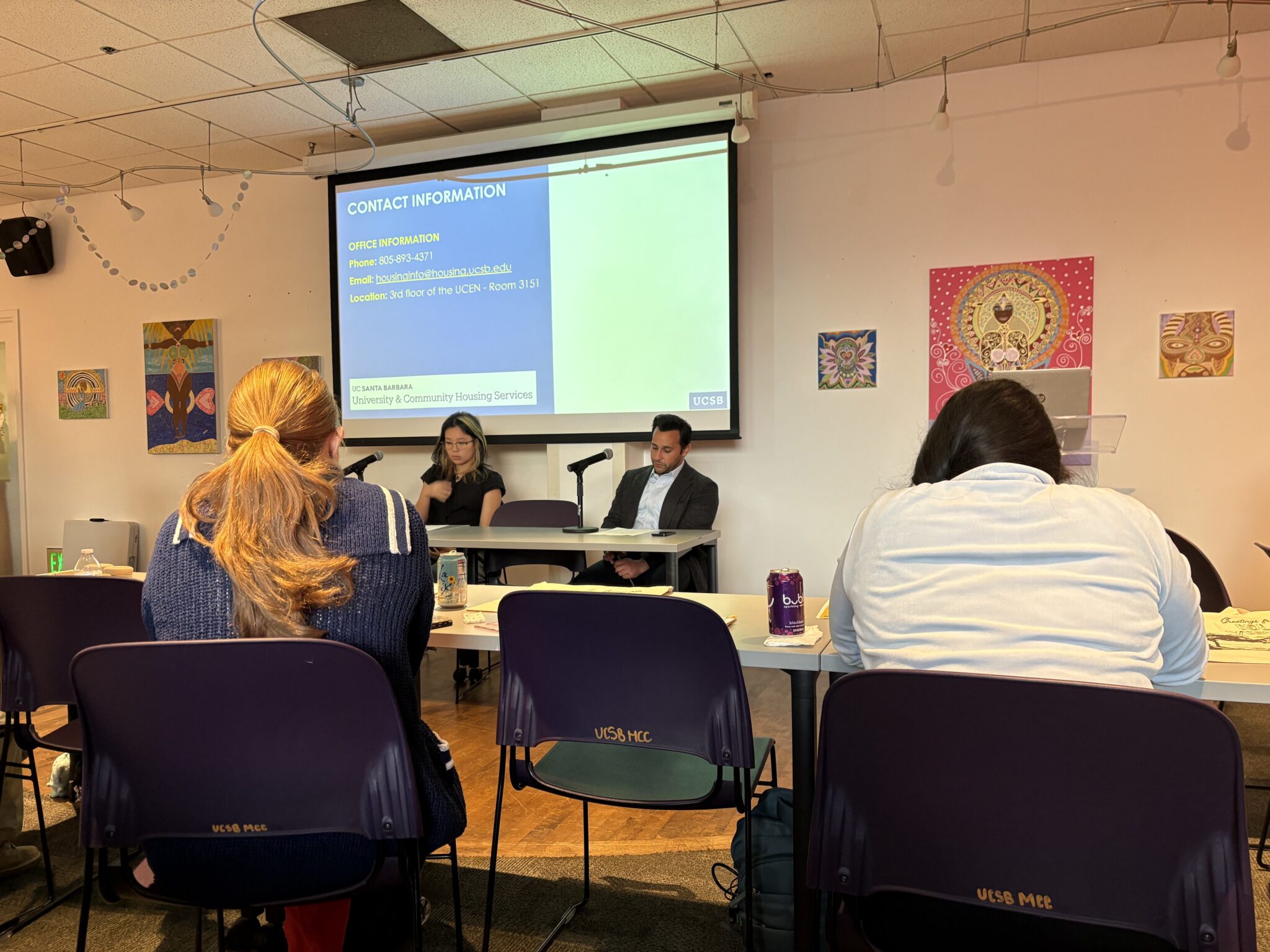
The MultiCultural Center hosted a housing discussion on Jan. 20 to inform students of their on and off-campus housing options. Elijah Obando / Daily Nexus
The event, titled “What’s going on with housing?” was held in collaboration with UC Santa Barbara University & Community Housing Services (UCHS), the Blum Center’s Campus Housing Coalition, the Isla Vista Tenants Union (IVTU) and the Isla Vista Community Services District (IVCSD).
The event began with a presentation from UCHS Manager Jenn Ja Birchim. Birchim informed attendees about the process of getting university housing for continuing students, explaining that typically 20% of the continuing student population receives university housing.
“Last year, we had about 5,100 applicants and we were able to offer [housing to] a little over half of the students that applied for campus housing contracts,” Birchim said.
Birchim clarified that housing contracts are based on a weighted lottery system and are not given on a first-come, first-served basis. This means that the system guarantees housing for certain applicants based on a criterion and then randomly selects the rest. Groups that are guaranteed include Regent Scholars, unaccompanied homeless youth, Guardian Scholars and veterans, though Birchim said they take up “a very, very small percentage.”
Birchim said that some applicants, though not guaranteed, are prioritized over the rest, such as students a part of the Promise Scholar program. Since many applicants are not guaranteed housing contracts, Birchim warned against students waiting until summer to find housing alternatives.
“We don’t really want students to wait until summer to figure out their housing situation, to hold on hope for a UCSB housing contract, because we don’t know whether or not we’re gonna have any space in UCSB housing until the new transfer [and] new freshman process ends, and that’s usually in probably late July,” Birchim said.
Birchim explained that UCSB’s student apartments are only available to third- and fourth-year applicants. However, this may change in the future after the construction of the San Benito Housing project.
Birchim also stated that with the demolition of the Santa Rosa Residence Hall set to take place at the end of the academic term, upcoming second-year applicants may be allowed to live in UCSB’s student apartments.
Birchim then shifted focus toward alternatives to university housing. She provided information for students about how to find housing in I.V. or the surrounding area. Birchim explained that students should know their budget, who they are going to live with and how to prepare for the leasing process. One of these resources is the UCHS Rental Listings website, which shows locations available for rent in the area.
“So you can all log in, and you can view [rental listings] by map, amenities, street, locations, Goleta, Santa Barbara, Isla Vista. I have two staff members that pre-screen any landlord before they list with us to make sure that scams don’t get through,” Birchim said.
According to Birchim, UCSB will be hosting three rental fairs in the upcoming months. The first fair will be on Feb. 5 at Storke Plaza, the second will be on Feb. 12 at the Corwin Pavilion and the last will be on March 3 at Storke Plaza.
The event concluded with a panel discussion presented by Becky Chen, a fourth-year sociology and film and media studies double major and student assistant for the Blum Center’s Campus Housing Coalition, and IVCSD General Manager Jonathan Abboud. Chen explained that the coalition is a research center on UCSB’s campus dedicated to housing and educating the student community.
The host and creator of the event, fourth-year economics and Black studies double major and MultiCultural Center programming assistant Thiana Aklikokou, explained that she created the event because of her own struggles with housing accessibility.
“All of this stemmed from my personal experience, having this rough time finding housing. I didn’t get housing my second year until August, like the end of August. So that’s kind of been why housing has been a thing for me ever since, ‘cause I just was like, it shouldn’t be like that,” Aklikokou said.
Aklikokou prompted the presenters with a series of questions.
“If you could change anything tomorrow, and you have the authority to do so, what would that be?” Aklikokou asked.
Abboud responded that he would make I.V. a city, and that he would have the University and and Isla Vista combined under one local government. Earlier in the panel, Abboud stated that the IVCSD has tried in the past to become a city but has failed every time.
Chen responded to the question by explaining she would close the inequality between property management companies and student tenants.
“I think it’s really important for students to get involved, but the barrier to that is our students are only here for around four years and because of their transiency, they don’t feel empowered to organize,” Chen said.
Aklikokou concluded the panel with a final question: “What is realistic [for the presenters to do] in the next one to three years or so?”
Chen responded by explaining that it is realistic to see more student engagement with upper levels of administration, such as the chancellor and higher officials in the financial aid office.
Abboud responded by saying that although it is realistic, it is most likely improbable that I.V. will become a city. He explained that a closer form of government with more power would be able to help I.V. residents more than under the county’s jurisdiction.
A version of this article appeared on p. 5 of the Jan. 29, 2026 edition of the Daily Nexus.



















The housing discussion helps students understand the opportunities and challenges, where finding accommodation can sometimes be as stressful as two players games competing in a lottery-style games.
Greetings to the community! I actually found this link in a YouTube comment under a review video. I was looking for a fresh start because my usual sites were just taking my money. I signed up for ivy bet and tried a few online casino bets to get the hang of it. The slots online were surprisingly smooth and didn’t lag at all. After a few spins, I secured a win that not only reimbursed my stakes but gave me enough extra to be really happy with my decision to join.