

The University of California Board of Regents voted to increase tuition costs based on inflation for incoming students and approved funding for UC Santa Barbara’s East Campus Housing project during its Nov. 18-20 meeting. Many students and faculty members voiced concerns over the tuition hike and other University-related matters.
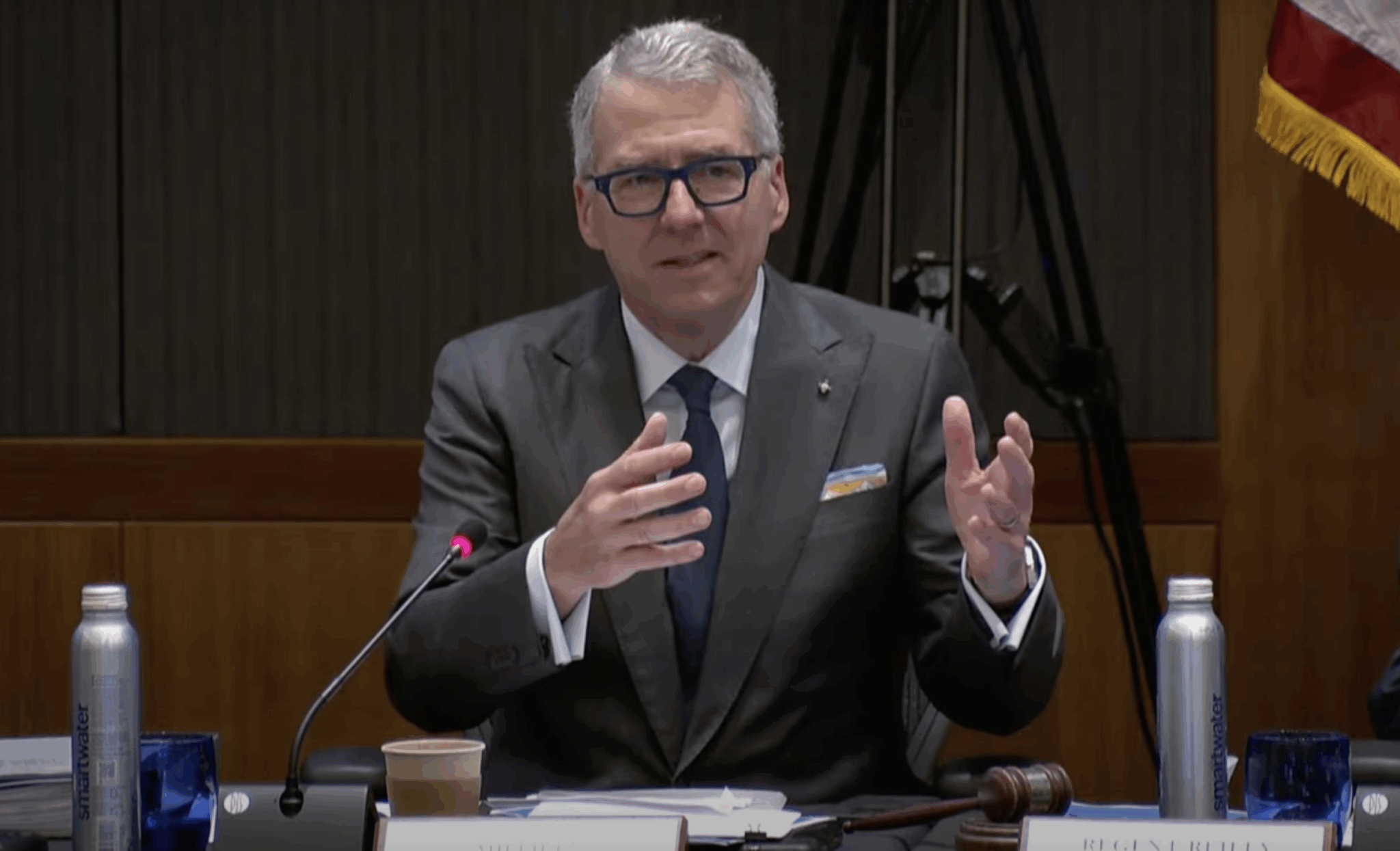
According to President Milliken, the UC faces unique challenges during this time, including rising operating costs, cuts in government funding, federal investigations and “preserving the critical balance between free speech and campus safety.” Courtesy of Board of Regents live stream
Held at the University of California (UC) Los Angeles, the Regents met to deliberate over various subjects, ranging from its finances to ways of mitigating federal actions regarding education.
Renewed tuition stability plan to increase incoming student tuition
The Board of Regents voted 13-3 to renew the UC’s Tuition Stability Plan on Nov. 19. Under the plan, students will pay a consistent amount of tuition based on the cost at their time of matriculation throughout their enrollment, unless they take longer than six years to graduate. However, the plan increases tuition costs based on inflation for incoming freshmen and transfer students.
Enacted in the fall of 2022, the plan aims to keep tuition stable for enrolled students while also enabling the UC to provide financial aid for low-income students and “preserve the excellence” of university programs.
The renewal of the plan includes modifications such as a reduction in the amount of capital generated from the plan that would be allocated for financial aid. The original plan allocated 45% of tuition revenue to financial aid, while the renewed plan decreased the allocation to 40%, with an eventual decrease to 33% “once the systemwide average return-to-aid rate reaches 33 percent of total Tuition and [Student Services Fee] revenue.”
The plan maintains a 5% cap on annual increases to tuition. However, it includes an adjustment that would enable up to 5% increase in tuition, even if inflation is below that percentage.
According to Nathan Brostrom, the executive vice president and chief financial officer of the UC, this adjustment was intended to serve as a safeguard against a “period of high inflation.”
Incoming in-state students for the 2026-27 academic year will see a 4.4% increase in tuition and other fees, amounting to a $654 increase. This change will generate an estimated $11.1 billion in revenue for the UC.
Although the renewal passed with a significant majority, UC Student Regent Sonya Brooks voted against the renewal. According to Brooks, a doctoral candidate in education policy at UCLA, she believes the Regents need to place housing insecurity and resource gaps across UC campuses under higher consideration, before raising costs for incoming students.
The renewal of the plan will last for seven years, until July 2033, after which it will be up for reauthorization by the Regents.
East Campus construction funding approval
The Regents approved $566,058,000 to fund UCSB’s proposed construction plan for the East Campus Student Housing project on Nov. 19. The project involves the demolition of Santa Rosa Residence Hall and the construction of four new six- to eight-story residence halls — providing 1,688 beds in total with 1,276 new beds in apartment-style units and 412 replacement residence hall beds.
The 1,276 new beds from this project, combined with the ongoing San Benito Housing Projects’ 2,224 new beds, will satisfy UCSB’s 2010 Long Range Development Plan, which stipulated the construction of 3,500 new student beds. According to the report, the completion of both housing projects will support the University’s goal to provide all first- and second-year students with on-campus housing.
In 2023, occupancy in campus housing exceeded capacity by 116%, forcing over 1,500 students into triple rooms designed for double occupancy. Once the East Campus housing project is opened, the University will be able to provide 13,500 students with campus housing, eliminating the need for triple occupancy in double rooms.
The plan proposes an average monthly rate of $883 per bed, 33% below the current market rate of Isla Vista.
The University also proposed a revised plan to renovate Ortega Dining Commons, as opposed to the original plan to demolish and replace the building, to keep up with an increased demand from future occupancy in the East Campus residence halls.
The total budget of $566,058,000 will be funded through $2.15 million from Higher Education Student Grant funds, $43 million from external financing supported by State General Funds for the Higher Education Student Housing Grant Program and $520,908,000 from external financing.
The University plans to demolish Santa Rosa Residence Hall and begin construction in summer 2026, with a scheduled completion in summer 2028 and occupancy in fall 2028.
2024-25 fiscal year financial report
According to the UC’s financial report presented on Nov. 19, the UC reported $8.4 billion in financing activities, which supported the construction of housing, research and academic facilities, as well as the expansion of university medical facilities.
Additionally, the report states that the UC’s revenues “modestly” exceed expenses. The UC’s investment performance has remained strong, particularly in the UC Retirement Plan — an investment fund which provides monthly benefits for eligible employees — which saw a 12.7% investment return.
The UC’s five medical centers — UCLA, San Diego, UCSF, Davis and Irvine — saw revenue growth driven by pharmacy revenue and higher volume of patients, earning a total of $2.219 billion in income.
Nov. 19 public comment
During public comment on Nov. 19, students and faculty discussed the affordability of higher education, protections for undocumented and international students and union contracts, among other topics.
UCLA student Daniella Abbott, the first student to speak, said she witnessed professors sharing personal opinions on “Israel and Gaza” and asked the Regents to implement “consistent and transparent” anti-harassment policies, guidelines “to distinguish protected political speech from targeted hate” and facilitate dialogue “that recognizes everyone’s humanity.”
Several students and faculty spoke against the Tuition Stability Plan, including Sherry Zhou, a UCLA student. Zhou urged the Regents to reject the plan’s renewal, citing the 250 public comments made against the plan from UCLA students as well as “hundreds” of other students across the UC system.
“The most troubling aspect is that this revenue is explicitly earmarked for capital development projects rather than for student services, student access or aid,” Zhou said. “To ask students to front the bill for infrastructure projects at a moment [when] student programs are being cut across campuses is deeply frustrating.”
Others urged the Regents to consider an increased number of resources for undocumented and international students, highlighting that the tuition increases would impact them to a greater extent. UC San Diego student Arif Ismail Ruslan spoke on his own experiences as an international student and said he was “barely able” to afford housing and tuition while working a job.
“Increasing tuition further would disproportionately affect international students across the board and it would make it harder for people like me in the future, for us to be able to gain the education that we actually need,” Ruslan said.
UCLA student Vanessa Cruz asked the Regents to allocate funds for fellowships open to undocumented students, CalFresh alternatives since undocumented and international students are ineligible to receive benefits and the enforcement of the Sending Alerts to Families in Education (S.A.F.E.) Act, which requires educational institutions to notify its communities of confirmed immigration enforcement activity on campus.
“Don’t state your support without doing the bare minimum,” Cruz said.
Several students also demanded the UC divest from weapons manufacturers and the state of Israel. UCLA student Miriam Shbaita asked the Regents to meet with the UC Divest Coalition and Students for Justice in Palestine.
“Mass kidnappings, incarcerations every night. I know and you know your investments fund and facilitate this violence. I want you to face that,” Shbaita said.
UCLA student Javier Nuñez-Verdugo advocated for increased staffing and resource allocation for Disabled Students Programs (DSP) across the UC, a view which other students shared.
“DSP services have not only been essential for the retention of my peers and I, but also have been criminally understaffed, underprioritized and underfunded,” Nuñez said.
Reflecting on the public comment segment, Regent Janet Reilly said board discussions would “call on [the Regents] to balance the fiscal prudence with the University’s core commitments of access and excellence and service to the public good,” a sentiment which UC President James B. Milliken echoed in his following speech.
According to Milliken, the UC faces unique challenges during this time, including rising operating costs, cuts in government funding, federal investigations and “preserving the critical balance between free speech and campus safety.”
Task force on federal actions
The Task Force on UC Adaptation to Disruption, a committee tasked with creating a framework to respond to federal changes related to higher education, said it would share its plans with UC leadership by the summer of 2026.
“In academic institutions, we are notoriously slow to change. We find it difficult, often, to face challenges of this kind, but are doing so clearly and with determination and with a consultative spirit,” Provost and Executive Vice President of Academic Affairs, Katherine Newman, said during another Nov. 19 session.
The task force is developing potential budget structures, organizational changes and technological investments, according to Newman. They would act as suggestions for the UCs and not be “prescriptive,” according to UC Irvine Provost and Executive Vice Chancellor Hal Stern.
Nov. 20 public comment
During public comment on Nov. 20, Political Director of Teamsters Local 2010 Ali Tweini asked Regents to have workers be “treated fairly, with respect and dignity.” He said “the least” the UC can do is to make sure workers are compensated well, and also urged the Regents to “not capitulate” to the Trump administration and to “protect” public education and freedom of speech.
UCLA and UC Berkeley alum John Dearing discussed the proposal from UC Investments to pay $2.4 billion for a 10% share in the collegiate athletic conference, the Big Ten Conference. Dearing said he believes this is an “absolutely terrible idea,” given that UCLA has recently left the Pac-12 Conference for budgetary reasons.
“We’re seeking even more money. UCLA was allowed to leave the [Pac-12] in search of more money to balance its budgets. If we just get more money, the problem will be solved. Now we’re saying if we can just get some more up-front capital from our own UC investment systems, the problem will be solved. This is covering over bad practices, and it leaves UC Berkeley behind, please reject this proposal,” Dearing said.
UCLA student Parker Hupf spoke on the Regents’ recent vote to approve campus police requests for military-grade equipment in compliance with Assembly Bill 481, which requires law enforcement agencies to gain approval for the acquisition of military equipment. Hupf believes this approval “reveals the monstrosity” of the UC.
Hupf said she was “shot in the head with a 40 millimeter flash grenade” in June, which “broke [her] skull into six pieces and caused internal bleeding,” and asked the Regents how they manage the “human and political consequences” of governing with technologies “engineered to manage compliance through fear.”
“If you believe this assessment is unfair, then please articulate to me a different vision in which militarization is recognized not as an inevitability, but a policy choice open to revision, restraint or refusal,” Hupf said.
UCSA President’s remarks
UC Davis student and UC Student Association (UCSA) President Aditi Hariharan spoke to the Regents about student exclusion from administrative decisions. Hariharan said that UC student body presidents’ quarterly meetings with Milliken have not been consistently scheduled, as well as the previous Regents meeting, which were shortened and therefore reduced the public comment “by a third.”
According to Hariharan, UCSA has “consistently experienced a lack of transparency and communication” from the UC Office of the President (UCOP), including UCSA not being informed about bargaining sessions being held with the California Nurses Association, as well as students not being able to access data collected surrounding the 2024 encampments.
“Students have been asking for data to be collected and shared at the system-wide level on how many students were investigated and disciplined in the aftermath of the 2023-24 encampments, the nature of the charges, the number of cases still pending and the demographic breakdown of these students,” Hariharan said. “I sent a letter Oct. 8, 2025, to UCOP for this data, and have still not received a response.”
Hariharan said that given UC Berkeley and other schools shared student information with the Trump administration, there is concern that “these students will be subject to federal investigation.”
She also criticized the recent changes in the Tuition Stability Plan, and urged the Regents to analyze how the funds of the “1% step increase” will be allocated.
“It is vital for that 1% to be prioritized to focus on student services such as basic needs, disability and health services, retention and academic support and other vital student needs,” Hariharan said. “Student Services are severely underfunded, many of which rely on temporary streams of funding rather than permanent, continuous budget allocations.”
She reminded the Regents of a one-time $8 million funding to all campuses two years ago for campuses to use with their own discretion, and while she said some campuses were able to hire additional staff with this money, many were unable to maintain the costs due to the temporary funding arrangements, which resulted in high wait times at disability support programs.
She also said the UC has “avoided accountability” through its implementation of California Senate Bill 98, or the S.A.F.E. Act. According to Hariharan, there is no “accountability or oversight” to ensure campuses are following SB 98, and the UC’s guidance specifies “no timeline, specific notification method or system-wide guidance” for how campuses can confirm Immigration and Customs Enforcement activity, which she says has students “concerned” regarding the “timeliness and effectiveness” of this bill.
Hariharan concluded by reminding the Regents of the importance of UCSA in giving a voice to the UC’s diverse pool of students.
“The UC Student Association and a diverse range of students are able to serve as ways to actually gather student feedback and testimonials, and I urge you to please utilize us and remember that the table of power cannot be complete without including meaningful seats at the table for the student voice,” Hariharan said.





















This is clearly do to the inflation brat on by the republitards in the Trump Aminidstation. I’m’ so sick and tired of these FoxNews whaching morrons scrooing up are lifes. IT TAKES A VILLAGE. VOTE DEMOCRAT
Of course it has nothing to do with the greedy unions demanding huge increases.
As of my writing this, there are 6 comments to this story at Instagram but only one here at the mother website. If it can pass the censors, my comment will only be the second. I wonder why that is. Two things conspicuously missing from this article are comments from UCSB Mafia Chancellor-grifter Assanis and UC President-grifter Merrick. More glaring is that there has yet to be an interview of the new UCSB Mafia Chancellor-grifter by the UCSB Mafia Daily Nexus or any other UCSB Mafia satellite media outlet like SB Independent, Noozhawk or Edhat, since the great grifter’s arrival about… Read more »
seek help stop rambling get on meds. stop harassing campus –
In the same way that 9-11 has become a largely forbidden topic of discussion, I’ve noticed that nobody discusses the 2012 mass suicide at UCSB either. Even I try to push it out of my mind. Mainstream media has almost completely scrubbed it from the Internet. I remember those days and I especially remember the days, weeks and months after when I was arrested, incarcerated and tortured at the Guantanamo Gulag. I knew back then and I continue to know that my agitation of the students, staff and faculty at UCSB to strike for 9-11 Truth had a large influence… Read more »
i really liked the years when you were banned from campus it was peaceful- keep your crazy where you are. No one owes you anything except a padded cell.
I was formally declared Persona Non Grata by unaccountable criminal UCSB Mafia. It’s a lifetime honor. UCSB Mafia owes me everything as does the County of Santa Barbara as does the State of California especially the San Francisco Bay Area. I saved them all from perishing. I should be the richest man in California. Maybe even King of California. Do you believe in Murphy’s Law? I do. There are many tenants to the Law but the main was that Murphy says, if you’re not prepared for something, that’s what will happen. Fortunately, I was prepared and the damage was minimized.… Read more »
Holy shit you need something else to do with your time. No one reads your manifestos you are bat shit crazy. Get professional help. all rambling nonsense. its so sad you cant see how far gone you are