
IVTP hosts “Fuck Fast Fashion” show to promote sustainable style
May 15, 2026 at 11:25 am
Isla Vista Trading Post held its “Fuck Fast Fashion” show featuring a runway of secondhand clothing, live music and local vendors on May 9. The event aimed to highlight the environmental and ethical impacts of the garment industry while offering students an alternative to commercial retail.
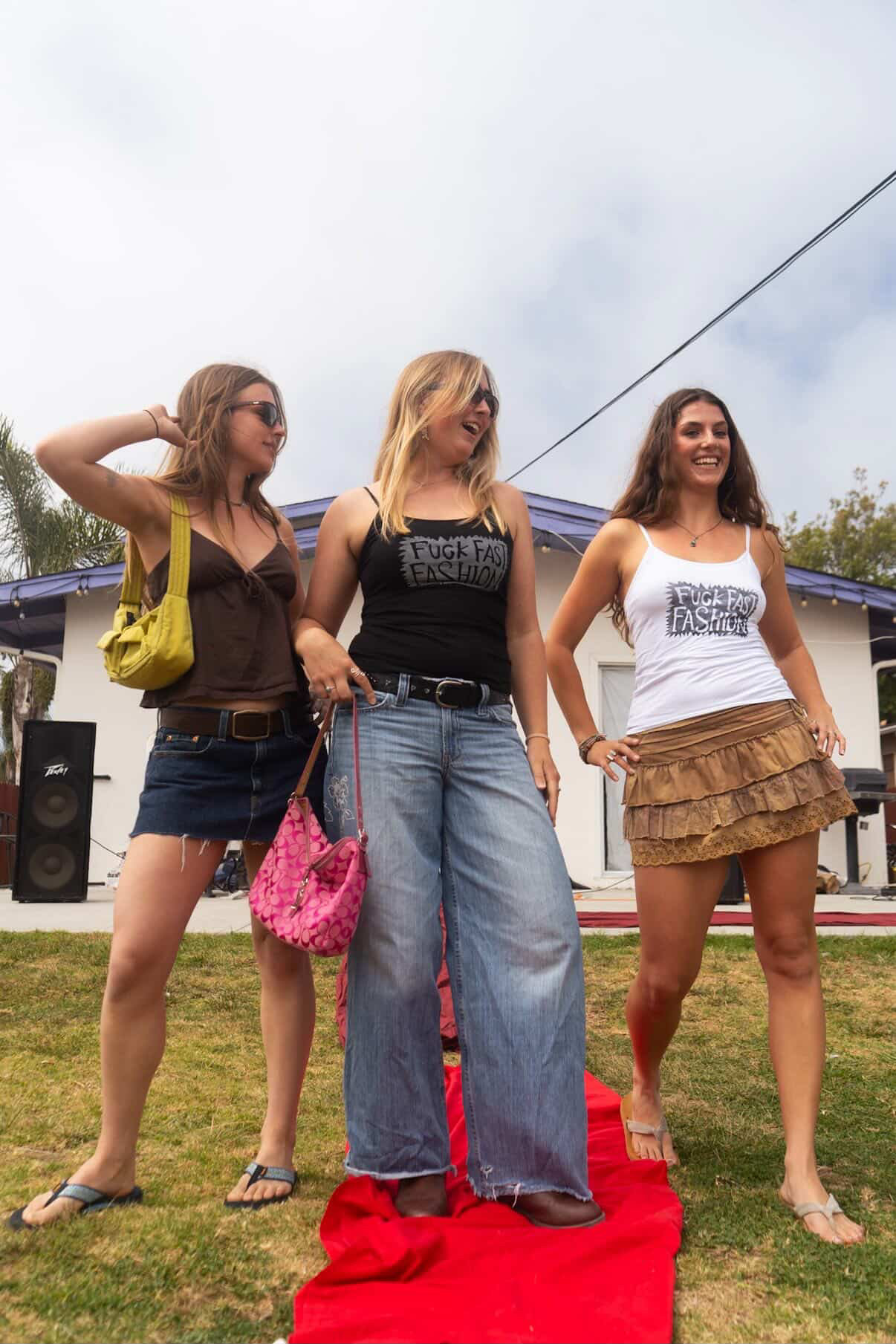
Isla Vista Trading Post (IVTP) operates primarily through a donation-based system, where community members can donate and take used clothes, facilitating a circular clothing economy within I.V. According to IVTP President and fourth-year communication major Shawn Wilke, the show was intended to demonstrate the versatility of used clothing.
“The fashion show isn’t all directly clothes from IVTP. We just want to give people a chance to come show their sustainable outfits and show that you can really make these cool outfits out of secondhand clothes,” Wilke said.
IVTP’s outreach coordinator and third-year environmental studies major Natalia Aiello expanded on the organization’s stance against the current fashion industry standard, citing ethical concerns and production speed.
“Fast fashion is something that is manufactured unethically,” Aiello said. “To us, what we characterize as fast fashion is something that’s made to fit the fast demand of the fashion industry constantly changing, but that’s at the sake of people. Communities are exploited to make that fast fashion. So it’s essentially poorly made, cheaply made [and] quickly made to keep up with trends.”
Event participants said that fabric quality and individual expression are the primary reasons to avoid traditional retail stores.
“I just don’t like fast fashion or shopping in new stores because the fabric these days, it just feels very cheap and it doesn’t feel like it’s going to last a long time,” fourth-year public health and sociology double major Claire Reynolds said. “I feel like you can find the things that are good material and have lasted through many people.”
Angelina Valadez, a third-year art major, noted how many people in the crowd were looking for unique pieces of clothing that define their personality.
“They look around and see clothes that are to their specific tastes,” Valadez said. “You get different kinds of clothes rather than the ones you just see everywhere in the stores.”
The event featured local crochet vendors who utilize upcycled materials, such as Olivia Perry, a first-year psychological & brain sciences major, who explained her process of creation and how she targets her sales toward college students.
“I’ll go to a thrift store or a scrap store and I’ll buy used yarn. It ties in by matching the theme, and you don’t need to go to all these fashion stores to get something cute when I’m over here making it,” Perry said. “Since I’m also a college student I understand the prices people are willing to pay and clothes they’re willing to wear. So I make a lot of day party wear and that definitely attracts people.”
Another crochet vendor at the event, Alicia Vinaja, a recent UCSB alum, observed a shift in student shopping habits.
“On your way back from class, you see all of the people that are selling their clothes and reselling. I know all of my friends thrift — none of them buy from the actual store anymore,” Vinaja said. “I think it’s becoming bigger and more accessible.”
Local band Good Grief performed at the event, and members spoke about how their own music coincided with the idea of going against fast fashion. Jake Twomey, a fourth-year political science and economics double major, described his band’s involvement and stance on issues that relate to the environment.
“We try to blend modernity with a sort of return to nature. You need to have that classic ‘Use what you have and don’t overproduce,’” Twomey said. “If [artists] have some sort of audience, it’s great to promote that issue. So when people talk about fast fashion, it’s about protecting this planet and using what we make.”
While the movement is gaining momentum, IVTP member and third-year environmental studies major Sammi Dorostkar noted that while accessibility to sustainable wear can seem out of reach, it can still be attainable.
“If you go into town there’s some vintage shops, and it’s like: You’re reselling a bad leather jacket for $200, but then there are some stores that are very accessible,” Dorostkar said.
Wilke explained how IVTP has started making slow fashion, a movement within the fashion industry that enables consumers to focus on quality over quantity when buying clothes, accessible to students on campus.
“We host these events where we give out clothes for free. It’s becoming more accessible but IVTP makes it easy because it’s in the area, you can walk and then you get items for free,” Wilke said. “Even though the name is ‘trading post’ we don’t expect anything in exchange.”
Aiello described how their events and the slogan “3-for-free” contradict the overconsumption in everyday shopping habits. The 3-for-free is a limit put in place by IVTP where students can only take three free items from the donation bins.
“The intention with our ‘3-for-free’ events is to limit people. Enforcing the idea of mindful consumption and we hope to further instill that in Isla Vista with our programs,” Aiello said.
Jetta Dohrenwend, third-year psychological & brain sciences major and IVTP member, emphasized the role of society engagement in reducing corporate reliance and how the event is all about collective action.
“It’s a community-building thing — something to bring people together to say, ‘We don’t have to consume more,’” Dohrenwend explained. “We actually don’t need to rely on companies with non-ethical clothing practices to have good fashion or have a cute style.”
The closing runway show had members of IVTP and the community show off their sustainable clothing outfits that reflected personality and resistance against the fast fashion industry.
A version of this article appeared on p. 6 of the May 14 print edition of the Daily Nexus.