
Science Communication Club aims to combat climate anxiety
By Lola Hadley
April 23, 2026 at 11:00 am
Members of the Science Communication Club at UC Santa Barbara gathered at the Career Center to discuss climate anxiety and courses of action on April 14.
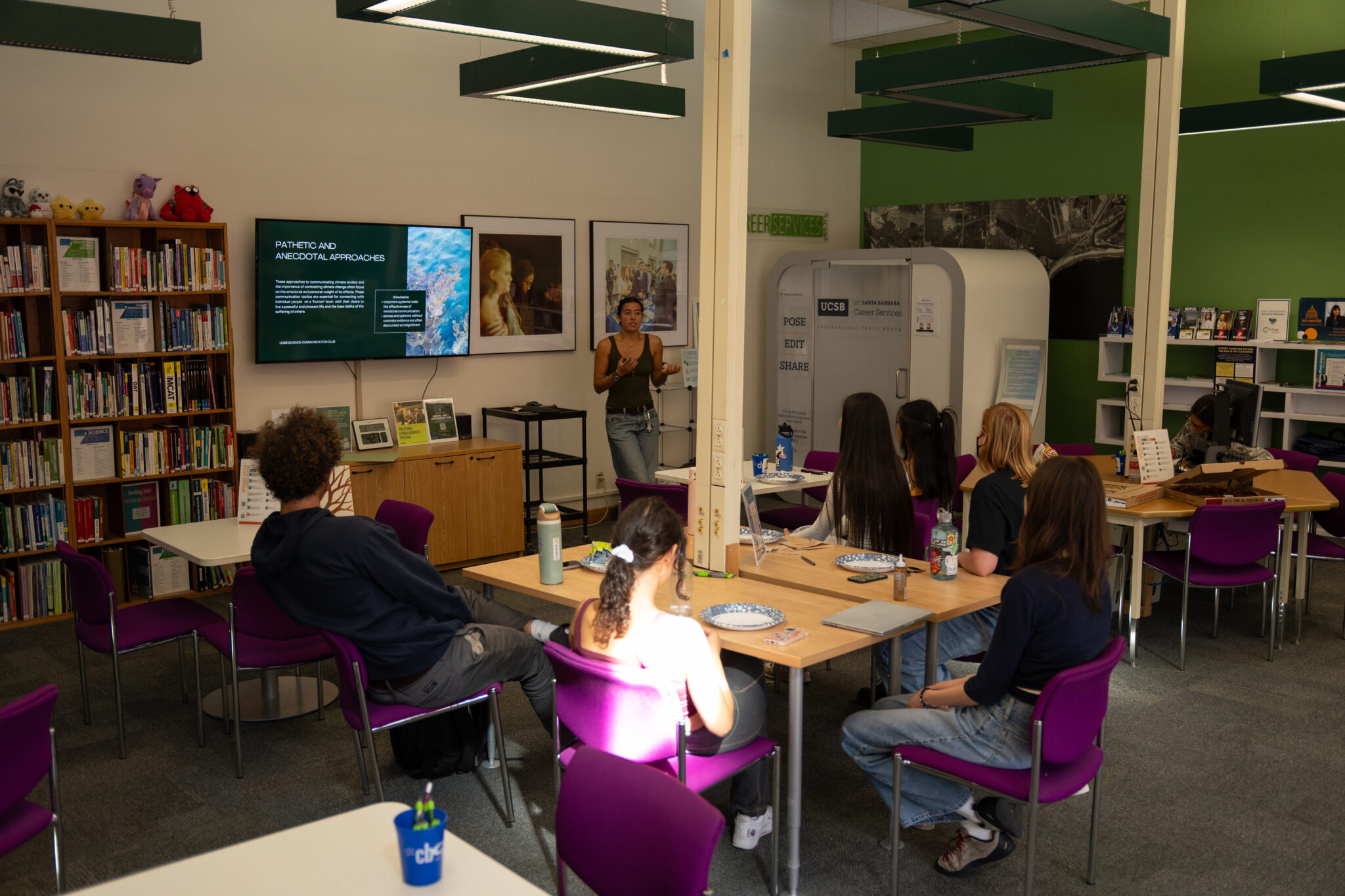
First-year biochemistry major and club vice president, Inji Hamdoun, began the event with a presentation and collaborative project to discuss climate anxiety. The gathering was held as part of the Associated Students (A.S.) Earth Month at UCSB.
The Science Communication Club was founded during the 2024-25 school year by current president and fourth-year communication and environmental science double major Melody Pederson, alongside Jasmine Ravel Schwam, UCSB alum.
“We are just really passionate about being a space for people of all majors, [science, technology, engineering and math] and social sciences, to come and make science more actionable, accessible and engaging because we really believe that science is for everyone,” Pederson said.
The purpose of science communication, according to Hamdoun, is to merge the emotional and personal aspects of communication with a scientific approach. According to Hamdoun, this is the link between information and human connections.
“It is intended to help people in a friendly environment talk specifically on how climate anxiety can be turned into a popular form of science communication,” Hamdoun said.
According to Hamdoun’s presentation, climate anxiety is a personal feeling of hopelessness that can sometimes be “conscious” or “in the back of your head.” Pederson connected the feeling of climate anxiety to the club’s mission.
“Because climate change can be so daunting and almost paralyzing with how fearful and scary it is, science communication is a really great tool to bring people in and bring people together so that nervous energy can be transformed into action and tangible steps,” Pederson said.
Attendees shared the reasons why they experience climate anxiety. One attendee said they have blocked out a lot of their climate anxiety, with another mentioning politicians and corporate executives who deny climate change making matters “substantially worse.”
“[Going] to new restaurants, buying new clothes and traveling bring me joy, but I am reminded of the negative environmental impacts of those things; it can be hard to enjoy them,” Pederson said. “Something I try to focus on is still enjoying and trying to be present in the moment and areas where I can make improvements.”
The presentation outlined four ways to incorporate effective communication during informed conversations on climate change. First, to make proactive statements, second, to focus on wider patterns, third, to find common ground and finally, to impact data.
“It can be through actions themselves, and I think that is the most powerful form of communication: showing that a response to climate change is possible by doing it directly,” Hamdoun said.
The Science Communication Club’s general consensus was that the climate crisis is not going away.
“But because the end goal is just to have a tool to communicate, I think the hope is that people will use this communication and apply it and then the people that they’re communicating with will be able to either pick that up indirectly or start a conversation,” Hamdoun said.
A version of this article appeared on p. 7 of the April 23 print edition of the Daily Nexus.
I really enjoyed reading about this club because it reminds me of a community group I joined a few years ago. Talking with others made environmental topics feel less overwhelming and much more hopeful. Small conversations often lead to simple actions, and those actions build confidence over time. Funny enough, I found https://total-wireless.pissedconsumer.com/customer-service.html while helping my parents solve a phone question, and it reminded me how sharing reliable information can reduce stress in any situation. Clubs like this show that kindness, science, and open discussion can help people feel connected while creating positive habits for the future.