
YDSA rally demands administration to designate UCSB a ‘sanctuary’ campus
By Wynne Bendell and Lucy Wellons
March 12, 2026 at 11:00 am
Speakers who have chosen to remain anonymous out of safety are referred to as spokespersons, attendees or speakers in this article.
Nearly 150 students rallied on March 5 to deliver a list of demands to the UC Santa Barbara Office of the Chancellor. The list included a petition signed by over 3000 UC Santa Barbara students urging the University to protect its students from United States Immigration and Customs Enforcement by designating the university as a sanctuary campus.
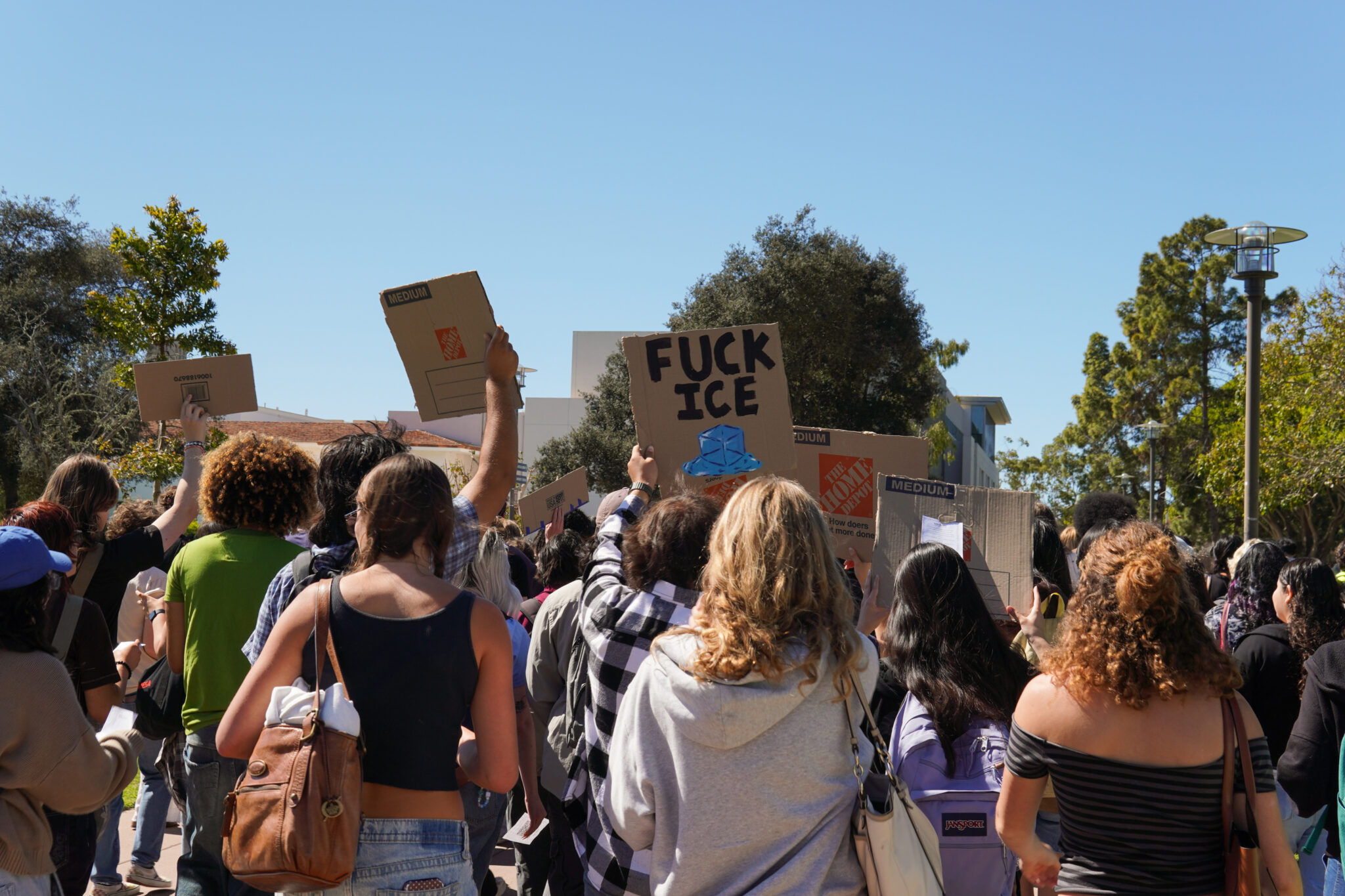
The rally was organized by UCSB’s chapter of the Young Democratic Socialists of America (YDSA) in response to nationwide escalations in Immigration and Customs Enforcement (I.C.E.) under President Donald Trump’s second term. Since Trump took office in January 2025, the number of people in detention centers has increased by over 75%, and I.C.E.’s budget has grown from around $10 billion to nearly $90 billion. 2025 became the deadliest year in U.S. detention centers in over two decades.
In an interview with the Daily Nexus, YDSA Secretary and third-year feminist studies major Alexandria Ewing said the rally’s purpose was to deliver a petition demanding a sanctuary campus, a place that protects students and community members from I.C.E. activity. The petition also outlined protective systems for students in the case that they face deportation and may have to leave UCSB.
“A sanctuary campus is a campus that puts in effort to protect its students from the threat of I.C.E., documented or undocumented, as well as community members,” Ewing said. “We are a public university, so people who don’t go here are allowed to come on and access our resources. Just because they don’t pay to go here doesn’t mean that they also shouldn’t have protection.”
The petition also outlined a list of demands, such as prohibiting I.C.E. and other immigration enforcement agencies from operating on school grounds, as well as an emergency fund and rapid response team for students who have been detained, deported or otherwise affected by immigration enforcement.
Another demand is that the University will comply with California Senate Bill SB98, which requires all public schools, colleges and universities to immediately notify students, parents and staff when I.C.E. agents are on campus. In January, Chancellor Dennis Assanis stated in a campus wide message that he would comply with the bill.
Students and community members gathered at the chemistry lawn while YDSA organizers handed out pamphlets with rally chants and a QR code to their petition.
A UCSB Improving Dreams, Equality, Access and Success (I.D.E.A.S.) spokesperson began by urging the University to make UCSB a more “equitable” campus. I.D.E.A.S. was established in 2006 by a group of undocumented students who felt a lack of representation on the UCSB campus and longed for a support group.
“I am here to address the universities and those in positions of power. We urge the administration to commit to making the undocumented student experience of campus more equitable and constructive,” the spokesperson said.
The spokesperson stressed that UCSB has a responsibility to protect its students in their pursuit of higher education by taking a stand against the Trump administration and I.C.E.
“The university is not a neutral space. It is an institution with the power either to communicate these harms or to reinforce them through inaction,” the spokesperson said.
Next, YDSA member and fourth-year sociology major Omar Opeyany criticised the UC Regents for purchasing a $7.8 million off-campus residence for the new UCSB chancellor, Dennis Assanis, while many students and staff struggle to find affordable housing.
“While we are here standing on the right side of history, the people who we pay our tuition to are living in comfort,” Opeyany said. “The ones we fund are getting a $7.8 million house and worrying about donors while we worry about whether our friends and families will be next.”
The crowd then marched through the library with signs reading “Fuck I.C.E.” and chanting, “No justice, no peace, no I.C.E. in our streets,” “The people united will never be divided” and “From Palestine to Mexico, all these walls have got to go,” among other chants.
At the library steps, YDSA member and third-year psychological and brain sciences major Eric Morgan, who works at an elementary school intervention program designed to help children develop their social and emotional development, said he doesn’t know how to help when the children have to deal with the fear of I.C.E activity.
“How can I solve their conflict when their threat is not a schoolyard bully but it is a massive agent? How am I supposed to help them, knowing that I.C.E. could be camping out around the corner, waiting to kidnap their parents coming to pick them up? How are kids supposed to develop their social skills properly when our world is filled with constant fear?” Morgan said.
I.C.E. agents have been reportedly seen stationed outside of dozens of k-12 schools across the country, particularly in Minneapolis and Los Angeles.
Morgan went on to say that UCSB is “failing” students by being complicit with the Trump administration’s immigration policies.
“[Administrators] don’t want to get in trouble with Trump’s administration, and as a result, we are the ones suffering. UCSB leaders are not willing to protect their students. They are putting our needs [below those] of the federal government, which continues to fail us,” Morgan said.
The crowd then marched to the entrance of Cheadle Hall, where UCSB administration is located, to deliver their list of demands outlined on their petition to the Office of the Chancellor. The demands included a guaranteed housing contract for undocumented students, a statement affirming the right to free speech and a written promise not to release student information to the federal government following UC Berkeley’s release of the information of over 150 students and staff, among others.
At Cheadle Hall, protestors chanted at administrators inside the building. YDSA members then read the anonymous testimonies of students who signed the petition.
“My friends and community, both undocumented and documented, should not have to worry about their safety in a place of learning. Everyone has the right to information and education. I am incredibly disappointed with the University’s lack of protection for its community,” one testimony read.
A group of YDSA members then entered Cheadle Hall and walked up five flights of stairs to deliver the demands to the Chancellor’s office, but both the Chancellor’s office and the Office of the Vice Chancellor for Student Affairs (VCSA) had locked their doors, drawn the blinds and did not respond to knocking and verbal calls. YDSA students slid the list of demands underneath the door of the Chancellor’s office.
According to Opeyany, who was in the group that entered Cheadle Hall, people exited the Chancellor’s office while he was waiting for the elevator after the rest of the group had left.
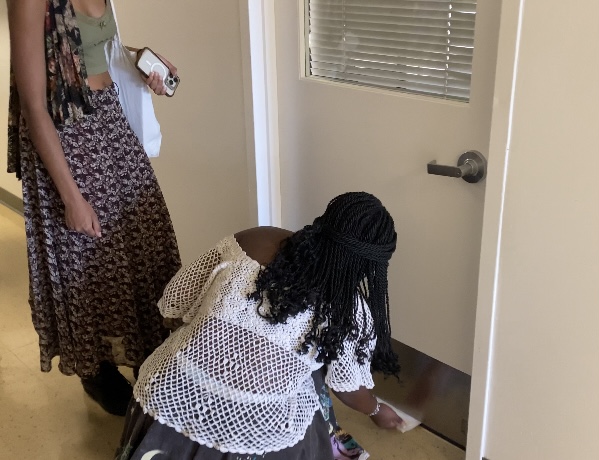
The rally ended with organizers taping the list of demands to the entrance of Cheadle Hall.
Ewing spoke on the impact that YDSA hoped the rally to deliver the petition would have on campus administration.
“We deliver that petition, we know they are going to see it,” Ewing said. “They have to meet with us and meet us where we’re at and be willing to negotiate with us in good faith.”
In an interview with the Nexus, YDSA member and first-year English major Suhani Patel said that the group offers a space for students to bring all their thoughts about I.C.E. and the federal government and use it to create change.
“One of the core missions of YDSA is helping people turn that anger, frustration, sadness, disappointment into tangible action. We all have these feelings, and it’s easy to feel like you’re the only one or like you’re just one person, you can’t really do anything,” Patel said. “But where they have power in their positions or in their money or in their sponsors, we have power in ourselves, in our numbers, in our community and in our labor.”

We our proud democrats hear in Santa Barbara and we won’t not be bullied by the FoxNews-whaching Republitard what lives at 1600 Pittsburg Ave. The Orange Clown Trump is the only precident to order deportatciaons of are brown nieghbors. Oboma and Clinton never deported any won. We must have OPEN BORDERS; we must imbrace SOCIALISM; we must stop GLOBEL WARMING; we must STOP LETTING RUSSIA INTERFEAR IN ARE ELECTION”S; we must RELEACE TRUMP”S TAX RECORDS; WE MUST ELECT ONLY DEMOCRAT’S because IT TAKE”S A VILLAGE!!!!!
You are obviously a Republican troll posing as a Democrat. Your propaganda is pathetic.
You don’t fool me at all–I see right through you.