
Senate discusses student fees, IVSCD takes first steps to achieve cityhood
By Wynne Bendell and Elijah Obando
February 11, 2026 at 12:00 pm
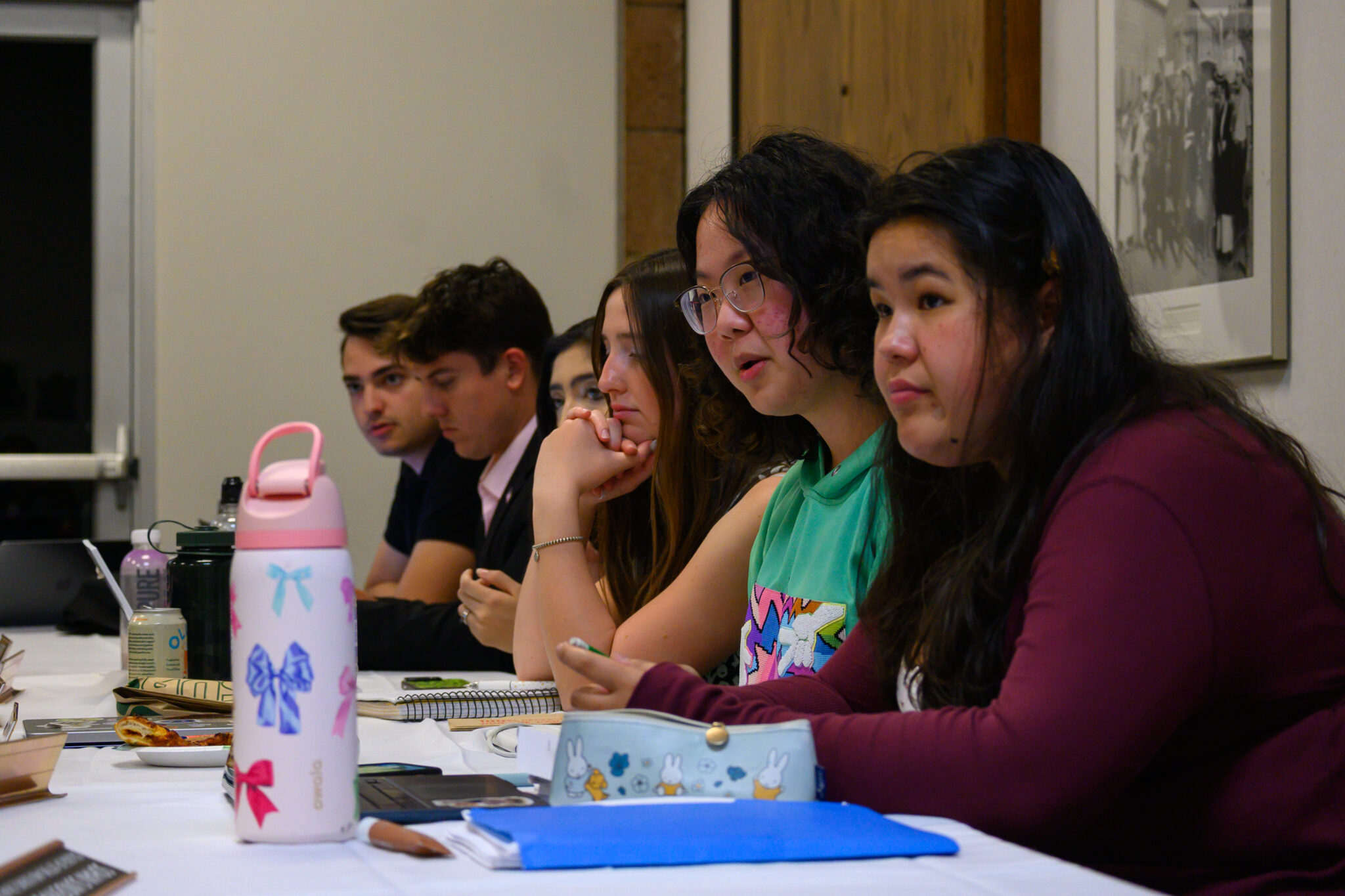
The 76th Associated Students Senate discussed student fee waste and solutions at its Feb. 4 meeting. The Isla Vista Community Services District requested funding for the first step of achieving cityhood.
Legislation passed
The Senate adopted a resolution that will introduce an Associated Students (A.S.) legal code amendment to democratize the Boards, Commissions and Units (BCU) fee proposal process. This amendment will be voted on in the spring election.
According to the resolution, any BCU that wants to propose a new lock-in fee must obtain 2,000 undergraduate signatures or 1,000 signatures for a non-lock-in fee. The signatures must be obtained with an electronic system administered by A.S. staff.
Next, the Senate adopted a resolution formally supporting the UC Student Association (UCSA) Racial Justice Now campaign. The Racial Justice Now campaign aims to uplift the concerns of marginalized students through policy change and advocacy.
Legislation proposed
Senator and third-year economics and philosophy double major Noah Luken presented a bill to create a textbook grant support program that would offer students financial assistance for purchasing textbooks. The bill will give the A.S. Book Bank Commission oversight of textbook grant requests and was referred to the advocacy committee.
Next, Senator and fourth-year history and global studies double major Neo Harter proposed a bill to update legal code on BCU autonomy. This bill gives the Senate the power to issue binding financial directives to BCUs, which they must comply with, as there will be a possible consequence of position removal for noncompliance. The bill was referred to the executive committee with concerns that it is an overreach of the Senate’s power.
Two resolutions were then proposed to cancel the lock-in fees for the United States Student Association and the Community Volunteer Foundation, as both groups have been inactive without boards for multiple years. Both resolutions were referred to the executive committee.
Lastly, Senator and first-year physics major Alec GeoSimonian presented a legislative reform amendment that would add midterm A.S. elections and reduce the size of the senate from 27 senators to 20. The amendment was referred to the executive committee.
Public forum
Fourth-year political science major Lily Mejia and fourth-year environmental science major Mathew Schoen requested $10,000 to update the Eternal Flame monument that sits between Buchanan Hall and the Library. The monument was built in 1963 during the height of the civil rights movement and serves as a symbol of community and activism. The flame was recently used as a gathering place for a student-led anti Immigration and Customs Enforcement walkout on Feb. 4.
Mejia explained that the Eternal Flame actively produces greenhouse gasses, which goes against the University of California carbon neutrality initiative. According to Mejia, the project will be in collaboration with the Department of Black Studies and Department of Environmental Studies, among others. They believe that the monument does not adequately honor UCSB’s Black history. They are currently working with student architects and engineers to create a sustainable LED-based design that uses the electricity from El Centro to power the flame.
The second presentation during the public forum was brought by First President Pro-Tempore and second-year political science major Evan Sussman. He explained that A.S. has accumulated around $13 million in reserves, with large portions rolled over and unused every year. He said reallocating funds would help entities that need it without asking students to pay more, and he urged the senate against raising the A.S. based fees.
Reports
Isla Vista Community Services District (IVCSD) Director Spencer Brandt presented a request for $25,225 of A.S. funding to contribute to a cityhood fiscal analysis of I.V. This analysis is a part of IVCSD’s continual push to make I.V. a city. The study, which is expected to begin this month and take three to four months to complete, would determine whether it is financially feasible for I.V. to become a city.
The study is only the first part of I.V.’s cityhood process. After the study, the results would be submitted to the Local Agency Formation Commission (LAFCO), where they will then conduct a more thorough study. If LAFCO determines that I.V. can financially afford cityhood, residents will be able to vote on whether I.V. becomes its own city. According to Brandt, if passed, it would take about one to two years for I.V. to transition into its own city.
Harter asked Brandt how cityhood would benefit tenants living in I.V., to which Brandt responded that rent control would become a possibility through cityhood.
“Any ordinance [related to rent control] would need to be adopted by the full Board of Supervisors, which is very politically diverse, and would have to apply to all the unincorporated areas in the county,” Brandt said. “There is no way to make a cookie-cutter ordinance for Isla Vista to solve that problem just for Isla Vista under our current government structure.”
After this, Sussman reported on his updates regarding the lagoon’s safety measures. He explained that the California Coastal Commission (CCC) has approved a temporary permit for 90 days, which includes newly set cameras and lighting systems around the lagoon. Once the permit expires, Sussman said that it is likely the lagoon will receive permanent lighting, and construction will begin as early as June.
Financial Motions
The Senate then allocated $15,000 from the Senate Unallocated Account to the Office of the President for honoraria and special events. The full request of $26,300 was not allocated because of concerns from Senators over the high request amount.
A version of this article appeared on p. 5 of the Feb. 12 print edition of the Daily Nexus.

The Senate’s latest discussions on student fees and the initial steps toward IVSCD cityhood highlight a growing need for modernized financial infrastructure to support these new administrative scales. As local governance and educational institutions evolve, the demand for transparent and efficient collection systems becomes a priority for both the public and private sectors. For businesses and service providers looking to scale alongside these types of regional developments, understanding how to accept payments in Ethiopia is essential for integrating into the digital economy. By adopting a robust payment gateway, organizations can ensure that fee collections and service transactions are handled securely,… Read more »
I saw a funny meme on my feed that led me to this site while I was relaxing in PK. I was specifically looking for a place with engaging slots online. My initial experience was a disaster with several annoying losses that made me want to quit. I decided to change my approach on Glory casino and suddenly the online casino bets started hitting. I made back my losses and earned a nice surplus today. I feel successful.