
Isla Vista unincorporated: the community’s fight for cityhood
By Jack Dindia
January 22, 2026 at 11:00 am
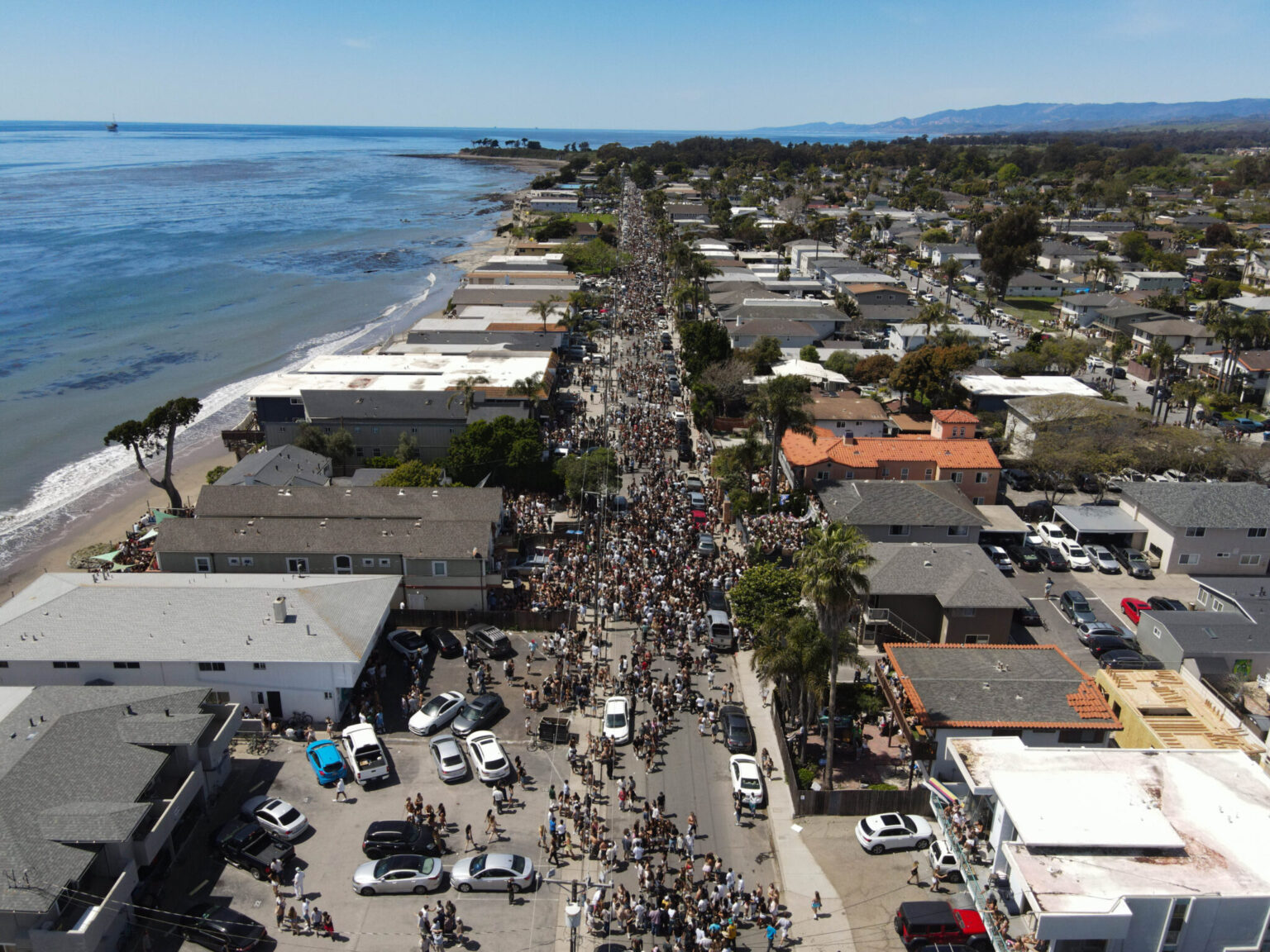
Given Isla Vista’s recent lack of autonomy in the noise ordinance for Deltopia, community members have revived conversations surrounding Isla Vista’s status as an unincorporated community. There have been many attempts to achieve cityhood for Isla Vista throughout its history, which some stakeholders believe may be the best option for the community to prosper.
A community is considered “unincorporated” if it does not have a local government. Instead, Isla Vista has the Isla Vista Community Services District (IVCSD), which serves as a form of self-governance where elected members handle basic services provided by the county’s government. However, community service districts (CSDs) only have the power to control services such as water, street lighting and sanitation, whereas the county is responsible for policing, zoning and road maintenance, among others.
An uphill battle for self-governance
Residents of I.V. have advocated for cityhood for over 50 years. The Local Agency Formation Commission (LAFCO), which is responsible for determining whether a community can become a city, rejected three separate requests for cityhood election throughout the 1970s and ‘80s due to insufficient tax revenue to support the costs of running a city.
Self-governance for I.V. was once again discussed after Goleta acquired cityhood in 2001. Mark Chaconas, former executive assistant for then LAFCO Commissioner Gail Marshall, believed I.V. would grant Goleta greater state funding due to the community’s dense population, with a 10-year surplus of $7.05 million if I.V. was excluded and $40.13 million if it was included.
However, former LAFCO Staff Executive Officer Bob Braitman said I.V. represented a community with a “separate identity and different issues” from Goleta, justifying its exclusion from cityhood. Additionally, many Goleta citizens were against including I.V. with Goleta due to its voting power and “broadly liberal base,” ultimately resulting in I.V. being omitted from Goleta’s cityhood.
Prior to the formation of the IVCSD in 2017, I.V. was dependent on its redevelopment agency (RDA), which was responsible for maintaining the community’s expenses, providing affordable housing and reducing crime, until former California Governor Jerry Brown dissolved all RDAs in the state in 2012, leaving the I.V. Recreation & Park District (IVRPD) as I.V.’s sole governing body.
The beginning of the IVCSD
Following the dissolution of I.V.’s RDA, in the summer of 2013 a group of UC Santa Barbara students researched the creation of the IVCSD, but were initially met with “disinterest and/or pessimism,” according to General Manager and IVCSD founding member Jonathan Abboud in his chapter in “Isla Vista: A Citizens History.” However, following the spring of 2014, which saw incidents such as the Deltopia riot and a mass shooting, conversations of a CSD began to re-emerge.
In the summer of 2014, UCSB’s Associated Students (A.S.) formed the UCSB Foundation Board of Trustees Advisory Committee on Isla Vista Strategies in order to improve issues within the community such as crime and housing. During conversations with stakeholders such as LAFCO, the committee discovered they could “pass special State legislation to create a customized form of a CSD tailored to Isla Vista’s needs.”
Throughout the next year, many town halls were held to discuss self-governance options, with the CSD receiving “the most and resounding support” compared to other options. On Dec. 2, 2014, Assembly Bill 3 (AB 3) was introduced by former Santa Barbara County (SBC) Supervisor Das Williams, which authorized the establishment of a CSD in I.V. Brown signed AB 3 into law on Oct. 7, 2015, which allowed I.V. residents to vote on creating their first multi-service local government.
During the following year, stakeholders engaged in community outreach to determine the best course of action to form a CSD. In April 2016, LAFCO commissioners voted to place the IVCSD on the November 2016 ballot through Measure E, which passed unanimously. IVCSD officially formed on March 1, 2017, and has been I.V.’s centralized government since. Another prominent example is the Spring Festival , IVCSD’s alternative event to Deltopia.
Self-governance of today
Since 2017, the IVCSD has expanded in many ways, including the passing of Measure R in 2018 which placed a utility users tax on I.V. Residents, the formation of its Rental Housing Mediation Program, Community Service Organizations in collaboration with the UCSB Police Department.
According to former IVCSD President and founding member Spencer Brandt, the 2015 assessment for I.V. to be a city failed as the community needs to be “revenue neutral,” which I.V. wasn’t since it “lack[s] a strong commercial tax base.” California Proposition 13, which limits the amount of property tax and property tax reassessments, also contributed to the failing of the assessment, as well as a high crime rate. However, there has been a “growth in property tax,” along with a 50% decrease in crime since 2015, according to Brandt.
Brandt believes the conversation of whether I.V. will become incorporated, either by being absorbed into Goleta or becoming an independent city, is “premature until we get a better idea of the financial feasibility of the incorporation.”
“What the right pathway is, whether it’s a good idea at all to pursue incorporation, really just depends on, ‘will this save taxpayers money? Is this financially feasible?’ And we just don’t know that at this point, we would need to actually undertake the work of doing the analysis and the funding study to find that out,” Brandt said.
Support from Associated Students
A.S. External Vice President for Local Affairs and third-year political science major E.J. Raad believes that the recent noise ordinance cancelling Deltopia wouldn’t have “ever happened” if I.V. were a city, since it would have autonomy from SBC. According to Raad, the ordinance was “imposed on us by the [SBC] Sheriff’s Office,” which I.V. can’t prevent since it doesn’t have its “own governance structure to make decisions about our community.”
“The whole point is representation with your taxation; you’re supposed to be able to have a say in how where you live is run, and we don’t really have that. We don’t completely have that because we’re not a city, and we don’t have that autonomy from the county. And so that’s the long-term solution that I’d be really interested in pursuing,” Raad said.
Members of the 76th A.S. Senate have begun outlining plans to incorporate I.V. According to Senators fourth-year history and global studies double major Neo Harter and third-year economics and philosophy double major Noah Luken, A.S. is commissioning a study on the living conditions of I.V. to help garner support for cityhood, which will begin during Week 3, or Week 4 at the latest.
Luken and Harter are also working to establish a party within A.S. titled “Save Isla Vista,” which will be centered around creating a city government for I.V. Additionally, Luken said A.S. can provide funding to support the progress towards cityhood, such as funding the preliminary LAFCO test.
Will Isla Vista become incorporated?
Whether I.V. will become an incorporated territory has yet to be determined. However, progress to make I.V. a better, safer community will continue with or without cityhood. According to Brandt, the Isla Vista Master Plan, a comprehensive planning effort from the IVCSD and SBC aimed at addressing housing, parking and other issues, may be easier to implement if I.V. were a city.
“The community put together the Isla Vista Master Plan that has never fully been implemented because we haven’t been able to solve the parking problem. We are now working on solving parking by beginning to do a compliance program. And so, I wonder if in the future, a city would be best equipped to be able to actually implement that master plan, and that would certainly mean changes, especially when it comes to the amount of housing in the community,” Brandt said.

A version of this article appeared on p. 1 of the Jan. 22, 2026 edition of the Daily Nexus.
