
Launching rockets may seem like a lofty goal achieved only at major companies like NASA and SpaceX, yet UC Santa Barbara students in the Gaucho Rocket Project turn their passion for rocketry into a reality by designing, building and launching rockets from scratch.
Members of the group worked diligently to achieve their first successful launch in Fall Quarter 2025: “We’ve been able to successfully launch our first liquid rocket — Altaris — which went about a mile high over the Mojave Desert,” Antonio Ruelas, chief operations officer for the project stated. Since then, the team has launched several rockets and aims to go further, with the project’s primary goal being to be the first North American collegiate team to successfully launch and land a landable rocket.
“We have our landable rocket project, Halo, with a GNC platform called Halo Junior,” Eddie Barajas, founder and president, described the range of projects that the group is currently working on. “We have a continuation of our last year’s project called Telluris, a solid, landable rocket and we have Sonus which will go Mach 1, creating a sonic boom, and is expected to go around two miles high.”
Gaucho Rocket Project designs each rocket with a mission objective in mind. For example, some rockets are built to ascend as high as possible, whereas landable rockets are designed to travel at a lower elevation while the group focuses on maintaining full control. The team offers frequent “onboarding projects” to give new members an opportunity to work on lower-stakes designs, traveling to the desert biweekly to launch these rockets.
The journey to building successful rockets from the ground up was far from easy and required extensive research by the Gaucho Rocket Project members. Ruelas outlined the hard work involved in getting the first project off the ground: “Over the summer, we wanted to get started with the liquid rocket and we had a few members really look into the science behind how to get a liquid rocket to work. We started ordering materials towards the end of the summer and building the rocket, launching it in Week 7 of fall quarter.”
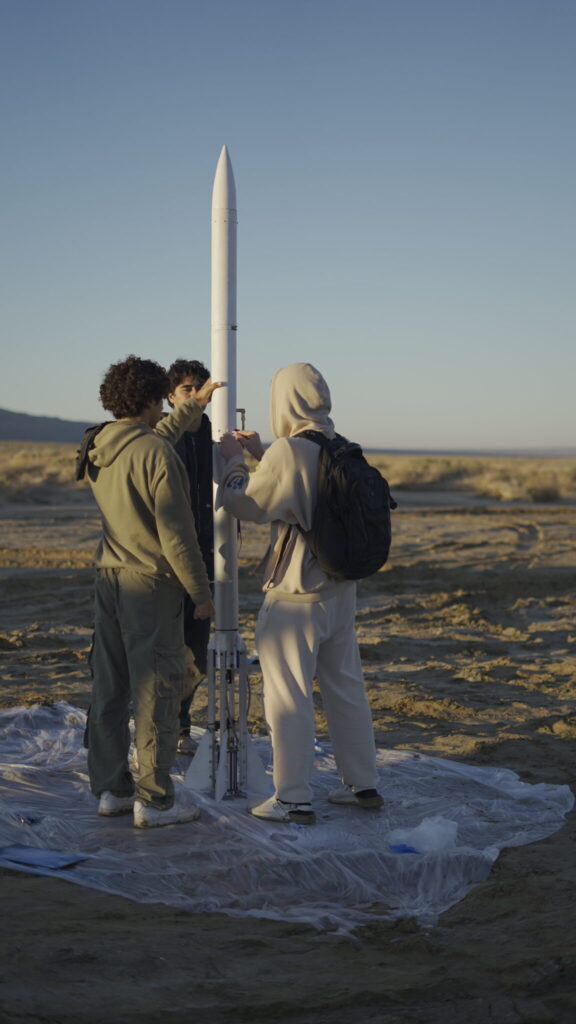
Members of the Gaucho Rocket Project set up their rocket “Altaris” for launch. CREDIT: Gaucho Rocket Project
While the fluid mechanics and propulsion mechanics required to get the rocket up in the air are well established in theory, bringing the design into reality was an extensive and difficult process.
“It starts with selecting what parameters we’re going to be designing around,” propulsion co-lead Casey Strattan shared, providing an overview of a rocket’s early design choices. “This includes selecting the thrust of the engine and what conditions the rocket will be flying in: near the ground, or at high altitude. What fuel we will use has to do with the energy density of the propellants and the availability.”
While most established companies use liquid oxygen as their oxidizer – the source of oxygen that causes the fuel to combust – it is difficult to handle as it must be held at very low temperatures. During the rocket launch and propagation, the oxygen must be continually vented to keep the rocket from exploding. The Gaucho Rocket Project team uses nitrous oxide as a reliable and readily available alternative.
It’s one thing to know the general steps and considerations that go into making a rocket, but when it comes to the actual building process “It’s easy to get lost in the details,” Strattan explained. “For example, if you’re making a valve, you need to decide what parts to pick, where to buy it, how to ensure it can rotate, how to mount it … the textbooks tell you what you need, but the practical details are the hardest part.”
Strattan added, “There’s no set textbook that will provide a step-by-step guide [on how to build a rocket] as the process varies each time depending on the varying parameters in your particular design. So we pull information from many different sources and often have to adapt it for our own purposes.”
In addition to launching rockets successfully, the group consistently ensures they are taking necessary safety precautions: “The only time the rocket is fueled is when it’s far away in the desert,” Barajas explains, “we also do tests before true launches.” These rocket tests include cold flow tests which involves running water through the system to ensure there are no leaks, running inert gas through the system to check pressure and hot fire tests, during which rockets are fired at full power while remaining fixed to the ground to ensure that the engines work and the components can withstand the stress.
Building rockets to propel high above the ground is an incredible achievement that the Gaucho Rocket Project has mastered repeatedly. However, their main goal of engineering a landable rocket offers many more challenges.
“Rockets are fairly unstable objects,” Barajas explained as to why landable rockets are so difficult. “They are naturally going to go sideways as they travel, not vertically, so you need to find a way to keep it upright … you have to find some way to control it and change direction, essentially like controlling a beast,” Barajas added.
This ambitious project is pursued at top spaceflight companies: SpaceX is able to land its rocket boosters – components of the rocket that provide thrust to propel it into space before disconnecting from the rocket’s body and falling back down to Earth – demonstrated in the successful landing of the Falcon 9 rocket in 2015. Since then, companies like Blue Origin and Landspace are also developing and testing methods to land their boosters. SpaceX is currently working on landing both the boosters and main “starship” together.
“We’re trying to land the whole rocket,” Strattan confirmed, but “another motivation is to achieve the last ‘hop’ milestone of the lander challenge” — a competition for collegiate teams to submit their rocket projects.
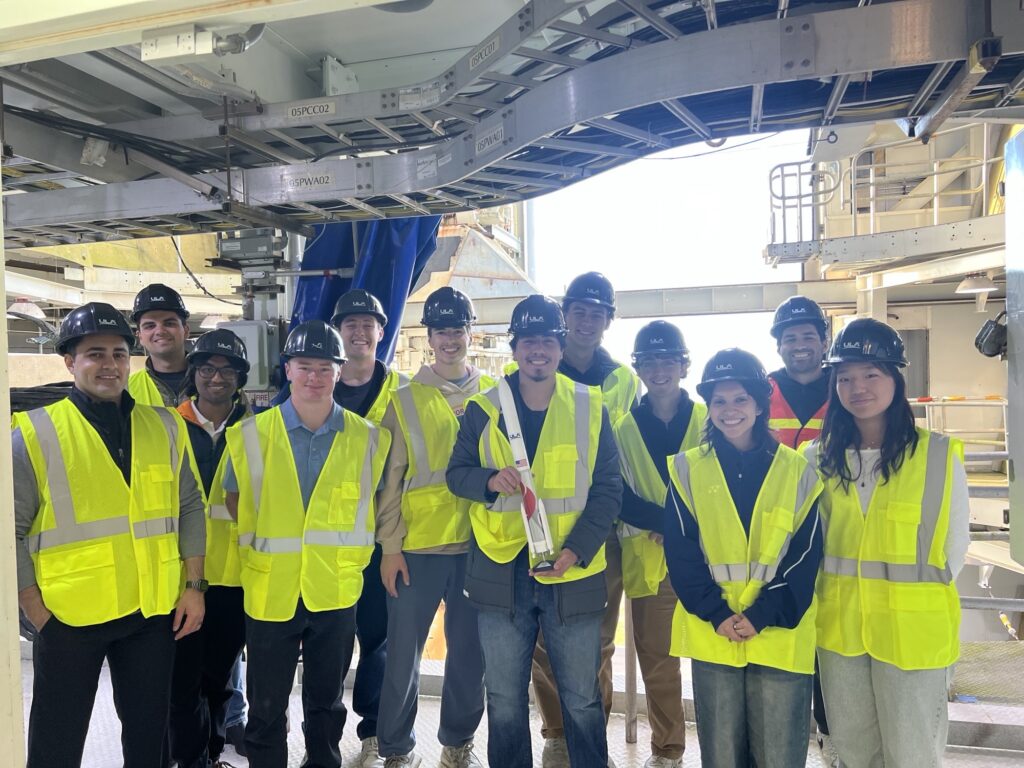
The team recently received an invitation to visit ULA, the United Launch Alliance. CREDIT: Gaucho Rocket Project
Development of landable rockets would be extremely beneficial to the space industry since they can be reused for multiple launches. Far less new material is required, significantly reducing costs per launch as well as environmental damage associated with their production. Mastering reusable rockets is projected to reduce space flight costs tenfold, enabling more frequent missions to space and more rapid scientific progress
“Landing a rocket is one of the most difficult things to do, and that’s why we’ve taken it on,” Barajas explained the overall motivation behind the team’s hard work, “I don’t think there’s anything that could better prepare our group for whatever task or idea they want to take on in the future.” The group has been designing the landable Halo rocket for around six months, and will soon be ready to order and test individual components, making definitive steps towards their goal.
A version of this article appeared on p.9 of the February 26, 2026 edition of the Daily Nexus.