
UC Santa Barbara Sustainability hosted a discussion panel on water safety in Goleta on Feb. 19 in collaboration with the Goleta Water District.
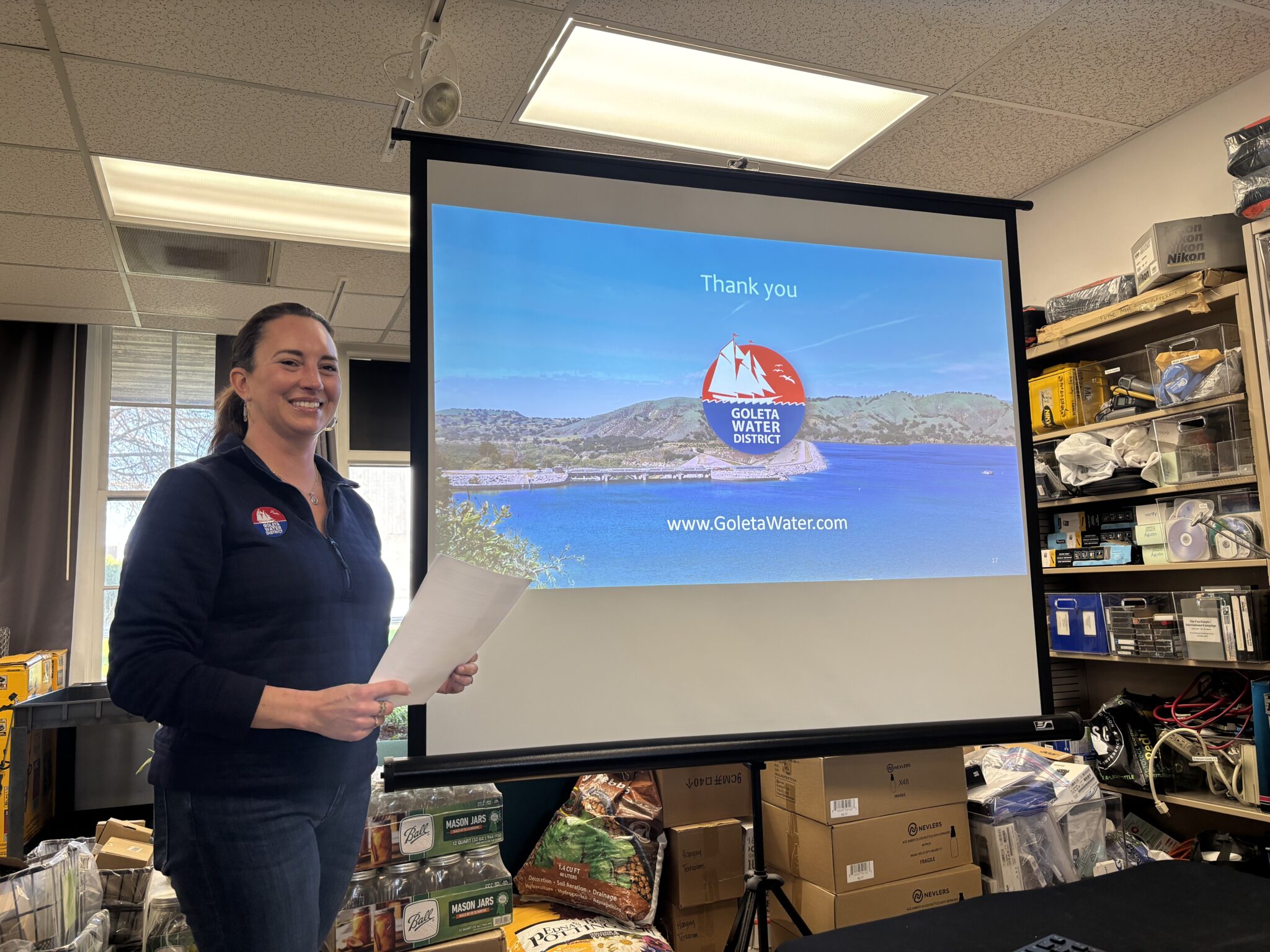
The Goleta Water District provides water to approximately 87,000 people across 29,000 acres within the Goleta Valley. Noura Elkhatib / Daily Nexus
Established in 1944, the Goleta Water District is governed by an elected five-member Board of Directors, with each director representing one of the five water districts in the Goleta Valley. Isla Vista falls within the fourth district.
Principal Policy Analyst Brooke Welch spoke during the event. Her job includes preparing strategic reports, sustainability planning and facilitating projects interdepartmentally.
According to Welch, the Goleta Water District provides water to approximately 87,000 people across 29,000 acres within the Goleta Valley.
“Uses range from residential to commercial to industrial, UCSB, to landscape, irrigation and agriculture,” Welch said.
Lake Cachuma is the primary source of water for the Goleta Valley, which includes all five districts. The water is extracted and is brought through the Tecolote Tunnel and lands in the Corona Del Mar Water Treatment Plant to be purified. While small amounts of sodium hypochlorite can be found in tap water in I.V., Welch noted that this is used for disinfecting.
Welch also said that while water levels of Lake Cachuma are currently at 100%, the Goleta Valley has a long history of drought.
After the presentation, Outreach and Marketing Coordinator for the Take Back the Tap program and third-year economics and political science double major Bhavya Uniyal asked Welch about the safety of the tap water in Goleta. She cited her experience with water testing in Goleta as a part of an internship.
“I found that even though the lead is well below the safety levels set by the EPA, it’s still present,” Uniyal said. She then noted the effects of long-term exposure of lead to I.V. residents, even in small amounts.
Welch stated that there is no lead in the water systems within the district’s jurisdiction.
According to the Water Quality page of the Goleta Water District website, the district collected an inventory of pipe material and tested it for lead and copper in the summer of 2024, as per a federal mandate known as the Lead and Copper Rule. This was a nationwide effort to check for lead and copper materials in public water supplies, which can lead to significant health problems.
Welch stated that any trace amounts of lead that can be found in water in I.V. are out of the Goleta Water District’s jurisdiction.
“The district’s pipes and facilities are lead-free up to the point of the meter. What happens on the other side of the meter is the private side, so we don’t regulate that,” Welch said.
The Goleta Water District is federally required to report the results of tap water quality testing to residents of the Goleta Valley through an annual Consumer Confidence Report. The most recent report available on the Goleta Water District website is from 2024.
Welch said that tap water is “one of the most heavily regulated substances there is.” She stated that the water that comes out of any of the sources used by the district, such as Lake Cachuma, is naturally very hard. Water is considered hard when there are naturally occurring minerals, such as magnesium and calcium, dissolved in the water.
According to Welch, at-home water treatments like reverse-osmosis or using a Brita filter don’t improve the safety of tap water.
“It doesn’t treat it any further, it just makes it taste better. It might remove a couple of extra minerals, but that’s it really,” Welch said.
In terms of sustainability, Welch presented the recently developed Net Zero Initiative, which aims to produce enough renewable energy to offset the district’s baseline annual energy use. This is done through electric vehicles, solar power systems and in-pipe hydroturbines, which generate electricity.
“We’re making big strides to really expand the sustainability of the district, and ultimately reducing our reliance on traditional energy sources,” Welch said.
A version of this article appeared on p. 5 of the Feb. 26, 2026 edition of the Daily Nexus.