
Courtesy of Toronto Film Festival
Directed by Ben Proudfoot, “The Eyes of Ghana” premiered at the 41st Santa Barbara International Film Festival on Feb. 7.
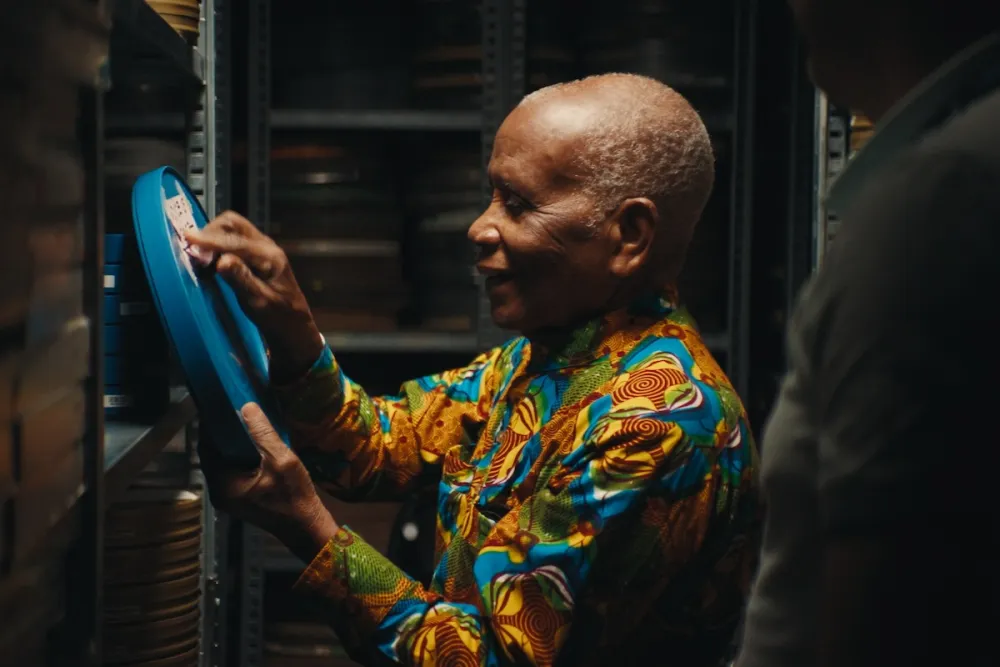
The documentary tells the story of Chris Hesse and his decades-long pursuit of restoring the film he shot during his time as the personal cinematographer for Ghana’s first president, Kwame Nkrumah, as he led his country to liberation from British colonial rule.
Nkrumah, born in Ghana under British rule, left the country to attend Lincoln University in Pennsylvania. During his time in the United States, Nkrumah began to get involved in political activism and formed his identity as a Pan-Africanist and socialist. This is also when he realized a nation can form an identity through film.
Nkrumah was deeply inspired by Hollywood and its ability to market the American people, their desires and motivations, and decided he wanted to bring that to Ghana. He went back to Ghana and began his political career, organizing the Ghanaian people around values of decolonialism, a nationalized economy and the idea of a “United States of Africa.”
After Nkrumah was elected as the first president of Ghana, he hired Hesse as his personal cinematographer and took him around the world to document his continued fight for a decolonized Africa. Nkrumah went on to nationalize Ghana’s economy, in line with his socialist platform, all while building a major film industry.
However, Nkrumah soon became an enemy to the western capitalist world and was overthrown in a military coup d’état, backed by the U.S. Central Intelligence Agency. Statues of Nkrumah were torn down, and the thousands of rolls of Hesse’s film were burned.
Decades later, with Ghana’s movie theaters left abandoned, Anita Afonu, a young Ghanaian filmmaker, was left trying to revive the industry. Afonu formed a strong friendship with Hesse, and he soon told her that all his film negatives are preserved in London, where they were originally sent as it was too warm in Ghana to process the film, and that it is his life’s last mission to digitize all his short films of Nkrumah.
With the help of Afonu, Hesse has started to digitize his films, around 15 minutes of which were shown throughout the documentary. The short films were premiered in Accra, Ghana at the newly restored Rex Cinema, which has been protected from demolition for decades by the original projectionist, Edmund Addo.
At the heart of this documentary is the appreciation for film as an art medium, not just to create a pretty picture but to be used as a tool for liberation. By building Ghana’s film industry, Nkrumah wanted to give Ghanaians autonomy to tell their own stories, which had only ever been told through a colonial lens. “The Eyes of Ghana” embodies that desire.
While Hesse might have seen himself as just a young man capturing the fight for freedom, he will forever be remembered as a fighter himself. His work is not only a record of the ongoing struggle for decolonialism, but has shaped the movement and inspired a new generation of Ghanaian filmmakers and activists.
A Q&A was held after the screening with Proudfoot and producer Nana Adwoa Frimpong. Proudfoot recounted his spontaneous meeting with Hesse on a trip to Ghana, where the two bonded over their mutual love of filmmaking.
“It was a bond forged between generations, and even though we had totally different lives and upbringings and [are] separated by several generations, we had a shared language of movies and love of movies, and that is what drove and infected the whole crew with the enthusiasm that it took to make it,” Proudfoot said.
In discussing future distribution of the documentary, staying true to the values of Nkrumah, Proudfood said they will prioritize distribution in Africa before thinking of how to get the film to American audiences.
“The most important audience for this film is in Accra, in Ghana and West Africa, and on the continent generally,” Proudfoot said.
Finally, when asked how this documentary has impacted her relationship with filmmaking, Frimpong recalled her time working on a project in film school, trying to think of what story she had to tell.
“It was in that moment, which was then reinforced by making this film, that [I realized] we all deserve to be witnessed and seen, and Chris Hesse knew that as a young person, and he is 93 years old now and is coming back to reinforce that to this generation,” Frimpong said.