

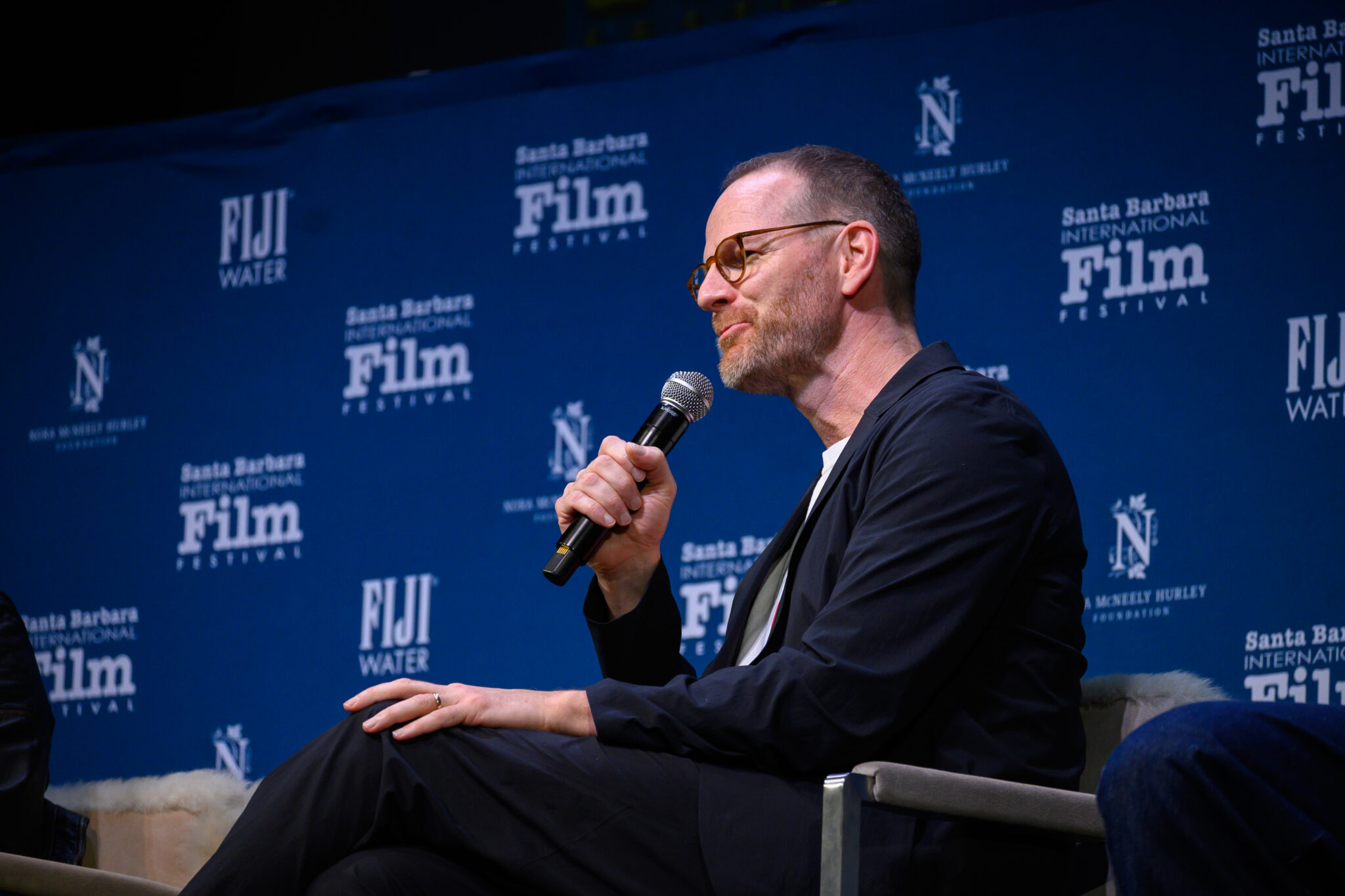
Norwegian director Joachim Trier talking about his film, “Sentimental Value.” (Sherine John / Daily Nexus)
The Santa Barbara International Film Festival held its annual International Feature Panel with five Academy Award-nominated directors — Kleber Mendonça Filho (“The Secret Agent”), Jafar Panahi (“It Was Just an Accident”), Joachim Trier (“Sentimental Value”), Oliver Laxe (“Sirāt”) and Kaouther Ben Hania (“The Voice of Hind Rajab”) — at Arlington Theatre on Feb. 8.
Santa Barbara International Film Festival (SBIFF) Executive Director Roger Durling hosted the panel and introduced the five directors as some of the “most exciting and groundbreaking directorial voices working around the world today.” Throughout the discussion, Durling questioned the panelists about their creative processes, the challenges of filmmaking and what it means to make a political film.
Durling began by addressing Filho, whose film “The Secret Agent” follows a former professor fleeing persecution and resisting an authoritarian regime during the Brazilian military dictatorship. The film was nominated for the Best Picture, Best International Feature Film, Best Casting and Best Actor categories of the 98th Academy Awards.
“The Secret Agent” features over 60 characters, and Filho emphasized that his process of casting began in his screenwriting process, during which he paid significant attention to “the faces that are going to be telling the story.” Filho said that he aimed to represent the diversity of Brazil in his work, and believes that films offer viewers access to the faces of different cultures.
“My country is incredibly diverse, and I think it’s one of the most beautiful aspects of Brazil as a nation, as a culture, is the diversity of places,” Filho said. “We are everything and we are mixed, and this mixing comes from being indigenous and European and African.”
Durling then asked Filho about how the editing approach of the film — which utilizes an associative approach and non-linear fracture techniques — matches with the film’s overarching themes of memory, considering how Brazil has “lost some of the memories about what happened in the 1970s.”
Filho stated that Brazilians are still dealing with what happened during the military dictatorship, which lasted from 1964 to 1985 and resulted in censorship and human rights abuses of dissidents who opposed the regime. He said that in order to retell this history, he paid attention to the film’s organization, reflecting the way such events are remembered.
“I think cinema is a great tool of memory, and I think also cinema is a great tool for amnesia. The way we remember things in our lives is nonlinear, and cinemas, they tend to organize facts and memory in a linear way,” Filho said.”Trying to come to terms with the way we remember things and the way that I’m making a film was quite a challenge as I was writing the script.”
The discussion then moved on to Panahi, whose film “It Was Just an Accident” depicts a group of former Iranian political prisoners who must decide whether or not to exact revenge on a man they suspect to be a jailhouse captor they encountered while imprisoned. The film won the Cannes Film Festival’s Palme d’Or award and was nominated for the Best International Feature Film and Best Original Screenplay categories of the 98th Academy Awards.
Pahani spoke in Persian, and his answers were translated into English by a translator.
Durling began by speaking about Panahi’s body of work and how the filmmaker has faced political persecution — Panahi was imprisoned for the content of his films, which are critical of the Iranian government. Durling then asked Panahi about his use of sound in his filmmaking and how it contributes to storytelling.
Panahi began by recounting an experience he had when he was imprisoned, when he tried to discern the character of his interrogator based on the man’s voice, which he said was the beginning of his scriptwriting process for his film. Panahi said that he decided to use a specific sound of an interrogator’s footsteps in the film to connect this with his experience and contribute to the film’s narrative.
“I had to work on a sound that the audience would hear for the first in the first 10 or 20 minutes of the film and then they would not hear it again throughout the film for over an hour,” Panahi said. “But then once they heard it at the end of the film, the audience members had to remember this was the sound that we heard in the beginning.”
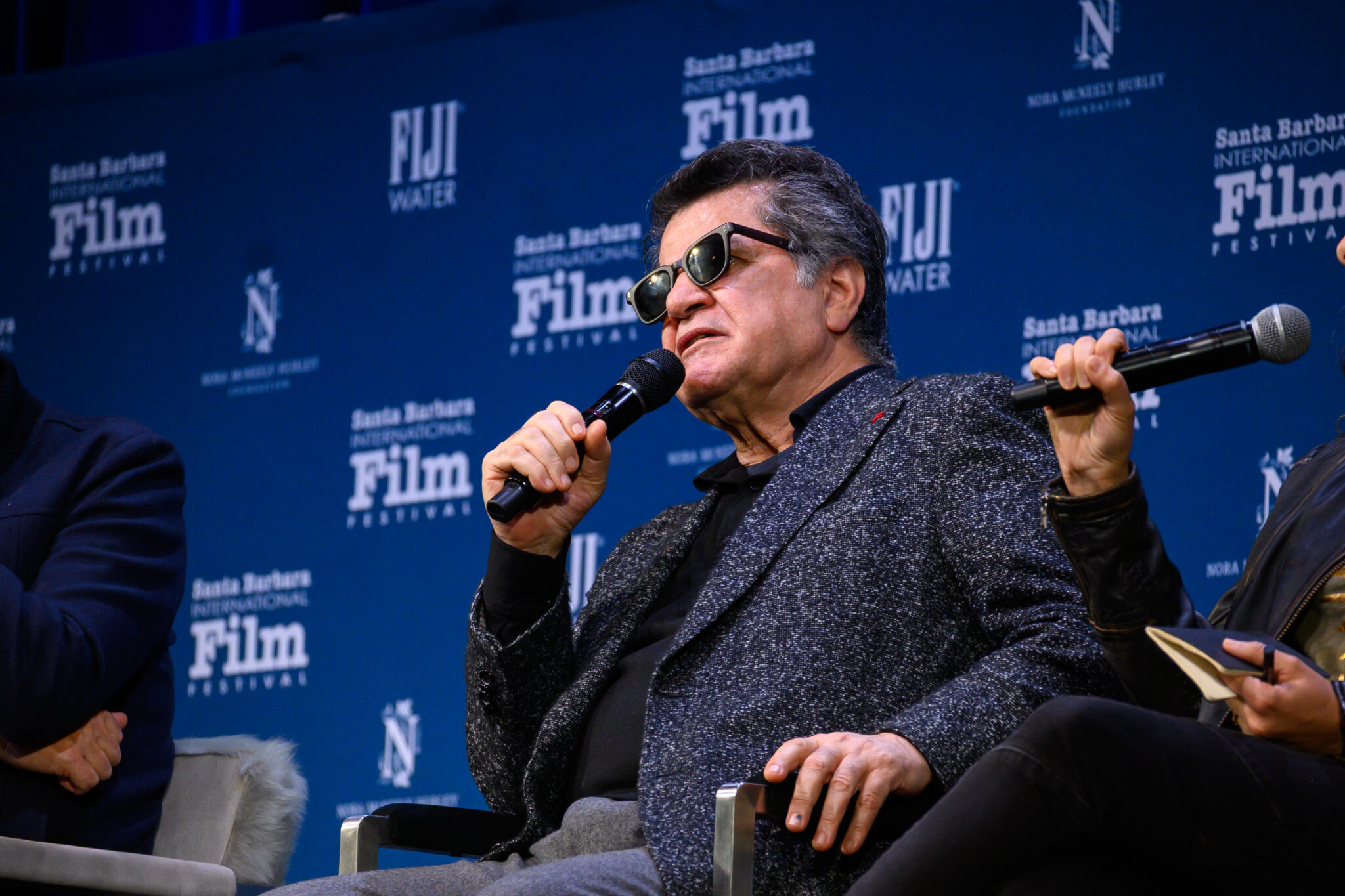
Jafar Pahani spoke in Persian, and his answers were translated into English by a translator. (Sherine John / Daily Nexus)
The discussion moved to the use of humor in Panahi’s film, despite its genre as a thriller and somewhat bleak themes. Panahi mentioned that he decided to incorporate humor throughout the film, up until the last 20 minutes. In this last portion, the narrative contrasted this humor so that there could be “pure silence” at the end.
“In any culture, in any place, moments of sorrow, moments of happiness are also mixed with moments of humor. A socially engaged filmmaker is trying to document realities and therefore cannot be turning a blind eye on what the realities are,” Panahi said. “All these particular elements together make up the realities of a society. If we take away any of those elements, then the sense of realism in the film will be depleted.
The discussion with Panahi concluded with him speaking on how he believes that there are no “purely good” or “purely evil” characters in film, and described a specific shot from the film in which he utilized red lighting to heighten the sense of anxiety.
Durling then introduced Trier, whose film “Sentimental Value” follows two sisters reuniting with their estranged father, a famous film director. The film received nine nominations at the 98th Academy Awards including Best Picture, Best Director, Best Actress, Best Supporting Actor and Best Supporting Actress.
Durling asked Trier about how he tries to match his use of color and saturation with the emotions of the characters on screen. Trier addressed this by speaking on his usage of 35mm film, and mentioned that he loves this type of film because he’s a third-generation filmmaker and prefers to be “old school.”
“My main argument for this is about skin tones and people and that that 35[mm] is really great at catching all the nuances and dynamics of how a face behaves kind of in situations where these wonderful actors are expressing themselves indirectly or directly,” Trier said.
The panel then moved on to focus on Laxe, whose film “Sirāt” follows a father as he travels through the Moroccan desert in search of his daughter who went missing at a rave. The film was nominated for the International Feature Film and Sound categories of the 98th Academy Awards.
Durling called the film one of the most “audacious” and “radical” films he’s seen, and drew attention to how the film’s team had an all female led sound design team earning an Oscar nomination. Laxe emphasized that he and his colleagues aimed to make it so viewers could “feel the sound in [their] body.”
The last panelist was Ben Hania, whose film “The Voice of Hind Rajab” retells the true story of Palestine Red Crescent Society volunteers as they try to help a 6-year-old girl, Rajab, who was killed in Gaza by the Israeli Defense Forces (IDF) in 2024. The film was nominated for the International Feature Film category.
Ben Hania spoke about how she incorporated real audio recordings of Rajab as she spoke to the volunteers on the phone, pleading for rescue. Ben Hania said the recordings were the “backbone of the movie,” and that they allow viewers to understand the events in Gaza and explore the feelings of helplessness.
She also spoke about her creative processes in adapting real-life events into scenes in a narrative that make sense to viewers.
“So to explain this to our audience, because for us, when you have a child grieving for her life and you have an ambulance, you send the ambulance, what are you waiting for?” Ben Hania said. “So I needed to explain this to the audience and how you do this [with a] whole set of explanations.”
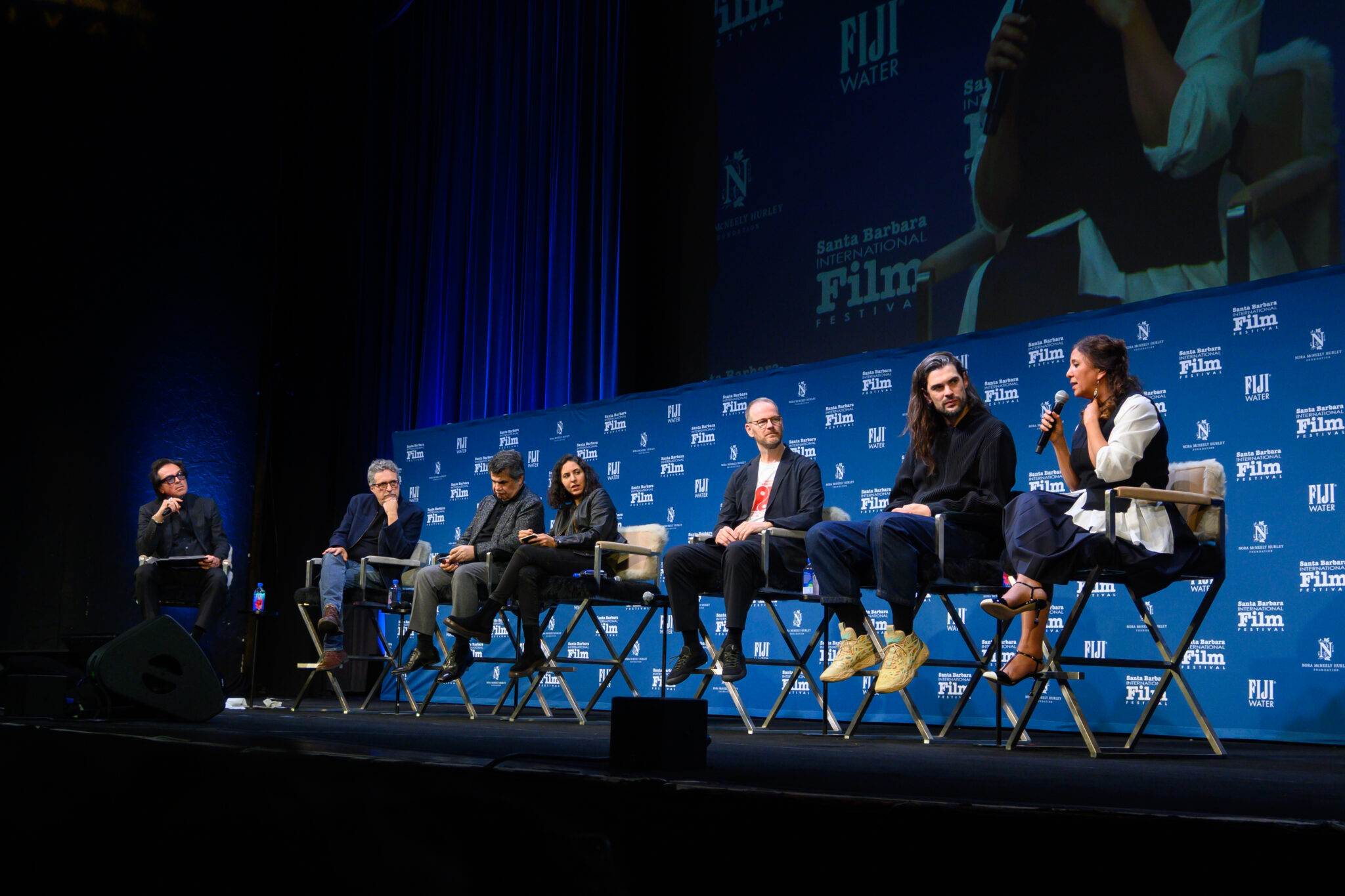
Tunisian filmmaker Kaouther Ben Hania talking about her film, “The Voice of Hind Rajab.” (Sherine John / Daily Nexus)
After Durling’s individual discussions with the panelists concluded, he ended the panel by posing a question to various directors present.
“Jafar Panahi mentioned that he does not make political films. He makes human films,” Durling said. “Can you comment on Panahi’s quote?”
Ben Hania said that she believes that humans are often inherently political, and that she finds cinema an important medium to share stories of the oppressed that may make viewers uncomfortable, but must be shared.
“We are a society, we need systems to organize ourselves,” Ben Hania said. “So when we approach a human being, when we approach human stories, we approach politically.”
Filho responded by acknowledging that many of his films have been called political films, but he said that he has never set out to make a political film.
“I believe that if you dedicate your time as a filmmaker to show life in society and people interacting,” Filho said. “You will make films about the human condition and inevitably these films will be political.”
“Sentimental Value” (Norway), “The Secret Agent” (Brazil), “It Was Just an Accident” (France), “Sirāt” (Spain) and “The Voice of Hind Rajab” (Tunisia) are all nominated for Best International Feature at the 98th Academy Awards.




















As someone who has worked in international cinema, I found the insights from these Academy Award-nominated directors incredibly enlightening. Their perspectives on how cultural narratives shape storytelling resonate deeply with my own experiences. However, I wonder if there’s a missed opportunity in discussing the intersection of technology and international features—specifically how emerging digital platforms are influencing global audiences. This could really enhance our understanding of diverse cinematic expressions while also bridging gaps between traditional filmmaking and modern viewer engagement. Would love to hear more geometry dash wave thoughts on this!