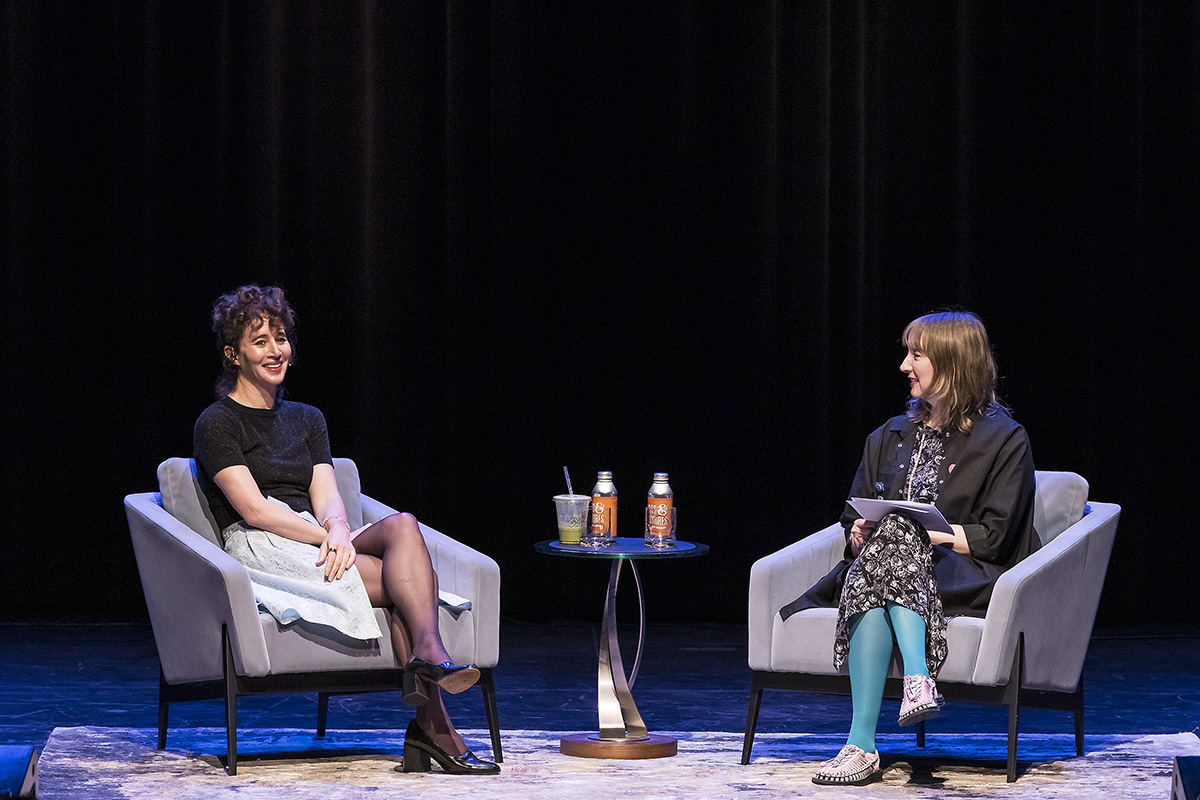
“All Fours” was a 2024 National Book Award finalist for Fiction and made the New York Times 10 Best Books of 2024 list. (Courtesy of David Bazemore)
Baby blue skirt floating behind her, world-renowned director, author, filmmaker, actress and author Miranda July strolled across the stage to the joyous applause of Campbell Hall’s audience on Tuesday, Jan. 20. Hosted by UC Santa Barbara Arts & Lectures, July, joined by California artist and UCSB art professor Shana Moulton, spoke in front of students and community members about life, creativity, her new book and aging.
Originally known as a filmmaker and performance artist with a raw, quirky style, July had written books before, but “All Fours,” published in May of 2024, garnered a new kind of attention. The novel follows an unnamed narrator on a roadtrip across the United States that quickly gets derailed and discusses prevalent issues like perimenopause, sexuality and domesticity. With over 210,000 ratings on Goodreads, July said she actually expected the success, earning clapping and exuberant whoops, with some audience members holding up July’s novel that they purchased from Chaucer’s Books in the lobby.
July spoke with a friend — whom “All Fours” is dedicated to and loosely based on — and they had a feeling the novel would make an impact because of the “loose space it was entering.” Next to her, Moulton smiled in agreement.
“This kind of success makes the world safer for me, and more friendly and warm,” July confessed.
The inspiration for “All Fours” came to her while she was making the film “Kajillionaire” (2020). July kept taking notes on her thoughts, but she “knew” it wasn’t for her current project. Describing a connect-the-dot puzzle where you can’t draw the line to connect the dots, she had to “withstand the not-knowing.” Giggles filled the air of Campbell as she aggressively poked the air and drew a zigzag to emphasize her analogy.
Moulton pointed out that “All Fours” started some communities among women on Substack, which July said is “amazing,” and reminds her of “Joanie 4 Jackie,” a network for women filmmakers she organized in the mid-90s. This modern group on Substack shared their experiences and work together in a somewhat similar manner. July emphasizes that this exists entirely separate from her, but she still writes on Substack.
The site has a “cool bias” for her work — her viewers seem to appreciate her writing more than the videos she posts there, despite her being known more largely as a filmmaker. Ever the rebel, July confessed she wants to see just how much “the system can handle” and experiment at some point by posting some “slutty” videos on Substack, earning an eruption of laughter from spectators.
July began rebelling against the “system” at a young age, starting with her first production at 17. Inspired by a pen pal that was in prison, she didn’t know how to express her intense feelings for the alternate world she had come to know, so she created a play to convey her emotions. Watching from the audience of the punk club that she had rented out in Berkeley, July knew that this production was going to be what she did. As the crowd in Campbell clapped, July allowed herself a moment of silent reflection.
What she was actually saying “yes” to at that age was not a path in life, but the “closest thing to love” she knew. The act of creating and directing the play was a space where she poured love and dedication into, a passion she has been pursuing ever since.
Appreciators of July’s art are certainly glad that she went this direction in life.
“Miranda July makes some really quirky, weird films. When I heard she was coming to speak at UCSB, I couldn’t believe it. I’m an artist myself, and I really love her performance art,” third-year art student M. Taylor said.
July doesn’t restrict herself to one creative field, however. While she is known for acclaimed films such as “Me and You and Everyone We Know” and “The Future,” she also is a novelist. Part of the inspiration for “All Fours” came from a book she picked up in a store with her ex-husband. A picture book of sorts, it followed a series of beautiful sisters through every stage in life. To the shocked laughter of the audience, she describes the panic of seeing women as “monstrous” towards the end of the book.
“I’ve been so free my whole life. I dropped out of college, I did my own thing and then I realized society was going to do that to me.” July knew herself, and by extension, all women, were going to be seen as a horrific creature for aging. Ever the boundary breaker, July insists she can’t have that.
Much to the amusement of the crowd, July furthered her point by jumping up from her chair and crouching behind it, so her head was only visible. Face above the fabric of the chair, she said being young and viewing womanhood as a “specific thing” is “almost like you’re in a fox hole … you’re in a fucking fox hole.”
“Perimenopause and getting comfortable with the changes that come with aging kick up the dirt around you, and breaks you free from the hole,” July said.
As the older women in the audience hummed in agreement, July simply announced, “I was freaked out, and I’m not now.”
She broke boundaries in the creative arts, changing the world to make it fit her notion of how it should behave. Perhaps that is the most punk and rebellious thing the human race can do.
This appeared in the Jan. 29 print edition of the Daily Nexus