

Iaorana Te Otea hosted its annual Winter Lū‘au at the Lotte Lehmann Concert Hall on Jan. 24. Over 300 guests showed support for UC Santa Barbara’s Polynesian dance, drum and appreciation club.
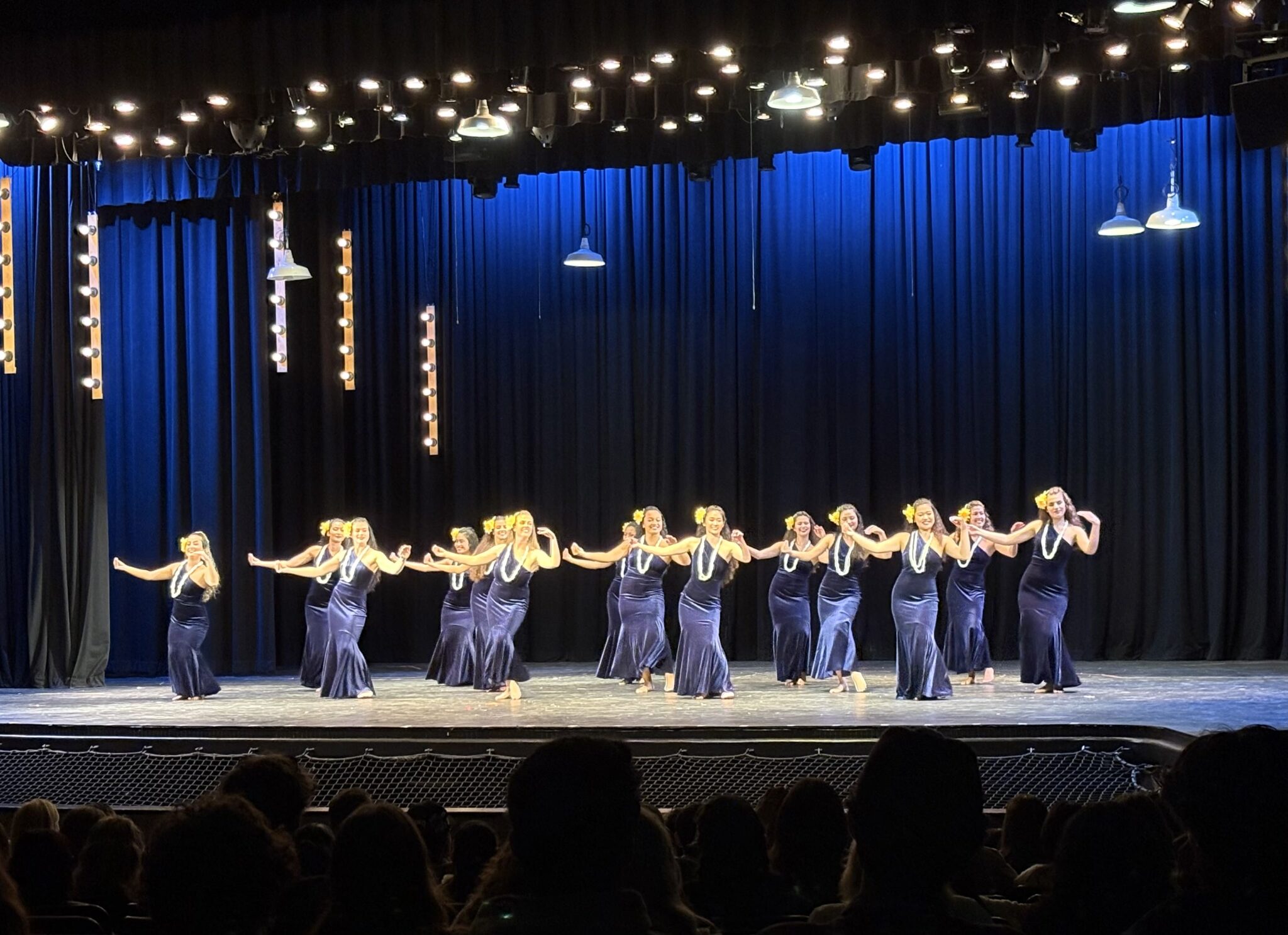
The annual Lū’au featured Polynesian dance and drum. Elijah Obando / Daily Nexus
Iaorana Te Otea (ITO) translates to “greetings from the drum beat.” The club aims to teach Hawaiian and Tahitian dancing as well as Tahitian drumming since its establishment at UCSB in 1990. A lū‘au is a traditional Hawaiian celebration significant to Polynesian culture, often including different styles of dancing and drumming.
The lū‘au consisted of original choreographed performances showcasing Hawaiian hula dancing, chanting and Tahitian drumming, and was split into two acts. The first act focused on Hula ‘Auana, a contemporary form of hula dancing, while the second act focused on Hula Kahiko, a traditional form of hula dancing.
Hannah Kang, a fourth-year political science and economics double major and co-president of ITO, explained the background and significance of Hula ‘Auana dancing.
“‘Auana symbolizes the water and nature of hula dancing. Hula ‘Auana is performed with a variety of instruments and vocals,” Kang said. “This style is more free-form than Kahiko.”
Kang further explained that Hula ‘Auana is performed to English or Hawaiian songs and accompanied by musical instruments.
For a majority of the lū‘au, Alex Yong, a fourth-year psychological & brain sciences and film and media studies double major, and ITO’s co-drum master, provided context for each of the performances.
“Our dancers have worked tirelessly since October to learn new techniques, chants and the ability to hold a smile for two and half minutes,” Yong said.
One performance during the lū‘au featured the use of a traditional Hawaiian rattle called an ‘ulī‘ulī, commonly used in the traditional Kahiko style of dancing. Yong explained the use of ‘ulī‘ulī and the background of the performance’s choreography in further detail.
“The ‘ulī‘ulī are commonly used in Kahiko, but you can also see them used in ‘Auana performances such as this one. This dance is about the beauty of the Naupaka flower, symbolizing a connection to the land, love and protection,” Yong said.
The second act of the lū‘au presented a “sneak-peek” of ITO’s drum performance to be performed in May and was led by Yong and Elijah Calip, a fourth-year microbiology major, and ITO’s other co-drum master.
For the remainder of the lū‘au, the performances used Hula Kahiko. Yong explained that the sounds of Hula Kahiko are made only using percussion instruments, such as bamboo sticks, called “pūʻili,” or hard gourds, called “ipu.” Yong said that Kahiko requires strength because it is used to honor the gods and chiefs, known as “the akua.”
The lū‘au closed with a group ‘Auana dance titled, “Ka Uluwehi O Ke Kai,” which translates to “the plants of the sea.” Yong explained the choice of this song for their closing number.
“We picked this as our closing song because it describes the intermingledness of the ocean seaweed. Like the seaweed, all of our dancers and drummers have created bonds and relationships with one another that are comparable to the entanglement of seaweed,” Yong said.
One attendee, Jaya Chohan, a third-year environmental studies and economics double major, said she attended the event to support her friends.
“I have two friends that are a part of ITO, so I came to support them. I really liked the drum performance. That was cool, so I’m excited for the next show,” Chohan said.
A version of this article appeared on p. 6 of the Jan. 29, 2026 edition of the Daily Nexus.
















Be care full or the Republitards and there freinds in ICE will deport you all. Obamo, Clintonn, they never deported ANY ONE. Trump is an idoit what doesn’t’ no that IT TAKE’s A Village
This sounds like such a beautiful event. I’ve always loved how cultural gatherings bring people together in a way nothing else really can. Music, dance, and shared history just hit on a human level — you don’t need to know every detail to feel the energy in the room. Events like this remind me that community is built through showing up and celebrating each other. I’ve had that same feeling attending shows I found after reading stubhub reviews , where the crowd energy makes the whole experience unforgettable. It’s great to see so many people supporting traditions and keeping them… Read more »