Ahead of the United States women’s national soccer team’s return to Santa Barbara for the first time since 1991 for their match against Chile, Head Coach Emma Hayes met with the media to outline her priorities. These included the squad rotation, development of new players and the significance of playing this match at Harder Stadium. By the end of the match, Hayes’ vision had clearly translated onto the field.
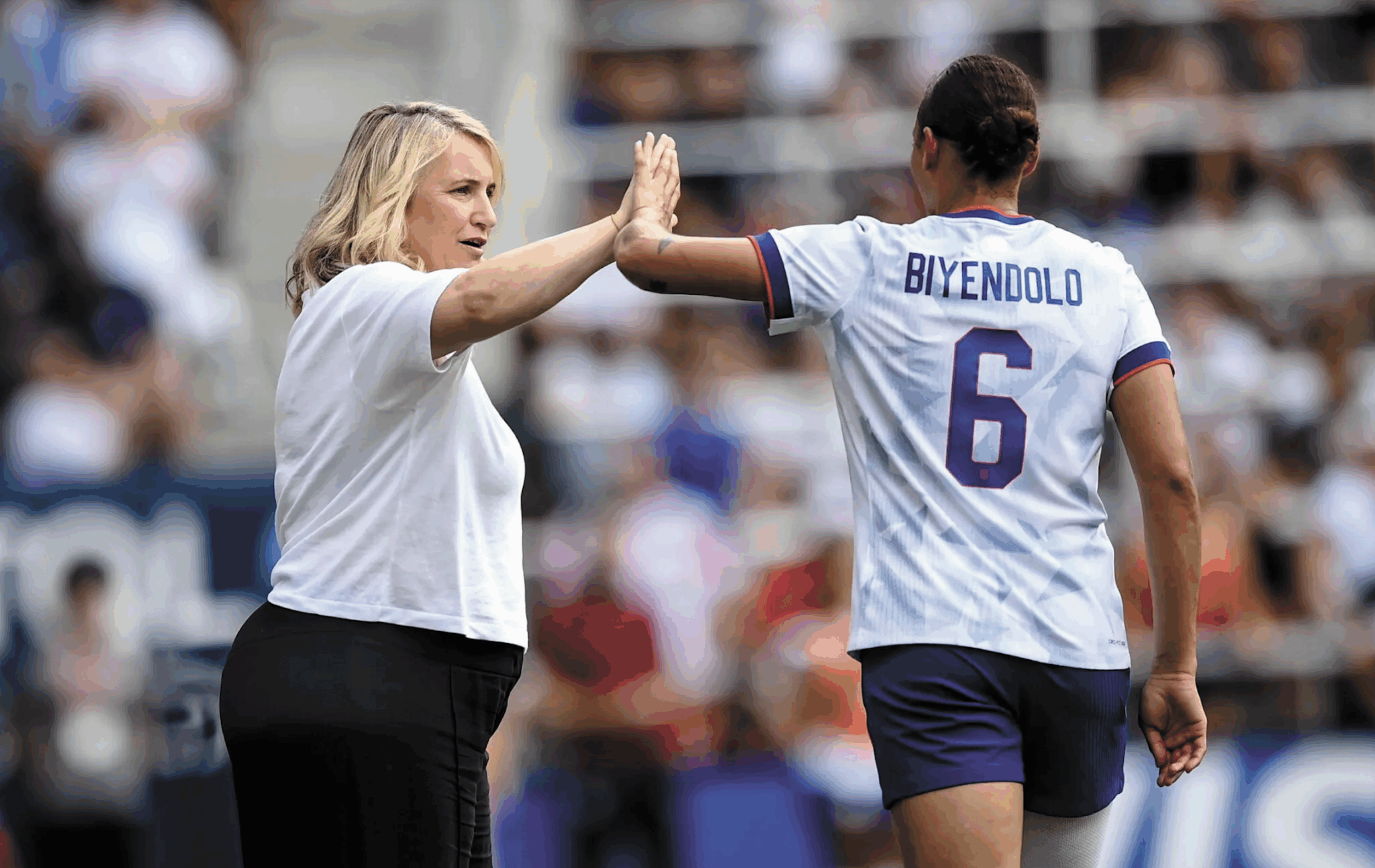
Head Coach Emma Hayes encourages forward Lynn Biyendolo. Courtesy of Getty Images
The match against Chile was a rare appearance for the U.S. women’s national soccer team (USWNT) at a historic stadium that many have labeled as a “soccer heaven.” Hayes emphasized that Harder Stadium was chosen intentionally and received immediate approval from her as the team continued to develop and prepare for the international stage.
“It’s not about the size of the crowd, it’s about the quality of the crowd … When something feels full and you’re performing for people, that shapes you,” Hayes said.
The anticipated atmosphere materialized on Tuesday night as a crowd of 14,797 fans filled Harder Stadium and provided consistent energy and cheers throughout the match. Hayes later said that she had challenged the team to match and feed the crowd’s energy with their performance.
Hayes had confirmed ahead of the game that the lineup would include many changes from the team’s previous match against Paraguay, which resulted in a 6-0 win for the squad. She cited her intentions of workload management and evaluating a broader group of players early in the season.
“Knowing where the players are at this stage of the season with their [National Women’s Soccer League] club, I will not start a player for two games in a row. So there will be a complete lineup change and that will bring a whole set of challenges,” Hayes said.
Hayes noted that with inexperience at the international level, the players needed time to settle in. She has been deliberate in prioritizing and establishing the squad’s foundation on the field.
“There’s still, you know, a little bit of nervousness,” she said. “They want to get those things right. They want to prove so much they can get those things right. So maybe it will take time for the flow of the game to come to us. But walking around on that field … one thing I do know is that it is an intimate place to play. And with a sellout situation, I hope it doesn’t take 45 minutes to get going with the fluidity that we want.”
The USWNT was able to maintain control and find their rhythm quickly, executing on Hayes’ emphasis of finding structure before striking.
“I always talk about getting the framework right,” Hayes said. “If your structure and principles are right, then you can decorate the house. Which in our world is to be a bit more fluid.”
Postgame, Hayes noted that the framework was an encouraging takeaway from their performance.
“The first thing was that they got the framework right … Sometimes it’s not about making the first pass, it’s about opening the space for someone else … I think that light bulb moment for the team was one that gave us more confidence,” Hayes said.
Several young players stood out during this match, including defender Emily Sams who wore the captain’s armband and contributed to the game in multiple ways, one of which was her first-ever international goal. After the match, Hayes praised Sams’ leadership.
“Sams without question leads by example with a combination of her behaviors not just in terms of being competitive but the standards she holds for herself. She’s a great teammate, very thoughtful and caring and kind,” Hayes said.
Beyond the match, Hayes admired Santa Barbara itself, showing the excitement she had for her staff and players to play in this environment.
“The mountains in the background and that beautiful coloring during sunset. I’ve got to remember to keep my eyes on the game tomorrow and not the view in the background because this is one spectacular place,” Hayes said.
As the USWNT showed up to Santa Barbara with a confident showing, Hayes framed the night as both a competitive step forward and a meaningful moment in the program’s history.
“To create legacy there has to be that common thread,” Hayes said. “Most importantly for any organization to thrive, you must have great glue and this glue right here is what keeps us all together.”