Brimming with football references and medical analogies, former University of California President Michael V. Drake spoke at Campbell Hall on Jan. 22. Drake discussed the role of higher education in society and major events within the UC during his presidency.
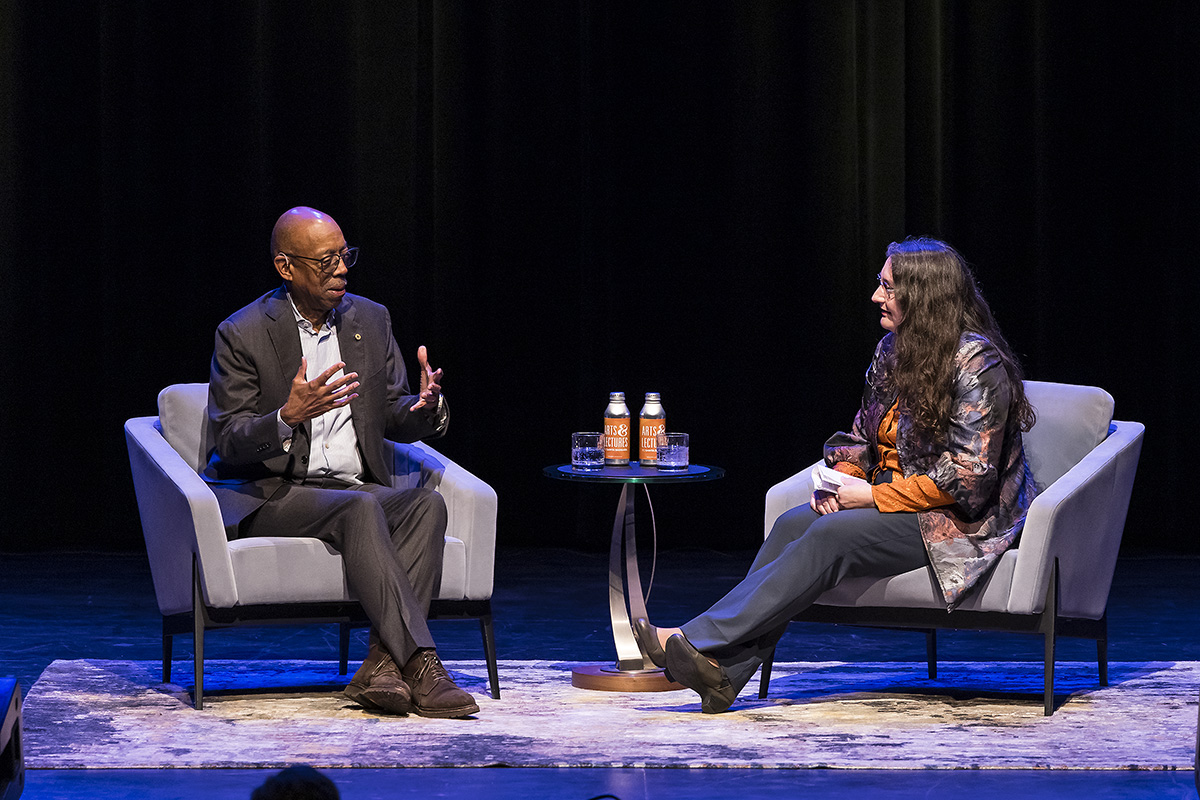
UCSB professor Susannah Scott interviewed former president Drake on stage, asking him questions about his journey to becoming UC president and the events that transpired during his term. Courtesy of David Bazemore
“As a surgeon … you sort of take responsibility for the thing that you’re doing,” Drake said regarding his transition from physician to higher education. “I always felt that I had to be prepared and ready to take responsibility for the thing that I was doing.”
The event was part of the Arts & Lectures “Justice for All” series. Drake was the 21st University of California (UC) president from August 2020 to August 2025, overseeing the reopening of campuses after the COVID-19 pandemic and the largest strike in the history of American higher education. During his tenure, the UC agreed upon a five-year compact with Governor Gavin Newsom to increase funding for the university system, alongside other goals for higher education.
Following decades of medical leadership at UC San Francisco and the wider UC system, his medical background informed his decision to take on the job as UC president at a time when the UC was deciding how to safely bring students back to campus after the pandemic.
Drake was the first Black UC president and lived through racial segregation during his childhood. In the wake of demonstrations against racial injustice during 2020, Drake entered the UC with goals to expand the diversity and accessibility of higher education.
UCSB Chancellor Dennis Assanis introduced Drake to the stage, highlighting their relationship throughout their time in university leadership and Drake’s accomplishments during his tenure.
“Under his leadership, the University of California expanded its strong commitment to access, affordability and academic excellence,” Assanis said.
Drake began his remarks by discussing his upbringing during racial segregation, as well as the role of higher education in America and how it had benefited him and his family.
“[It] took a lot for the country to move through this period, roughly 100 years after the Civil War, to finally take off the shackles of Jim Crow,” Drake said. “One of the things that seemed important to me at the time, and in retrospect, was very important, was that one of the pathways for our – I’ll say salvation, for our improvement, for our growth, one of those pathways was education.”
Drake explained that during his time overseeing UC Irvine and Ohio State University, he taught a course titled “Civil Rights, the Supreme Court and the Music of the Civil Rights Era.” He said his son’s school art assignment influenced his approach to the course as well as his high school job at Tower Records in Sacramento.
Regarding his thoughts on the role of universities within society, Drake referenced the ideas of Clark Kerr, the first UC Berkeley chancellor and twelfth UC president.
“One [of Kerr’s ideas] is that knowledge makes the world go round, and the university is still the best place for new ideas. I think that that’s true,” Drake said. “Universities need to evolve with and change with the time, but [are] celebrated and protected by successful societies, and it’s something for us to remember to do as we move forward.”
Next, UCSB professor Susannah Scott interviewed Drake on stage, asking him questions about his journey to becoming UC president and the events that transpired during his term. Scott asked Drake to describe one thing he wished he could’ve accomplished during his time as president, to which Drake replied he wished he was able to implement an employee tuition support plan.
“For mid to lower income families, it’s a big help and I think that we should do that to try to help them,” Drake said. “I liked having my colleagues be invested as parents of students.”
Drake described an instance in which a woman wore Ohio State merchandise to represent her children’s school as an example of how tuition support for employees helps increase social mobility.
“I said, ‘Were you an alum? How are you associated with the university?’ And she said, ‘Oh gosh, no, I didn’t go to college, but both of my children did, and I couldn’t be more proud,’” Drake said. “The concept of people working and then creating opportunities for the future, for their kids … I still think that’s a great idea.”
Speaking on the 40-day graduate student strike in 2022, Drake said it was “difficult” to come to a resolution because it “pitted” the UC against its students.
“I wish that the two sides could have appreciated the value of the change that we made … from the university side to realize the importance of treating graduate students fairly, make it that they can support themselves,” Drake said. “I would have liked some of the organizers to be more appreciative of the challenge that it was for us to do that, and then more welcoming and grateful for the changes that we brought to them.”
The conversation then moved on to campus climate during the 2023-24 academic year, where students held demonstrations following the attack on Israel by militant group Hamas and Israel’s continued siege on the Gaza Strip. Drake said that following the Oct. 7 attack, the Congressional Jewish Caucus invited him to see raw footage of the event.
“In a campus community where we need to represent everyone, we’re a place for everyone trying to balance those forces,” Drake said. “It was challenging for the world as a whole, challenging for us as campuses … I’m glad we’re on the other side and I look forward to the world really dealing with the horror that still exists these days in Gaza.”
Drake continued by explaining that each campus had its own response as well as its own encampment. Meaning, each campus community necessitated a different response to student demonstrations.
“That’s kind of our balance is to try to have rules that apply broadly, that everyone can follow, but then nurturing the individual specialness of each of the campuses and of the labs,” Drake said.
Scott also touched on UC Berkeley’s release of 160 names to the Department of Education’s (DOJ) Office for Civil Rights. Although it occurred after Drake left office, the original agreement for redacted information was made during Drake’s term. Drake reflected on his father-in-law’s experience as a surgeon during the Korean War and how that impacted his decision-making skills when faced with situations such as this one.
“The idea of applying principles in a consistent and transparent way to problems that come up, and trying to know your values and stick with your values and applying those is a good way to make the next step when you’re dealing with a traumatic or difficult circumstance,” Drake said.
Scott and Drake also discussed how universities can build back trust in higher education with the American public. A Pew Research Center study conducted last year found that a growing number of Americans believe higher education is “generally going in the wrong direction.”
Drake said that he would like to further “interrogate” the claim that higher education isn’t useful anymore.
“You’re on the airplane. You want your pilot to be trained, or the person who designed the plane to be an engineer … So there are lots and lots of things that I think everybody would say are critical, of course, that means that universities have to be as strong as they can be for it to work,” Drake said. “We have to be thoughtful [or] better about the elitism of our being good at things and so that we can be better at certain things, but that doesn’t mean we’re better than you as a person at all.”
The evening concluded with Drake discussing his hopes for the UC under President James Milliken.
“The incredible people that we have in our community, from the people who work in food service and groundskeepers to everybody who works in the administrative staff, the faculty, the students, the people who come here to try to learn and make themselves in the world a better place. What a great privilege [it] is to be involved [in] that,” Drake said. “What a great privilege [it] is to take that knowledge out into the world after and see those things actually work. I think we have to remember that.”
A version of this article appeared on p.5 of the Jan. 29, 2026 edition of the Daily Nexus.