

The Environmental Defense Center hosted a “People’s Hearing” on Jan. 16 to discuss and raise awareness of the federal government’s plan to open the California coast to new offshore oil and gas development.
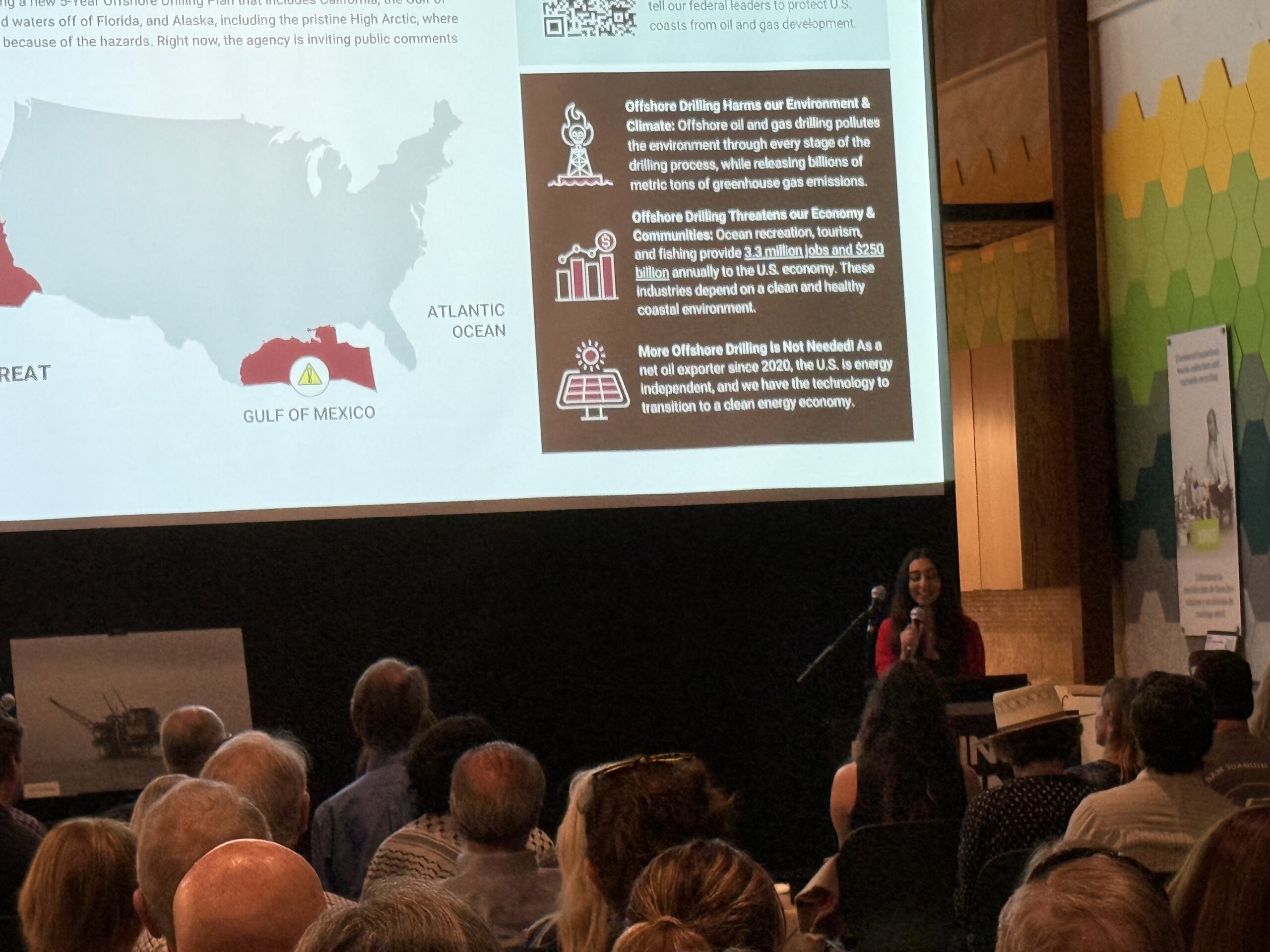
Nikki Talebi spoke regarding her personal experiences, which contributed to her belief that environmental advocacy is so critical. Iris Guo / Daily Nexus
Held at the Community Environmental Council’s Environmental Hub in downtown Santa Barbara, the event included speakers and tabling from various local environmental organizations, including Surfrider Santa Barbara, the Sierra Club Santa Barbara-Ventura chapter, UC Santa Barbara Environmental Affairs Board (EAB) and Santa Barbara Channelkeeper. Prominent environmentalists were also present, including actor Ted Danson.
Last November, the U.S. Department of the Interior (DOI) released an offshore oil and gas leasing plan that aims to reopen the California coastline to offshore drilling. The plan includes 34 lease sales — three of which are in the Southern California program area — which are scheduled to begin as early as 2027.
In the plan, Secretary of the Interior Doug Burgum said it was created in order to ensure that “America’s offshore industry stays strong,” which could thus enable America to be “energy dominant for decades to come.”
Maggie Hall, deputy chief counsel at the Environmental Defense Center (EDC), was the first speaker at the event and spoke about the logistics of the plan, as well as arguing for why it could be detrimental to local environmental interests. According to Hall, “no new leasing has occurred in the [Southern California program area] since 1984,” and the EDC is working to “keep it that way.”
Hall explained the history of oil drilling off the California coast, as well as the major oil spills that have occurred since the first oil drilling in the world occurred in 1986 off Summerland.
“In 1969, the well blowout at Platform A in Santa Barbara sent an estimated 3 million gallons of crude oil into the Pacific Ocean, devastating wildlife, marine ecosystems and tourism, and giving rise to the modern-day environmental movement,” Hall said. “Fast forward to May 19, 2015, the oil pipeline then operated by Plains All-American ruptured and spilled crude oil onto Refugio State Beach and into the ocean.”
Hall described these events as having “devastating impacts” on the local environment, and said that there is “no safe way to drill for oil.”
“This is especially important in such a diverse and sensitive environment that we have here,” Hall said. “The Santa Barbara Channel has been dubbed the Galapagos of North America because of its incredible biological diversity.”
According to Hall, the EDC is currently working to fight the “dangerous proposal” by working with a broad coalition of national groups to submit a collective sign-on letter. The letter urges regional governments to adopt resolutions opposing the plan and to connect with state representatives to compel the federal government to remove California from the plan.
Following this, Chumash community leader Mia Lopez spoke about how the interests of the local Indigenous communities come into play in relation to the proposed oil and gas developments. Lopez encouraged attendees to “protect the land” and warned them against “[forgetting] their connection to the earth.”
“We’re not here because our voice is any different than any of yours. We’re here because the Mother Earth is our responsibility,” Lopez said. “That’s part of what our culture teaches us, that no matter what’s happening, we have a bigger responsibility. We don’t get to walk away and say, well, it’s just too big.”
Ted Danson then spoke regarding his experience with environmental activism and thanked attendees and fellow speakers for their dedication. He encouraged the audience to “fight with love” and recognized that people with differing political affiliations and points of view share a mutual love for the California coast.
“Let’s protect this thing that we both love. Because if you come from anger, rarely does it work,” Danson said.
Following this, Congressmember Salud Carbajal thanked local community leaders for their continued dedication to the matter. Carbajal said that issues with offshore drilling have motivated his policymaking and advocacy in protecting the coasts.
“The Trump administration’s recent meddling in the disabled pipeline permitting process has been atrocious and detrimental to our community,” Carbajal said. “These decisions are deeply troubling, not only for the future of our coastlines, but for the public’s trust in our nation’s commitment to environmental protection.”
After, California Assemblymember Gregg Hart and Santa Barbara County Supervisors Laura Capps and Joan Hartman shared similar messages, emphasizing people’s abilities to advocate for issues they care about.
“That’s what we do here in California. That’s what we do here in Santa Barbara,” Capps said. “The people rise up. That’s what we did after 2015, right? The people rise up.”
Hartman specifically emphasized the ability of energy to shape power structures, concluding that renewable energy sources like solar could “distribute power, literally and politically.”
“Oil doesn’t just power cars. It keeps us addicted, tied to weekly fill-ups, to centralized utilities, to geopolitics that send our military overseas to secure supply lines,” Hartman said. “It creates a system where a few people at the top hold all the levers.”
Among the politicians and prominent community members who spoke, Nikki Talebi, a fourth-year environmental studies major and advocacy co-chair of EAB, represented UCSB students. Talebi spoke regarding her personal experiences, which contributed to her belief that “California is a special place” and that environmental advocacy is so critical.
“There is now a plan to recklessly sell our ocean — which is an integral part of our identities — and a part of the many communities who have lived along this coast for centuries for oil drilling,” Talebi said. “When one oil spill has the power to span across the coast of California, this is a decision that will affect us all.”
A version of this article appeared on p. 6 of the Jan 22, 2026 edition of the Daily Nexus.



















Reilly v. State, et. al.
July 24, 1975 settlement date
Santa Barbara County, Municipal Court Case No. 36,506.
My attorney representing me was Marc McGinnes. The state did not immediately remove the pilings. Another person was subsequently injured and McGinnes represented this individual also! The state in my settlement proceedings stated that they were in the immediate process of removing the pilings, prompting me to agree to a settlement!
What is (legally) wrong with this picture?! Misrepresentation? I later talked to McGinnes about this issue and he declined to pursue the matter further. I was shafted big time.
Not only did the state of California not immediately “mitigate the situation,” waiting at least eight months before doing anything, but afterwards the state merely posted warning signs in the area, which remained there for the next twenty years! All of this happening amidst the apathy of the county electorate! It shows to me vividly that only the squeaky wheel gets the grease over time. All the other voices are merely muted by the media powers-that-be—surely a tortured poet’s dilemma to this very day!
That’s not the only transgression that the state of California made in my case. In the initial eight months before any mitigation efforts, the powers-that-be sent one of their investigative goons to my residence in North Tustin at the time. He asked me one question: “Did you have any knowledgeable connection to the second individual injured at the same place and in the same manner?” I said no adamantly, he hesitated for a moment and then promptly drove off. The authorities at the time couldn’t own up to their own negligence and wrongdoing, and they were still trying to intimidate… Read more »
On February 23, 1942, the WWII “Attack on Ellwood Beach ” began, the first such attack on the mainland US since the War of 1812. If you search the archives of the LA Times, you will find an article describing this in detail on February 20, 1980. At the time I read this, I noticed that the editors failed to mention the ongoing presence of the scattered rusted protruding shards. I personally hand-delivered a letter to the editor in downtown LA, blasting their blatant omission in their ongoing analysis. It was never published—yet another iconic example of a rigged media… Read more »
Remember Robert A. Huttenback? He was the former UCSB chancellor involved in a high-profile scandal regarding the misuse of university funds to renovate his personal off-campus home. He resigned in July 1986 following months of controversy and an internal University of California audit. In July 1988, a Santa Maria jury convicted both Huttenback and his wife, Freda, of embezzlement. Huttenback was also convicted on several counts of tax evasion. From my perspective of looking back on fifty-plus years of UCSB history, the former Chancellor Yang reminds me a lot about him. Yang left the scene of an accident occurring on… Read more »
Reilly v. State The courtroom is a furnace again, and Michael Reilly stands in it— a single wick, trembling, while California looms above him, a colossus greased in crude and confidence. They call it justice. They call it due process. But the walls hum with the oilmen’s breath, thick as tar, and the lawyer’s tongues shine with the polish of practiced forgetting. Truth is a sparrow here— small-boned, breakable, shooed from the rafters each time it tries to land. The State arrives armored in precedent in the slow geological weight of money turned into law. Reilly arrives with only his… Read more »
Congratulations are in order today for California Attorney General Rob Bonta challenging the federal regulatory move to take over jurisdiction and approve Sable Offshore Corp’s pipeline plan. Let’s see what the Ninth Court of Appeals has to say on this in due time. Perhaps the battle over Sable hasn’t been completely lost just yet! Following this news today, Sable (SOC) stock dropped 10-17%! Hot damn!
Today Trump criticized all world environmentalists on the recent cold spell racing now across the US, pointing to record cold temperatures. “Where’s the global warming?” he said. The scientific fact of the matter is that these atypical weather events such as this one where the Arctic air spills southward substantially into the US are a direct result of the global warming phenomenon! What a complete ignoramus! His sociopathic narcissism coupled with his insularity provided by his inherited wealth is a direct limitation to his intellectual awareness and capacity on a plethora of subjects and fronts. Ditto for Tammy Faye Baker… Read more »
Here’s another stupid executive order the man of mediocre intelligence favorable to the gullible masses has done: In order to produce a penny, the US treasury incurs a total loss of 2.69 cents per penny. This resulted in a total loss to the Treasury of $85.9 million in 2024. However, and get this clearly, it costs 13.78 cents to produce and distribute a nickel, resulting in a net loss of 8.78 cents per nickel. With the loss of the penny in circulation, the Treasury is now forced to produce millions more in nickels, resulting in an overall loss MORE than… Read more »
More on my perspectives on Paramahansa Yogananda:
Extra dimensional branes (D-branes) in string theory do indeed possess energy.
These are where open strings can end. This is Oppenheimer’s and my own scientific vision of the conscious blissful Vedantic afterlife. Herein lies the key to the ultimate union of science and religion!
A bit more on Yogananda: Theta waves (4-8 Hz) are linked to deep relaxation, emotional healing, and subconscious emotional processing. They are prominent during meditation and REM sleep, enabling access to deep memories and emotions. Christian Evangelists like Graham attempt to influence their flock mainly through the activation of Beta waves (12-30 Hz) and verbatim, essentially garbling and clouding the mind’s Third Eye. This is a heinous approach to the Divine Cosmic Intelligence in the here and now! Even Jesus spoke of the “Third Eye.” (Mathew 6:22). He even revealed to his disciples how to develop it to full influential… Read more »
The seat of the soul (the Third Eye) is the pineal gland. Chaga mushroom helps to decalcify this gland, clear out all the toxins and make this awareness more present. It can be bought in capsule form at your local Walmart or at any comprehensive herbal store.
It is one of the most powerful antioxidants on the planet, if not the most powerful one found! Use this sacramental herb in moderation, though—one capsule per day. This beats the Hell out of LSD, Cocaine and pot!
I much prefer to imbibe the sacrament of chaga (a very real physical entity, not the transubstantive mythology of the Catholic Eucharist) at bedtime around 10:30pm.
I awake fully restored from a very profound and deep sleep pattern, free of any nightmares
and interruptions.
Stresses and anxieties from the previous day have been completely vanquished. No need to partake of alcohol at any time to numb life’s challenges. It beats any tranquilizer hands-down. And it’s inexpensive—$15.00 for (60) capsules. Take this advice from a grizzled UCSB veteran of life’s vicissitudes at age 74!
Via the sacrament of chaga, there is no need now to feed the insatiable greed of the corporate coffers of the Roman Catholic Church, the Latter-Day-Saints, Osteen’s organization based in Texas, or that of Graham’s Evangelistic juggernaut. Don’t be fooled by the fearful rhetoric perpetuated incessantly down through the centuries of “fire-and-brimstone,” intended to enslave the human psyche of its creative explorative nature into the infinite “Tree of Knowledge,” and stultify the essence of the human spirit! The fires of Gehenna are found only on this earth—God is first and foremost a very loving Godhead welcoming you into his eternal… Read more »
You cannot enter the Kingdom of Heaven by being a cannibal. That’s an impossibility;
or by simply following “the Word.” The essence of the soul transcends these earthly parameters and must be addressed accordingly. To quote from the late poet W.B. Yeats,
these are simply phenomenal “gyres” serving solely to placate the psyche throughout the hardships of life.
The medical community does not presently recognize calcified pineal glands as a condition requiring specific medical treatment, and as a direct result, there are no medical treatments or formal clinical studies done to reverse this process. The medical community should certainly address this issue in the coming years! They are also blatantly ignorant of the sacred energy chakras that exist within the human body as described by the ancient Indian mystics. Isn’t it but a small wonder that there exist such a spiritual malaise and clear dystopian American culture today? It surely requires the Herculean efforts of a “poet alchemist”… Read more »
The Poet Alchemist The city rots in its gray husk— a carcass of billboards and broken vows— and still he walks, pockets full of ash, seeking the faintest glint beneath the ruin. He knows the chemistry of despair, how it crusts like lead on the tongue, how it stains the fingertips of anyone who dares to touch the age they live in. He gathers what others discard: the rusted hinge of a shuttered school, a headline curled like a dead leaf, the sigh of a woman counting coins that will never be enough. He takes them into his hands the… Read more »
There should be many, many doctoral dissertations made here @UCSB involving the various effects of chaga from neuroscientific point of view in the future. This is a fertile field wide open as all of cyberspace! I look forward to hearing from the researchers’ results in my golden years. No wonder the Russians train their Olympic athletes with this drug!
BeamMeUpKirk.com—I conceived and registered this domain on GoDaddy on August 17, 2025, some three-plus weeks before the evangelist’s passing. I had but a brief intuitive glimpse into the precognitive dimensions of the Cosmic Intelligence whereby both the past, present and future melds themselves into the “eternal now” in his benevolent Eye. Materialistic cynics call it simply a “coincidence.” I call it evidence of my psychic abilities in line with “Cosmic Synchronicity of God’s will.” Herein below is a later reflection on the domain’s meaning all the world can now see. Enjoy. The union of science and religion has finally arrived!… Read more »
Yogananda’s core message in recent discussions is that while astrology can reflect past karma, a soul “is ever free” and can transcend planetary influences through regular meditation and attunement with the Divine. In 2026, the Year of the Fire Horse, which begins on February 17th with an eclipse, is considered a very significant event in the Chinese zodiac, happening once every 60 years. Astrologers highlight its importance as a time when the Horse’s energy combines intensely with the transformative Fire element. Also, major outer planets move into the fire sign Aries, reinforcing themes of rebellion, courage, and creative change! This… Read more »
The forthcoming lunar eclipse on February 17th occurs exactly on my midheaven in my natal chart.
I was born within (24) hours of the feast day of St. Brigid of Ireland. She was born from a pagan chieftain around 450 AD. It is also the ancient Celtic festival of Imbolc, marking the beginning of spring according to the ancient pagan Druids. As of 2023, the Irish government recognizes February 1st as a public holiday in her honor. St Brigid is the patroness of babies, dairy maids, travelers, and sailors. My father, who still is remarkably healthy, with all his faculties fully intact to this day at age 102, attended St. Brigid’s elementary school in Los Angeles… Read more »
Here’s where I stand on I.C.E.—I wrote this poem over six months ago.
Google: Michael W. Reilly-Daily Nexus, then scroll down until you reach the article
“Varios vehiculos de I.C.E. vistos en el oeste bajo de Santa Barbara.”
Then read the poem. It remains a rallying cry across this nation for justice against this ugly heartless fascist regime!
My book of poems, succinctly encapsulating what I have previously published in the Daily Nexus is finally going to be published c/o Henry Holt Publishers. I just got word from my publisher via email this afternoon. It’s been a slow arduous grind with many delays, but finally it’s coming to a fruition. It is my hope that it ultimately will make an impact on the populace. It is titled, “A Golden Star Book of Poems,” and features the Horsehead Nebula amidst the constellation Orion, with a quote from Old Testament Job. It will be available through Amazon.
What’s your response to the I.C.E. poem I published six months ago? I want to hear from the UCSB community and for that matter, anybody, who has the courage to read it and respond forthrightly. All of you can’t hide your heads in the sand! Let’s get some responses now! Where’s your courage in this moment of crisis for our country?!
I most emphatically agree with Arizona AG Mayes’ stance vis-a-vis the I.C.E. agents, from a “stand-your-grounds” aspect under AZ law! Come on. What’s your take? You can’t all be cowards out there! Notice now how the “Cheeto man” is backing down his forces in Minnesota trying to take some of the heat off? This is a monumental pivotal moment in US history and will surely be a major issue determining the outcome of the November elections. For God’s sake, participate, or we shall all surely lose our freedoms to this incompetent dictator!
In an enclosed system, air feeds the fire. The more oxygen is fed into the system, the brighter the fire becomes. I here to do just precisely that—surgically, strategically, and inexorably, utilizing the ancient archetypes most importantly.