

[UPDATE 01/26/5:40 p.m.]: Villacreses and Espinoza informed the Nexus after the following article’s publication regarding specific details they spoke about. The following article has been updated to reflect these details accurately.
The UC Santa Barbara Associated Students hosted a “Protect Your Peers” week to raise awareness and provide resources on the rights of undocumented and international communities.
Rapid response training
Associated Students (A.S.) collaborated with 805 UndocuFund, a non-profit organization that supports undocumented communities in the 805 area code, to host a second Immigration and Customs Enforcement (I.C.E.) rapid response training on Jan. 12. The first training was held last November and saw around 100 attendees, while the more recent training saw over 200 attendees.
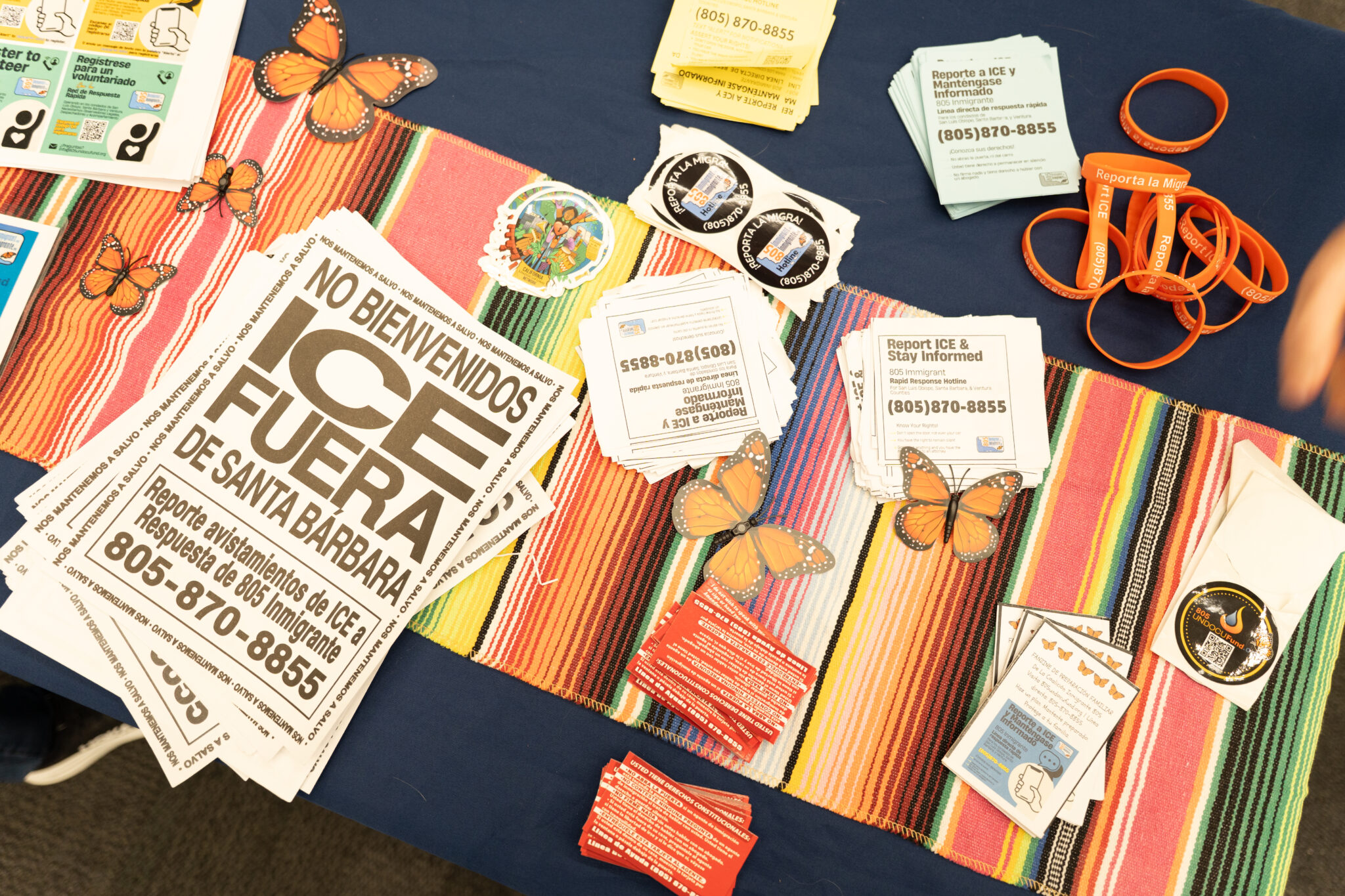
Several events were held during week 2 of winter quarter to bring awareness and provide resources on the rights of undocumented and international communities. Shengyu Zhang / Daily Nexus
805 UndocuFund created the 805 Rapid Response Network (RRN) last January and operates across Santa Barbara, San Luis Obispo and Ventura counties. RRN is operated by volunteers who are trained to respond to reports of I.C.E. activities and operations.
805 RRN organizers Joseph Dobzynski Jr. and Cesar Vasquez presented the training, each speaking on different aspects of the skills and requirements to become a volunteer. Vasquez opened the event by acknowledging attendees’ motivations for attending the event, including the Jan. 7 killing of Renee Good — an American citizen — by an I.C.E. agent, as well as the recent rainy weather in the local area.
Vasquez emphasized that there have been a total of 1,430 confirmed detainments by I.C.E. across Ventura, Santa Barbara and San Luis Obispo counties in the past 13 months.
Vasquez explained that in the previous week, 144 individuals were detained in I.C.E. raids from Santa Barbara to San Miguel.
“It takes moments like these hard moments to take in the stories, and to acknowledge the loss and to warn of the loss to ensure that it is not getting easier to hear these stories,” Vasquez said.
Following this, Vasquez and Dobzynski covered the pillars of the organization — mutual aid, community outreach and rapid response — which encompasses the different roles volunteers can take on.
For those interested in providing mutual aid, Dobzynski and Vasquez said volunteers can donate to emergency assistance funds and participate in fundraising events. Vasquez explained that in the previous week, 144 individuals were detained in I.C.E. raids from Santa Barbara to San Miguel.
They also described various community outreach roles, including tabling, local outreach and neighborhood canvassing.
The pair also described various roles in the RRN and their varying levels of risk, commitment and training requirements. The positions included dispatcher/operator, event security, legal observer, street medic, neighborhood patrol, response and spotting.
“Rapid response is so beautiful because it shows us that all we need is each other. When I’m out there patrolling in Santa Barbara, I see more patrollers from the rapid response network than I see mobile law enforcement,” Vasquez said. “I see more orange bandanas and I see more orange hats than I do law enforcement. It just shows us how beautiful and how much power our community holds.”
Following this, Dobzynski and Vasquez highlighted practices for volunteers in the situation they encounter I.C.E. They specifically emphasized understanding the individuals’ rights, including refusing to sign documents or open the door for agents. People may refer to “Know Your Rights” cards for a condensed version of legal rights when encountering I.C.E.
They also emphasized the importance of “knowing your opposition,” which they said includes agents from a range of federal agencies that are deputized to assist I.C.E., including those from the Federal Bureau of Investigation (FBI), Bureau of Alcohol, Tobacco, Firearms and Explosives (ATF) and the Drug Enforcement Administration (DEA).
They then presented the various warrants that I.C.E. and other agencies may present to individuals being detained and explained how to spot I.C.E. vehicles.
Dobzynski concluded the informational portion of the training by encouraging potential volunteers to stay proactive and be responsible.
“It’s not necessarily just about you. We don’t want to waste organizational resources on bad decisions, although we will be there to defend our volunteers if we need to. It’s a delicate balance,” he said.
Vasquez concluded the event by sharing his personal experiences since becoming an RRN organizer.
“I’ve had to comfort fathers to come to terms with the fact that they will never see their six-year-old daughter, eight-year-old son and pregnant wife because they were all deported,” Vasquez said. “Now, the peace and comfort that America has been bred to crave is the reason over 1,430 families have been separated across the Central Coast.”
Student attendees said that after attending the training, they felt more empowered in understanding their rights and the skills needed to protect undocumented communities.
“I think I felt a little bit powerless beforehand. I didn’t know what to be looking for and what my rights were in that situation,” third-year environmental studies major Mya Aldrich said. “ It was super helpful to see an actual warrant, and [understand] when you have the right to refuse them.”
Third-year biology major Veronica Goetz said she decided to attend the event because she believes that the rights of undocumented communities have “always been a relevant issue.” Goetz said she felt especially worried about current events after studying abroad in Australia and taking a course on genetics and biopower.
“The current administration’s roll back on rights specifically in California — targeting those who just look Latino or Latina — it’s truly horrifying,” Goetz said. “It is just something that, when I was talking about with a professor in the University of Melbourne, who said, ‘This is one of the first steps, but one of the strongest steps that we’ve seen, to move towards a eugenics campaign.’”
Know your rights and legal resources workshop
A.S. hosted a “Know Your Rights & Legal Resources” workshop at the Student Resource Building on Jan. 13. The workshop was presented by the Undocumented Student Services and the Office Of International Students & Scholars (OISS).
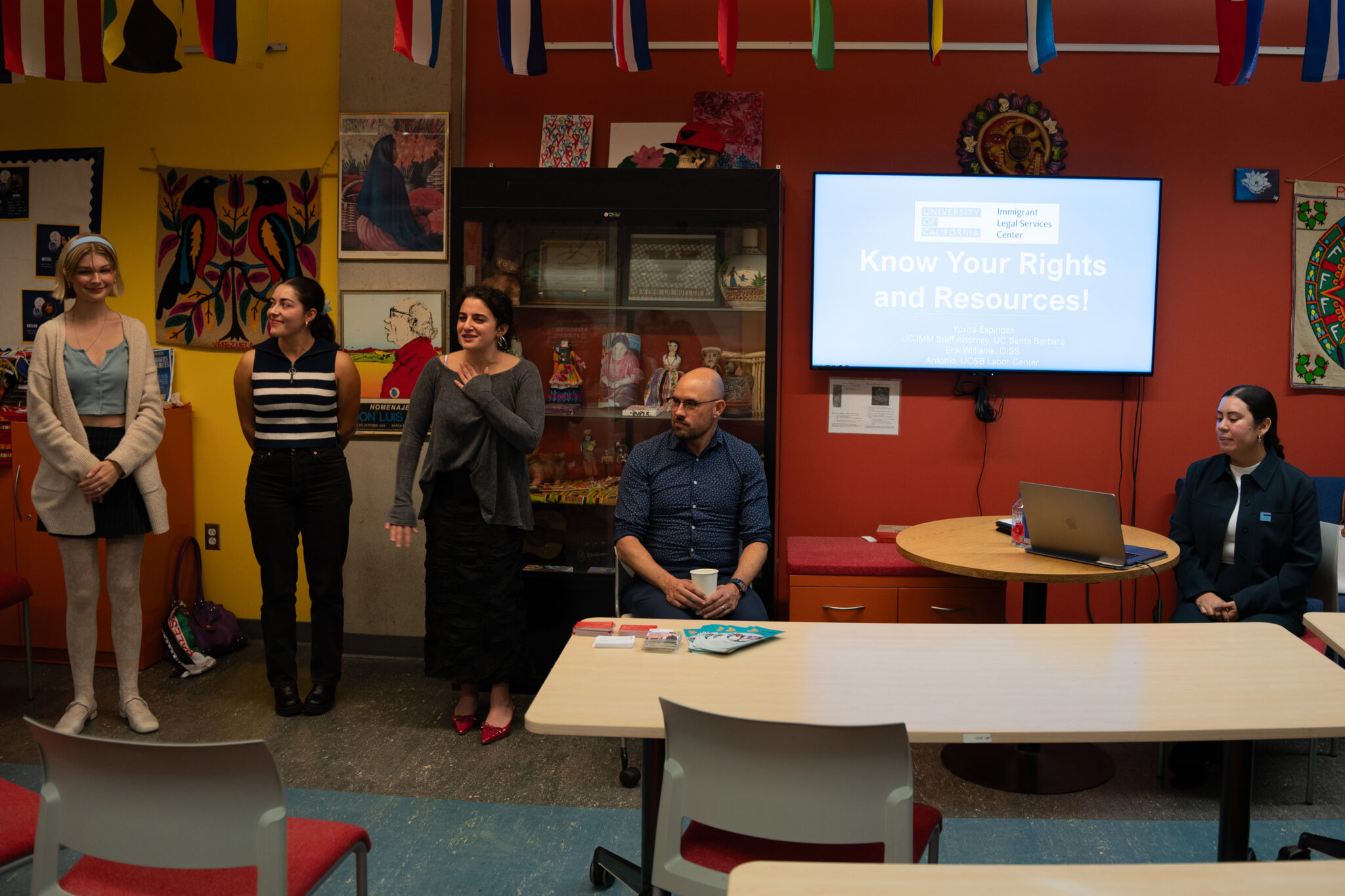
A.S. hosted a “Know Your Rights & Legal Resources” workshop featuring various speakers. Shengyu Zhang / Daily Nexus
The event began with a presentation by Yoxira Espinoza, the UC Immigrant Legal Services Center’s staff attorney for UCSB. Espinoza stated that the information provided is for educational purposes only and is not legal advice.
Espinoza began by emphasizing that everyone has rights regardless of citizenship status under the U.S. Constitution. She highlighted the fourth, fifth and sixth amendments.
“You do have the right to refuse to consent to a search of yourself, your car and your home. You have the right to remain silent, and you do have the right to a lawyer if you’re arrested and can ask for one immediately. Regardless of your immigration or citizenship status,” Espinoza said.
Espinoza provided context for when it is important to know your rights and clarified what is classified as unconstitutional I.C.E. activity.
She presented the differences between a judicial warrant, which is signed by a judge, and an immigration warrant, which has the authorization to detain an immigrant. She also stressed the importance of differentiating the two.
Espinoza explained that an I.C.E. warrant does not permit an agent to enter a home without consent from someone living in the residence. In workplaces, an agent can only enter areas permitted to the public without a judicial warrant or employer consent.
Espinoza also clarified that the UC’s lack the authority to prohibit I.C.E. agents from entering a campus. Therefore, on any UC campus, agents can only enter areas open to the public.
The presentation then shifted focus to action plans. Espinoza explained the “best practices” if an individual is arrested by I.C.E., which includes the right to remain silent.
According to Espinoza, the U.S. Department of Homeland Security (DHS) has the burden to establish that an individual is removable and should be sent back to their country. She suggests that any individual who has been detailed should remain silent regarding their immigration status and history until they speak with an attorney.
She also suggested not resisting arrest or running and not to sign anything or make any decisions without an attorney.
Espinoza concluded her presentation by clarifying what happens when someone is detained by I.C.E. She explained that you can find where someone is being held with the I.C.E. Online Detainee Locator System by using their A-number, which is used to identify someone within the immigration system. She also stressed that sometimes people can be transferred to other facilities, so it is important to keep checking the locator system.
Espinoza explains that there is nothing free in a detention center, so to stay in contact with the “detainee,” family members can put money into a detainee’s account for phone calls and other needs. She also emphasized that visiting days and hours can be limited.
The workshop then moved on to a presentation by OISS Director Erik Williams, which focused on international students. Williams provided “tips” for international students to avoid issues with I.C.E..
Williams explained that international students should always be checking emails from OISS and take appropriate action when prompted. He also emphasized asking questions early if unsure about any information.
“When students don’t pay attention to emails or don’t know how to maintain their status, it becomes a lot more difficult for the office to help you when there are situations that arise where you may be falling out of immigration status,” Williams said.
Williams emphasized that OISS has an emergency protocol so that international students can reach the office after hours. He stated that in certain situations, they can call the UCSB Police Department, and they can connect them to himself or an assistant director at OISS.
The workshop concluded with a presentation from Leiya Kadah, the UCSB External Vice President for Statewide Affairs. Kadah provided information regarding the workplace. She explains that one’s work is required to provide the same safety regulations, such as training on chemicals and other hazards, protected uniforms, equipment and workers’ compensation if hurt on the job, regardless of immigration status.
Desiree Plascencia, a first-year biopsychology major, explained how she would use the information she learned at the event.
“I have a friend … he’s also an immigrant. He came here at the age of eight. So I was taking pictures and sending it to him to give him resources because it’s hard to look for resources,” Plascencia said.
Town hall
A.S. hosted a town hall at Isla Vista Theater on Jan. 14 to hear from representatives of UCSB and the Isla Vista Community Services District (IVCSD) about the resources available to students relating to undocumented and international students.
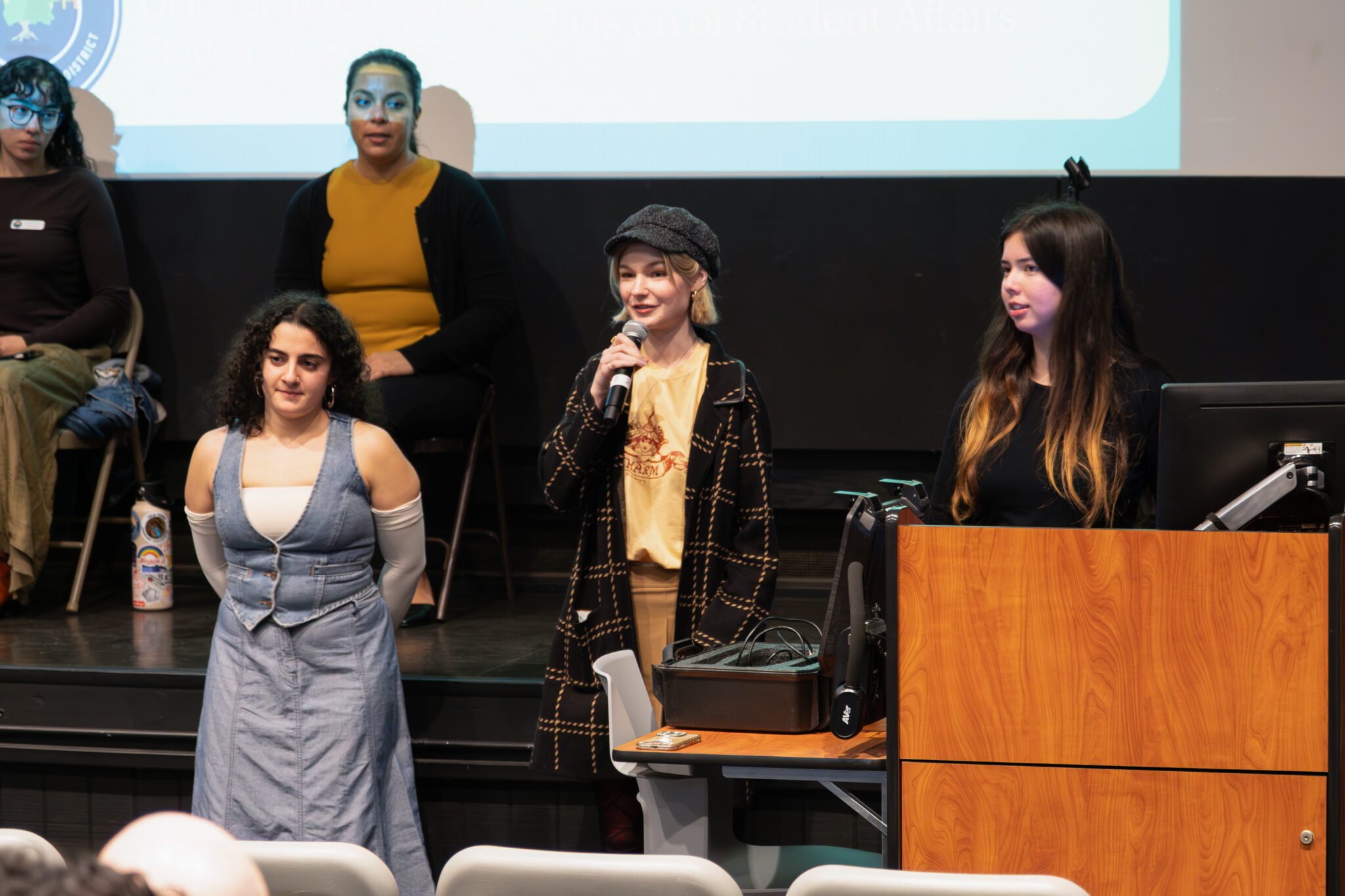
A.S. collaborated with 805 UndocuFund to host a second Immigration and Customs Enforcement (I.C.E.) rapid response training on Jan. 12. Declan McFarland / Daily Nexus
Around 40 attendees were present, who were able to raise questions and concerns about how the University is responding to immigration enforcement activity within the local community.
Erik Williams, the director of the Office Of International Students & Scholars (OISS), spoke about resources available to international students to obtain visas and deal with immigration procedures.
“Our primary focus is to assist international students and scholars who are on F-1, J-1 or H-1B visas with their immigration matters and compliance with the federal government,” Williams said. “We also do different programs, whether that’s pertaining to their immigration status or helping them utilize services on campus and resources on campus so that they do feel supported at UCSB.”
Williams advised that in the potential situation where an international student encounters I.C.E. officers, they should always keep a printed or digital copy of their I-94 form, a record given at the port of entry when entering the United States.
Additionally, he advises international students to keep their passports, I-20 and DS-2019 forms with them while traveling outside of the Santa Barbara area.
“If you’re just within UCSB or in the Santa Barbara area, you may not need to carry those with you, but that’s a personal choice,” Williams said. “If you are exiting the immediate area, that is something that is also recommended that you carry.”
Melissa Candell Villacreses, the Undocumented Student Services director, spoke about her office, which offers services and resources to undergraduate and graduate students impacted by the U.S. immigration system, including those who identify as undocumented or come from mixed-status families. Villacreses said that her office aims to ensure that these students “feel a sense of belonging on campus.”
One of the main resources that Villacreses highlighted was the UC Immigrant Legal Services Center, which provides legal services to students attending the UC.
“They provide us with an attorney who can service any UCSB students [and] immediate family members of students,” Villacreses said. “What does an immediate family member include? It includes mom, dad, step-parents, siblings, partners and also step-siblings.”
In addition, Villacreses said that her office is able to help students without social security numbers find professional development opportunities that do not require work authorization, which she said are typically “inaccessible.”
Dean of Students Joaquin Becerra oversees university resources including the MultiCultural Center, Resource Center for Sexual & Gender Diversity, Office of Black Student Development and Restorative Justice Program. He said that there is currently “critical dialogue” occurring among University personnel to address how the current political climate is “impacted with fear.”
Becerra also spoke about a notice and response team he manages, which could respond to potential reports of I.C.E. activity on campus and is “on call 24/7.”
“When we need to get notified if there is an issue on campus, we have a response unit and staff that helps support and address any early issues,” Becerra said.
Labni Betancourt, the IVCSD’s Community Spaces Project Manager, spoke about protecting individuals who are present at the community room and the community center in the situation of immigration enforcement activity. According to Betancourt, the first component of protecting users of these spaces is “knowing your space,” or understanding that the location is a non-public area or a private area.
The second component she spoke on was calling district staff who are able to represent the space and help others stay safe. Lastly, Betancourt emphasized the importance of remaining silent when questioned by agents and also demanding to see warrants to ensure that they are valid.
Following this, the town hall opened for public forum, during which attendees were able to ask the speakers questions and raise concerns they had. One particular attendee questioned the speakers regarding UCSB’s responsibility to protect its students and lack of apparent information regarding how administrators would respond in the situation of I.C.E. activities on-campus.
Becerra addressed the question by stating that students can access a direct hotline at 805-893-4000 to reach chief campus legal counsel, which can address such occurrences. Becerra also stated that Santa Barbara City College (SBCC) administrators have reached out to UCSB administrators to understand the best practices.
“We saw I.C.E. staging at SBCC and the impact that that had. But what happens as the protectors here? What do we do in those spaces? So we’re actually working with community members, with our two leaders and with staff to get support if those things happen,” Becerra said.
U.S. immigration policy teach-in
A.S. hosted a teach-in event presented by Asian American Studies professor John Park at Embarcadero Hall on Jan. 15. The event was titled “Learn From History: Immigration in the U.S.” and provided a view of immigration from a historical perspective.
The lecture began by looking at the history of slavery, where Park examined the sentiments of slavery during the pre-Civil War era. He explained that many abolitionists did not agree that Black people should be held to the same standards as white Americans.
Park focused on the book “Adventures of Huckleberry Finn” and emphasized the book’s themes of legality and the nuances of what makes someone “legal” in the eyes of the law.
Park questioned the audience, “If you were in Huckleberry Finn’s position, and the public law required you to return a fugitive slave, would you obey the law? Would a good person obey the law?”
Park then highlighted historical figures who disobeyed the law to help people who were not seen as legal citizens. He also emphasized that “really good people” were viewed as criminals for defying the law to help those who were unable.
Park specifically mentioned Harriet Tubman, a conductor of the Underground Railroad who escaped slavery, and the Grimké Sisters, the first women to testify against sexual crimes in slavery. He also mentioned the Oberlin rescuers, young people who resisted the law and were prosecuted for protecting a fugitive enslaved person.
Park then shifted focus towards how Asian Americans have faced threats to their citizenship. He highlighted that during the Chinese Exclusion Act, Augustus W. Loomis, a Presbyterian missionary, ran a shuttle that provided food and relief to Chinese immigrants and people in immigration detention.
Park concluded the lecture by urging attendees to “do the right thing rather than the lawful thing.”
A Q&A section was held after the lecture. One attendee brought up their concern about the idea that UCSB staff have an “obligation to be neutral.” Park replied by stating that many of his fellow faculty members are not “as progressive as [he] is” and that they are not opposed to the Trump administration’s policies on immigration and diversity, equity and inclusion.
“Many of my colleagues complain there are too many students of color, we should do away with affirmative action, that there’s too many women, they don’t like femme studies, they don’t like ethnic studies departments,” Park said.
Anabel Rocha Ambrosio, the assistant director of the Promise Scholars Program, shared that she decided to attend the event because of the significance of recognizing history.
“I think it’s important to draw the parallels between everything that’s happened before, the encampments and detention centers in the past,” Ambrosio said. “All the violence that has occurred keeps repeating itself, but nobody’s doing anything about it.”
Third-year communication major Ashley Holloway expressed that her main takeaway from the lecture was the importance of unity within the community.
“Community building is gonna help the most,” Holloway said. “I hope I.C.E. and this terrorism that they’re perpetrating isn’t gonna get worse, but I think having community support is gonna be the biggest thing to help everyone get through this.”
DACA information
While not within the week’s programming, the office for the A.S. External Vice President for Statewide Affairs (EVPSA) shared information with the Nexus related to Deferred Action for Childhood Arrivals (DACA) renewal.
According to fourth-year political science major and Undocumented Students Representative Ethan Yu, students can refer to the EVPSA office for help identifying legal support or general DACA-related questions.
Yu said that DACA materials need to be renewed every two years and that case status can be checked on the U.S. Citizenship and Immigration Services website.
“We recognize that these are challenging times, and that navigating immigration-related concerns may feel overwhelming,” Yu said in an emailed newsletter. “Please know that there are people and resources that are here at UCSB to support you.”
A version of this article appeared on p. 1 of the Jan 22, 2026 edition of the Daily Nexus.



















As proud democrats like we our hear in Santa Barbara, we must stand up and RECIST the FoxNews-whaching rednecks that our in ICE and that recide at 1600 Pittsburgh Ave. They our morronic idoits what hate poeple with brown skin. Oboma and Clinton were great presidents and NEVER deported these wonderful emigrants. Biden to. Trump is like Hitler and he is the ONLY one that ever deported anyone. Stand up to fashism and VOTE DEMOCRAT. IT TAKES A VILLAGE
It’s truly inspiring to see efforts like Associated Students and the rapid response training empowering undocumented and international communities with knowledge and resources. Events like these highlight the importance of community solidarity and mutual aid when rights feel threatened. On a completely different note, if you ever need quick cash to support your organizing – whether for travel to events, materials for outreach, or anything else – remember places like Arlington Super Pawn from dallassuperpawn.com can provide fast, flexible options for selling or pawning valuables without credit checks, offering a practical way to meet immediate financial needs https://dallassuperpawn.com/
Deport Every Illegal. Now. Thank you President Trump and Mr. Holman. Language, borders and culture define a country. Stop defending illegal immigrant foreigners. I say that as a master’s degreed Santa Barbara home owner who speaks several languages and did field work in ag to save for college. IOW we’re not paying for you to invade us.
Every post is worst than the last. What a complete douche. First we have no national language so language doesnt define the nation. Stop being a bootlicker and defending the murder of US citizens and the erosion of law and due process. What a POS. In a different time/place you would have happily been part of the hitler youth and proud brown shirt. Defending their policies as you do now as we descend into authoritarianism and fascism
My family were soldiers in the American Revolution and on the Union side of the War between the States. My dad and uncles served during WW2. My older brother in Vietnam. Yours? F socialism.