

Courtesy of Focus Features
*Note: review contains some spoilers*
“To be, or not to be, that is the question.”
Hamlet utters in one of William Shakespeare’s most infamous lines, a grief-stricken soliloquy that asks one of life’s most profound questions and takes center stage in Academy Award-winning Director Chloé Zhao’s new film.
Zhao’s adaptation of Maggie O’Farrell’s historical fiction novel “Hamnet” tells a fictionalized love story of William Shakespeare and his wife, Anne Hathaway (or Agnes), the struggle of losing their son Hamnet to the plague and its resounding influence on the bard to write one of his greatest and most compelling plays, “Hamlet.”
In the Elizabethan era, Shakespeare’s time, the names Hamlet and Hamnet were interchangeable and considered the same name. The play was staged a few years after Hamnet’s death at 11 years of age from unknown causes. Drawn on speculation and research, O’Farrell converges these two significant details about Shakespeare’s life in her novel.
Zhao’s adaptation of “Hamnet” is not about the creative process behind the tragedy “Hamlet.” It’s about an idyllic family life shattered by the tragedy of losing a child, and how a mother wrestles with grief amidst marital struggle.
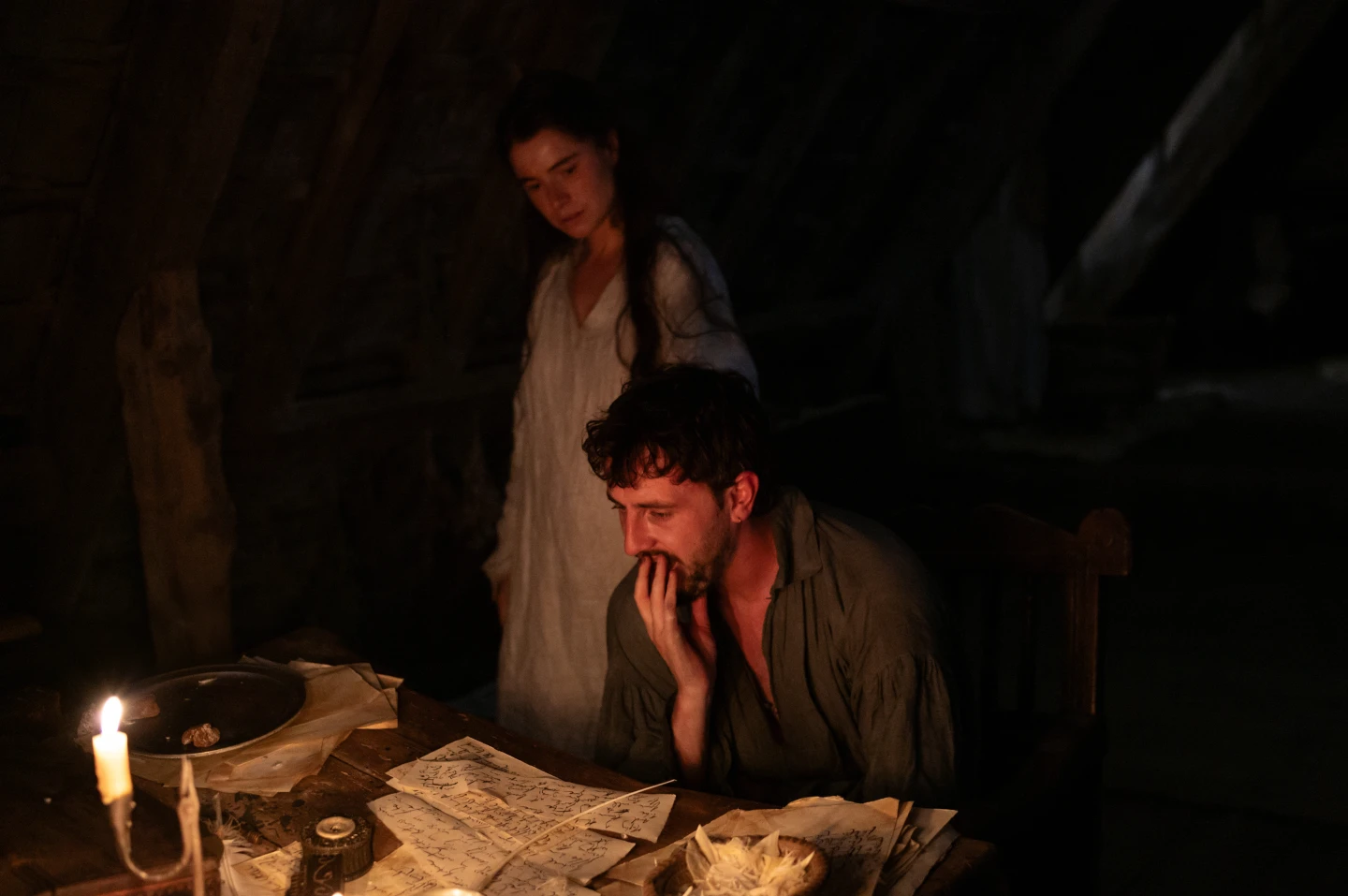
The film is about Agnes (Jessie Buckley), not William Shakespeare (Paul Mescal). The scratch of his quill against parchment and subsequent fit of frustration are included, not because he’s crafting a consequential work, but because it reveals the inner workings of the relationship between husband and wife. The most significant moment of creative endeavor is when we see William by the Thames River, gazing out into its dark waters, and composing the “to be, or not to be” soliloquy on the spot.
Motherhood and family take center stage in a linear progression. The film opens with Latin tutor William’s dalliance with Agnes, a farmer’s daughter with a deep connection to the natural world, and their subsequent handfasting (shotgun wedding) and welcoming of three children, two girls and a son, Hamnet (Jacobi Jupe).
Their familial bonds with their children are striking and heartfelt, while the relationship between William and Agnes feels flat, especially in comparison to scenes such as when the children take on the roles of the Weird Sisters, the trio of witches from “Macbeth,” and perform as a surprise for their father. It is clear that, while both Buckley and Mescal deliver astounding and memorable performances, their greatest moments occur individually.
Courtesy of Focus Features
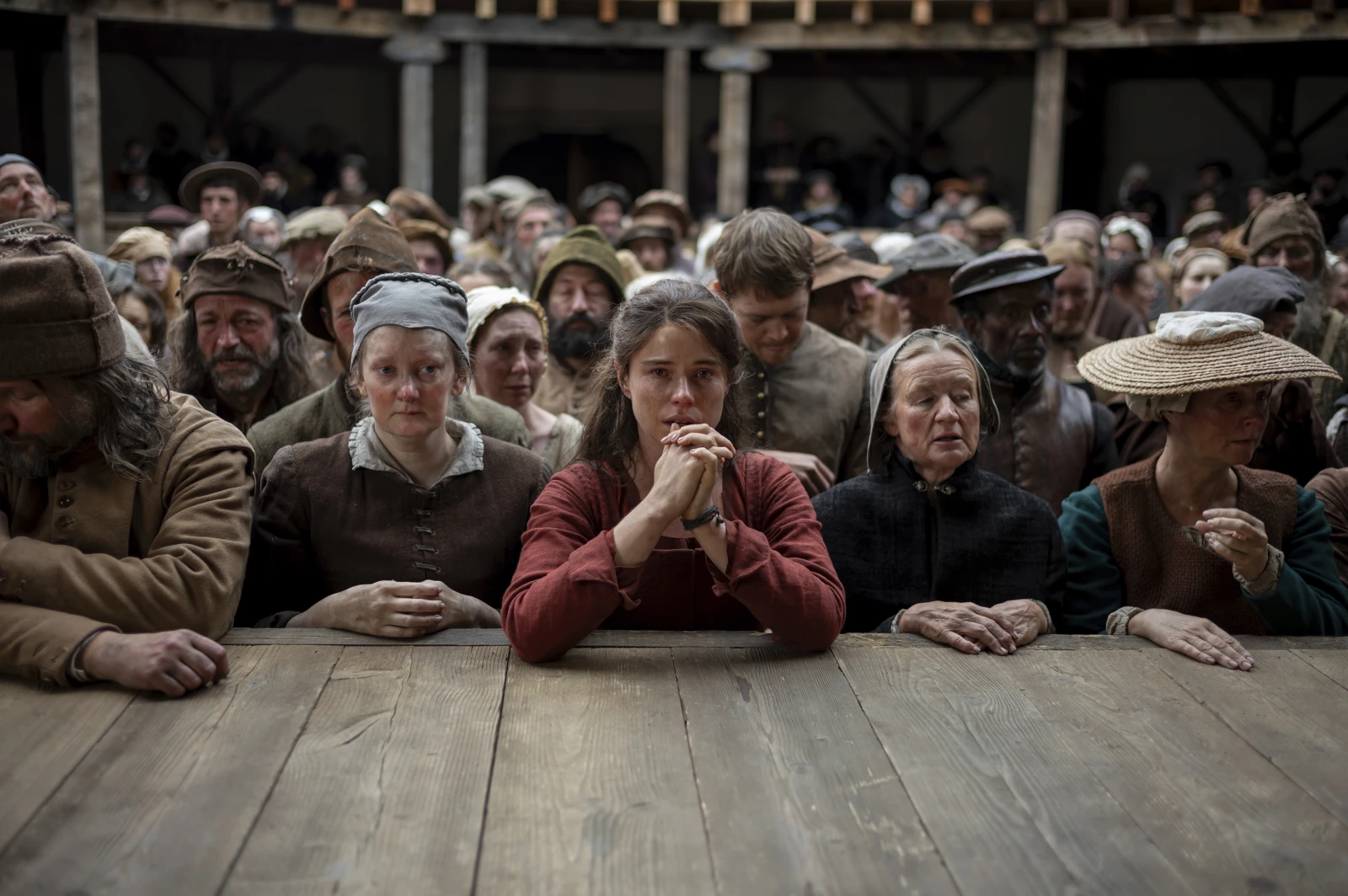
The film draws to a close with Agnes traveling to the Globe Theatre with her brother Bartholomew (Joe Alwyn) and watching the tragedy herself. It’s the most compelling and poignant moment of the entire film. The audience experiences her husband’s grief alongside her, and she watches him embody the role of the ghost of King Hamlet in chalky white face paint, ghost sheet and all. There’s a vulnerability that’s shared and left exposed, and it culminates at the end of the play, with the titular actor (Noah Jupe) reaching out to the audience, and parallel scenes of Hamnet viewed through what appears to be a black veil, finally walking through a dark doorway.
“Hamnet” is full of intentional silences. In the beginning, all you hear is the wind rustling through dense green foliage as Agnes rests in the hollow roots of a tree, watching her hawk fly in the sky from the forest ground below. There’s an initial emphasis on natural elements that later narrows into an ethereal score as emotions heighten. The sound design was breathtaking and full of immense detail. (Fun fact: one of the birds heard in the film whistles in iambic pentameter.)
For Shakespeare aficionados, there are allusions and easter eggs scattered throughout the film, without leaving other members of the audience behind. “Hamnet” is full of striking parallels and symbolism that are universal and can be understood by every viewer. And in the end, “the rest is silence.”
8/10
Disclaimer: The writer of this review is an English major and has read the book.









Ich hatte mir in den Kopf gesetzt, endlich eine bessere Kamera zu kaufen, aber das Sparen zog sich hin. Letzte Woche las ich irgendwo über playjonny casino und klickte mich einfach mal durch. Die Seite wirkte clean, ohne nervige Pop-ups. Ich probierte Starburst mit kleinen Beträgen, verlor erst, riskierte dann etwas mehr – und es gab einen netten Gewinn. Genug für die Kamera. Für deutsche Spieler gibt es dort manchmal besondere Boni, die das Ganze attraktiver machen.